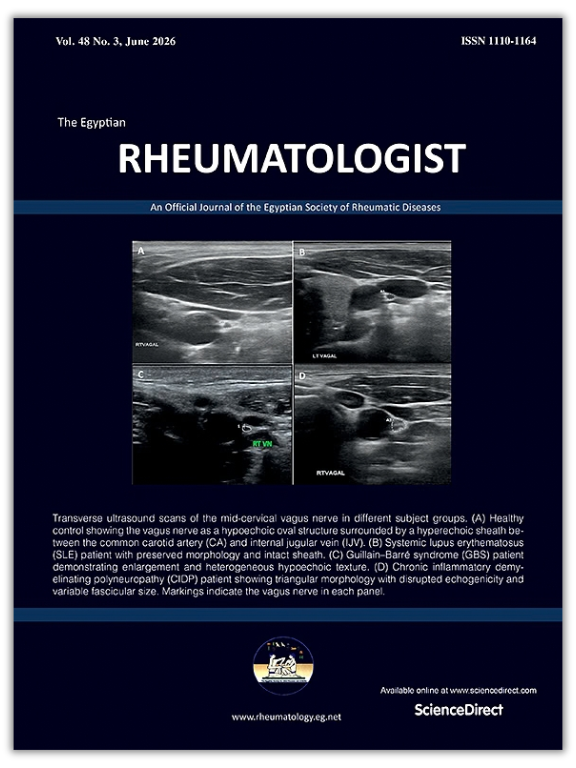
The editor-in-chief of The Egyptian Rheumatologist has resigned following claims of questionable citation practices and improper peer review at the journal.
At least three publishers are also investigating alleged data errors in papers in other journals by the former journal editor, Tamer Gheita, and his research group. Gheita, a professor of rheumatology at Cairo University in Giza, has denied the claims, calling the complaints “subjective” and “malicious.”
The Egyptian Society of Rheumatic Diseases (ESRd) started investigating Gheita in June following concerns about his editorial practices at the society’s journal, including unusually rapid peer-review timelines and questionable citation patterns, according to Bassel Elzorkany, interim editor-in-chief for the journal. Elzorkany told Retraction Watch the ESRd board temporarily suspended Gheita, and Gheita resigned shortly afterward.
“We acted promptly once concerns were raised,” said Elzorkany, secretary general for the society. “As the investigation is still in progress, we cannot characterize its outcome or comment further on a specific allegation at this stage.”
An anonymous complaint sent to us accused Gheita of allegedly inflating his citation metrics by forcing authors to cite his work in the journal and accepting articles for publication in days, without proper peer review.
Gheita told us he did not “instruct, pressure, or encourage authors to cite” his publications for “reasons unrelated to scientific relevance.” In an email, Gheita said he served as editor-in-chief for the journal from 2013 to July 2026. According to journal records Gheita was previously an associate editor for the journal and became editor-in-chief in July 2012.
“I do not agree that the available citation patterns establish a scheme to manipulate citations,” he told us. “Authors determine the references included in their manuscripts based on the scientific literature relevant to their work. There was no journal policy requiring or encouraging authors to cite me or any other specific individual.”
Gheita said he conducted his own analysis of four journal issues published between October 2025 and June 2026, in which he identified 2,009 references in total. Of these, 69 references (3.4%) cited papers with him as a coauthor. References to articles published in The Egyptian Rheumatologist represented 117 of the 2,009 references, or about 5.8%, Gheita said.
But according to data in the anonymous complaint and confirmed through an analysis by Mariana Ribeiro, Retraction Watch Sleuth in Residence, between January 2011 and January 2026, 49% of articles in The Egyptian Rheumatologist cited Gheita’s publications. In 2011, there were no citations to Gheita’s work, rising to 12% of papers published in 2012 and up to 73% of those from 2020, according to data verified by Ribeiro.
A 2015 article in the journal about lupus, for example, cites Gheita at least 10 times.
During Gheita’s tenure, the journal also accepted hundreds of articles within three days of submission, many on the same day. A paper about Henoch–Schönlein purpura published online in July 2016, for example, shows a submission date of May 1 and an acceptance date of May 1. Another paper, about arthritis, shows the journal received the paper Nov. 30, 2022 and accepted it the same day.
Gheita said he would “caution” against drawing conclusions about peer review solely from dates displayed in public databases or submission systems. Historical publishing workflows and changes in electronic submission systems can result in dates appearing “deceptively close together,” he told us.
“A conclusion that a manuscript was accepted without peer review should, in my view, be based on the actual editorial records and workflow history held by the publisher, rather than solely on publicly available submission and acceptance dates,” he told us. “The underlying editorial history, including previous versions, transfers, reviewer assignments, and editorial decisions, would be the appropriate evidence for determining what actually occurred.”
Elzorkany told us the ESRd board referred the anonymous complaints about Gheita’s work to the journal’s publisher, Elsevier, and requested a full investigation.
A spokesperson for Elsevier told us the publisher is “aware” of the claims involving the journal and that “an investigation is ongoing.”
“We cannot provide further information until this is complete,” the spokesperson told us.
Meanwhile, a sleuth has raised concerns on PubPeer about at least 13 papers that include Gheita as an author, involve subsets of his data or encompass his common research group. The Egyptian Rheumatologist published one of the flagged papers and the other 12 were published in other journals.
After receiving an anonymous complaint, psychologist Nick Brown started investigating the research group earlier this year, finding what appears to be “numerous inconsistencies and errors in the statistical reporting,” he told us. The papers in question were published from 2019 to 2026 in various journals, many with large authorship groups and overlapping authors.
Brown told us the article problems include “impossible p values,” issues with data formatting and rounding, and overall numbers that aren’t compatible with subgroups in the data, among other issues.
“I find the whole set of articles thoroughly implausible,” he told us.
For example, Brown wrote on PubPeer that for seven measures in a 2021 article in Lupus about systemic lupus erythematosus children in Egypt, the overall mean doesn’t make sense when compared to other data in the paper. In addition, 43 values in three columns of a data table are mathematically impossible given the number of participants in the study, according to Brown’s analysis.
Similarly, for three measures in a 2026 article in Scientific Reports about systemic sclerosis in children, the overall mean and standard deviation are inconsistent with other data in the paper, Brown wrote on PubPeer. He noted further problems with incorrect or incompatible values in the paper. Brown also reached out to several journals to share his concerns, he said.
Gheita said he takes the PubPeer concerns “seriously.” He and his coauthors are reviewing the comments and will “respond to substantiated concerns on the basis of the underlying evidence,” he told us.
“If an error is confirmed, we support addressing it through the appropriate scientific and editorial processes,” he said. “At the same time, we have not received formal comments or requests for clarification from the journals concerning several of the matters referred to in your email.”
Lupus, a Sage title, published some of the flagged articles. A spokesperson for Sage confirmed the articles are under investigation, but declined to share further information.
Scientific Reports, Rheumatology International and Clinical Rheumatology published several other flagged papers. Tim Kersjes, head of research integrity for Springer Nature, which publishes the three titles, told us Springer is “aware of concerns with these papers” and is “investigating them carefully.”
“We will take editorial action as appropriate once our investigations are complete,” Kersjes told us.
Wolters Kluwer, which publishes the Saudi Journal of Medicine and Medical Sciences, where one of the flagged papers appears, declined to comment, citing its policy not to comment on “ongoing editorial matters.”
A spokesperson for Taylor & Francis confirmed the publisher is investigating another paper in Open Access Rheumatology: Research and Reviews.
Ahmed Elsaman, a professor of rheumatology at Sohag University in Egypt and an author on seven of the papers, called some of the issues raised on PubPeer “relatively limited technical observations.” The publications being scrutinized originate from the Egyptian College of Rheumatology Study Groups, a longstanding multicenter research collaboration involving rheumatologists and investigators from across Egypt, Elsaman said in an email.
Since 2016, the groups have generated clinical and epidemiological data on several rheumatic diseases through large, multicentre cohorts, according to Elsaman. He pointed to a 2023 article by the group in Rheumatology International that included 10,364 patients recruited from 26 specialised centres across 22 Egyptian cities. (Brown critiqued this paper on PubPeer.)
“This is just an example to show how huge is our work,” Elsaman told us. “We fully welcome legitimate post-publication scientific scrutiny. Large multicentre studies may contain typographical, transcriptional, reporting, or statistical errors, and we are prepared to investigate and correct any genuine error through the appropriate editorial process.”
But Elsaman said his concern is the “apparent escalation of relatively limited technical observations into implications of fabrication or research misconduct without evidence proportionate to such serious allegations.”
Elsaman added he and his research group attempted to respond to the critiques on PubPeer, but he said the replies were not accepted.
Samar Tharwat of Mansoura University in Egypt is an author on at least 11 of the papers critiqued by Brown, and Faten Ismail of Minia University in Egypt is an author on at least nine of the articles. Neither Tharwat nor Ismail returned messages seeking comment. We contacted authors appearing in five or more of the papers. Elsaman is the only author who returned our messages.
Tharwat is also the author of a retracted 2023 COVID-19 paper in Open Medicine. Editors withdrew the work because of “significant overlap with other papers published by the same authors in Journal of Clinical Virology Plus,” according to the retraction notice.
Like Retraction Watch? You can make a tax-deductible contribution to support our work, follow us on X or Bluesky, like us on Facebook, follow us on LinkedIn, add us to your RSS reader, or subscribe to our daily digest. If you find a retraction that’s not in our database, you can let us know here. For comments or feedback, email us at [email protected].