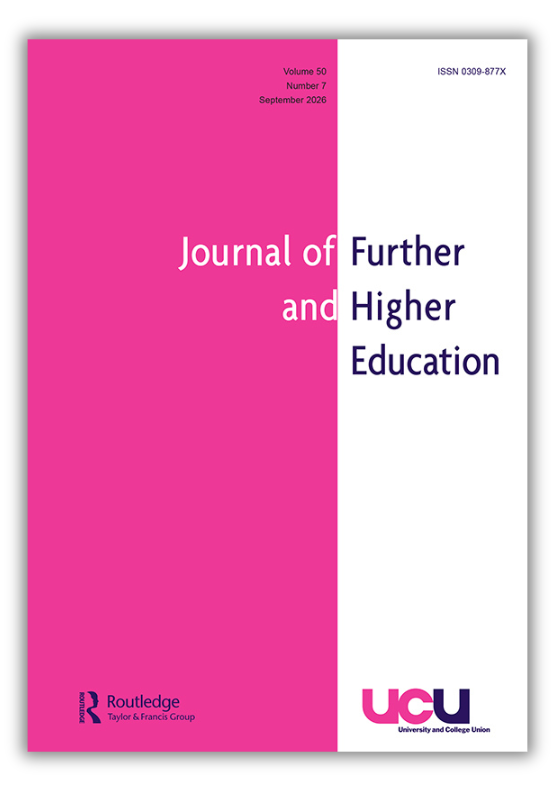
Taylor & Francis is investigating an article in one of its journals after the editors published an editorial about academic freedom that contains multiple fake references and citation errors.
In May, Anastasia Christou and Steve Lambert, coeditors of Journal of Further and Higher Education (JFHE), published an opinion piece about attacks on academic freedom and social justice research. The journal’s deputy editor Rosalind Latiner Raby also coauthored the editorial.
Of 31 references in the editorial, at least nine are nonexistent articles or contain incorrect journals or inaccurate author names. The problematic references include real scholars linked to articles they didn’t write and real journal titles associated with the wrong authors. The article also has numerous citation errors in the text. Fake references can be a sign of artificial intelligence use since large language models, such as ChatGPT, are known to hallucinate references.
A spokesperson for Taylor & Francis told Retraction Watch its publishing ethics and integrity team is “investigating the concerns that have been raised,” but would not comment further.
Lambert, an associate professor of educational leadership at the University of Chester in England, told us he was “unable to comment until the journal’s publishers have completed their investigation.”
Christou, a social justice professor at Middlesex University in London, and Raby, a director at the nonprofit California Colleges for International Education, did not return messages seeking comment.
One of the references cites a 2025 article about self-censorship in higher education in the Journal of Higher Education by John Skrentny, a professor at the University of California, San Diego. Skrentny told us he did not write the paper attributed to him and has “never published or submitted an article to the Journal of Higher Education.”
Brendan Cantwell, a researcher at Michigan State University who studies higher education, also had a nonexistent paper about academic freedom in Higher Education Policy attributed to him.
“The cited article is not something that I wrote and is presumably ‘a fabricated citation,’” Cantwell told us.
Many Google Scholar links in the editorial return “Sorry we couldn’t find this article” pages, including links for the fake papers by Cantwell and Skrentny. Other reference links connect to articles by different authors.
The editorial also cites real articles but with incorrect authors, including the 2025 paper “Decolonising Solidarity in Higher Education: Navigating Barriers and Enablers in Advocacy with People from Displaced Backgrounds” in International Journal of Inclusive Education. While the editorial identifies “Stevenson, J., M. Asamoah, N. Bouakkaz, and E. Swanby” as authors of the article, the paper is really by Melanie Baak et al.
Baak told us the reference is “definitely the article that we wrote, but not the author team.”
Within the text, the JFHE editorial paraphrases several passages from real articles, but attributes them to fabricated references. The editorial for example, paraphrases text from Baak’s article, but attributes it to the fake Cantwell paper.
The JFHE paper is among several articles with fake references we’ve reported on recently. In March we wrote about a librarian who discovered 12 of 14 references in a Springer Nature paper didn’t exist. Last December, we covered a paper in the Journal of Academic Ethics that included fake references, and in June 2025, we reported on a paper rejected for use of AI that was later published in World of Media with hardly any changes.
JFHE is an open access, international, peer-reviewed journal publishing scholarly work that “represents the whole field of post-16 education and training,” according to its website.
The Christou editorial concludes by stating the editors are “grateful to the researchers whose work appears in this journal,” and that they are “committed – as scholars, as editors, and as reflexive citizens of the world that education is meant to serve” to the “irreplaceable work of expanding the critical space of what can be thought, questioned, argued, problematised, articulated, and inclusively known.”
Update, Sept. 21, 2026: This article was updated to correct the journal name and acronym. It’s the Journal of Further and Higher Education, not the Journal of Higher and Further Education.
Like Retraction Watch? You can make a tax-deductible contribution to support our work, follow us on X or Bluesky, like us on Facebook, follow us on LinkedIn, add us to your RSS reader, or subscribe to our daily digest. If you find a retraction that’s not in our database, you can let us know here. For comments or feedback, email us at [email protected].
One has to wonder how people in academia keep making this mistake.
The fact that AIs hallucinate references has been known to be a major flaw for years.
How are people who use AIs unaware of this?
If you are going to use an AI to do underlying research for something that you are writing you have to fact check everything that the AI generates, both textual statements and bibliographic references.
Failing to do that is academic malpractice.
> One has to wonder…
One has to also wonder why the editors did not resign? At least this journal is supposedly not worth submitting any serious work after this incident. (The ethics journal case was even funnier.)
I find it fascinating that for all the talk about hallucinated references and how bad they are, no one speaks to the fact that, by definition, the reference was not read or reviewed. I think it is equally awful that academics are representing themselves as having surveyed and considered the literature when writing, when in fact they’ve done nothing of the sort.
Perhaps Professor John Skrentny did not write the paper about self-censorship attributed to him in the Journal of Higher Education because of self-censorship. 🙂 Seriously though, I am not sure how this happens in this day and age. At least click on the link to check the references exist if you are going to use AI inappropriately. Every academic should know that this is an issue at this point. In my experience publishing in a T&F journal, the copy editors/typesetters make sure the articles go somewhere in ask for corrections but maybe because it was an editorial it didn’t go through that process, different T&F journals use different processes, or the authors ignored what the copyeditors asked about the references.
I used to edit (cooy edit if you are American) course materials at a university. We checked every reference. How are journals not doing the same, or at least not doing spot checks? It’s very easy to do and doesn’t take long.
Has Taylor and Francis acknowledged this investigation publicly and/or made any kind of statement? Fascinating.