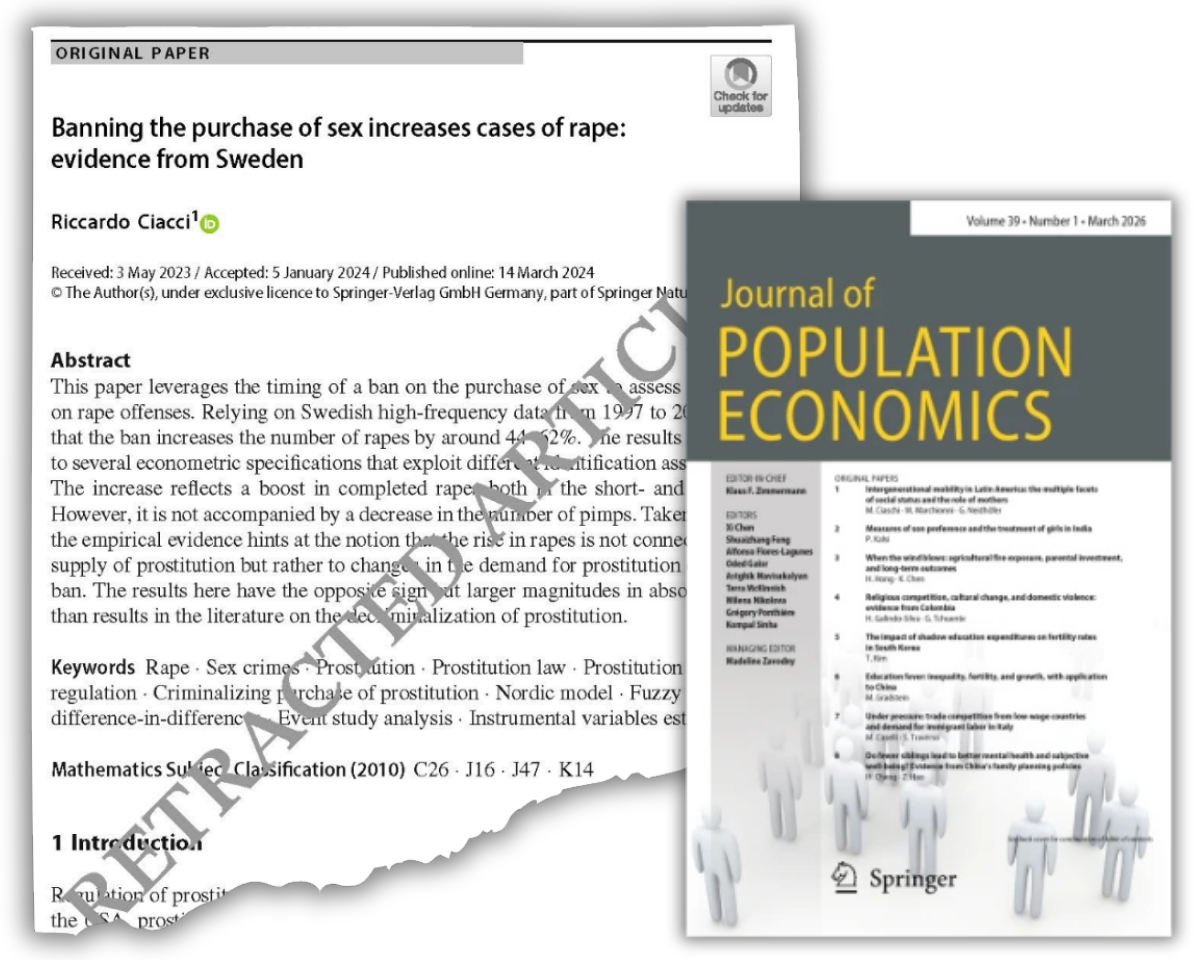
In March 2024, Riccardo Ciacci, an economist at the Universidad Pontificia Comillas in Spain, published a paper claiming Sweden’s ban on buying sex had increased reported rapes by as much as 62%. The finding gained attention on social media, and quickly drew criticism from others in the field.
In particular, a group of three economists took their concerns to social media and to the journal editors, and eventually published a critique of Ciacci’s work. They claimed his analysis reports a statistical relationship not relevant to the finding described in the paper. They concluded there was no large or statistically significant finding.
What followed was a year-long effort to fix the paper, and then ultimately, a decision to retract it. Ciacci, who was not accused of misconduct, said the retraction, which he disagrees with, has cost him a promotion and funding for future research. He also alleges he experienced an onslaught of harassment on social media. In the end, Ciacci maintains the retraction was unjustified, and critics say it came far too late.
Joop Adema, a postdoc at the University of Innsbruck and one of the authors of the critique, said he first decided to look into the paper after seeing an extremely large effect size. “In my view, the paper is extremely flawed,” he said in an email to Retraction Watch, adding that a nationwide reform is notoriously hard to study because it lacks statistical power and a control group. “This is a known issue: Papers with flashy results and large effect sizes gain attention and are more likely to be published,” Adema said.
He and Johanna Rickne and Olle Folke, of Stockholm University and Uppsala University, respectively, thought Ciacci’s findings were surprising given the stable number of reported rapes around the year of the reform, and they published an analysis contesting his findings online. They also sent the report to Ciacci and the journal, saying their reanalysis “completely overturns” the conclusions of Ciacci’s paper, and called for a retraction.
Their conversation began on the evening of March 19, 2024, a few days after the Journal of Population Economics published Ciacci’s paper. Folke emailed Ciacci requesting data to do a replication, and again the next morning, warning he would post his critique on social media later that day, asking Ciacci to respond “relatively quickly.” Ciacci replied that afternoon, after Folke had already posted on X, saying his teaching load had slowed him down. He suggested coauthoring another paper to explore the topic more, but didn’t share the replication files.
The same evening, Ciacci and Folke went back and forth on X. Ciacci wrote that Folke “merely [does] not like the results of the paper,” to which Folke responded that he had found “large methodological issues” and asked whether Ciacci was withholding files because he had “something to hide.”

Ciacci countered that preparing the files takes time, and again suggested coauthoring another paper. “Given that we have large differences with in [sic] the views on basic statistics I do not see any promise for a fruitful collaboration. It is bizarre to have coauthorship as a requirement to hand over replication files,” Folke replied.
The next day, Ciacci shared the code, but not his data, via email.
Folke said he was “not even close” to replicating the result using data he obtained online, in the absence of Ciacci’s data. In a subsequent email, he said he identified statistical errors that “are grounds for a retraction.” He also said he would contact the journal with his colleagues who helped with the analysis. “Again, I want to stress that my issues with the paper are not ideological but methodological,” Folke wrote.
Ciacci said the comments on X about his paper became a harassment campaign, documenting screenshots in a Dropbox on his website, but the critics reject this characterization. “No, we do not agree that we harassed Riccardo Ciacci,” Rickne and Folke told us in an email to us.
“The posts are not directed at [Ciacci] as a person but discuss the research and replication process,” they added.
“Our effort to raise awareness (on Twitter at the time) about his paper is motivated by our belief that this is an important topic and we need to make policies based on credible evidence and is not personal,” Adema said in an email, adding that none of them knew Ciacci beforehand.
The journal began to investigate after receiving Adema, Rickne and Folke’s criticisms, according to a report summarizing their findings. Separately, the journal editors said they initiated the internal investigation after Ciacci’s complaint about an extensive social media attack, in a response to an X thread about the paper’s issues from the Institute for Replication — a nonprofit that replicates findings in social science.
Klaus Zimmermann, editor-in-chief of the Journal of Population Economics, appointed an independent editor, Alfonso Flores-Lagunes, of the W.E. Upjohn Institute for Employment Research, to convene a committee of experts charged with evaluating the scientific merits of their criticisms.
In June 2024, the committee reported that they found no misconduct, but rather that the issue of multicollinearity – when independent variables in a model are correlated – was “simply not detected by the author, and it was subsequently not detected by the peer reviewers of the paper.” But they acknowledged it as a “fundamental error” that Ciacci had dealt with in an “arbitrary way.” The committee concluded Ciacci’s highlighted result was probably smaller and less precise than the paper reported.
They decided to give Ciacci a chance to test the robustness of his result and publish a corrigendum. The panel also acknowledged that they were “saddened” by the way Ciacci had been treated on social media and in email interactions with critics.
Over the following few months, the Journal of Population Economics committee sent Ciacci instructions for reanalyzing his data, but found his drafts to be insufficient. In October, Flores-Lagunes told him the draft was “far away from something we can publish,” and warned that the next one would be the final chance before the journal would “have no other choice but to retract.”
The journal eventually published Ciacci’s reanalysis as a new paper, in March 2025. “This substantial additional material was published with replication files and access to the data for further analysis and debate,” Zimmerman wrote in a commentary published alongside the new paper. The journal billed the reanalysis as an adjunct to the original work rather than a correction.
“Due to the slow response by the author, it took months to understand that there was not simply a correctable mistake, but there was insufficient evidence of the robustness of the claimed results,” said Flores-Lagunes. Ciacci saw it differently, believing “they considered there was nothing to correct in the first article, explicitly discarding the corrigendum format,” and he believed that since the editors opted to publish the additional article, “retraction had been discarded.” He thought the matter was closed.
In May 2025, an email arrived from Tim Kersjes, the head of research integrity at Springer Nature, the journal’s publisher. He wrote that they had reviewed the case and recommended the original article be retracted. He said a retraction was not an accusation, but rather a “neutral tool to correct the literature,” and that no misconduct was being alleged.
In response, Ciacci asked on what basis they had determined his findings to be wrong, and argued in subsequent emails that retraction was not the appropriate course of action, claiming it was prompted by what he calls the online harassment campaign.
The journal’s move to reinvestigate followed “further concerns” being raised about the article, Stephanie Boughton, the research integrity manager at Springer Nature, told us.
In early May 2025, a few weeks before Kersjes’ email, Adema, Folke and Rickne published another replication analysis with the Institute for Replication looking into Ciacci’s original paper. Adema said he and his coauthors were “surprised” to see Ciacci’s new paper, and that it didn’t address their main concerns. Their updated replication analysis “invalidates the [original] paper’s four alternative estimation strategies,” the authors claimed. They again urged the journal to revisit the article.
After sending their analysis to the Institute for Replication, Adema, Rickne and Folke had tried to publish their analysis in the Journal of Population Economics, but Zimmermann rejected it, telling them: “As you are aware, we have already published Ciacci (2025) after a thorough editorial investigation. Therefore the Journal decided after internal consultation not to reopen the case since it has already been judged on the basis of its main identification strategy and results.”
In June 2025 Ciacci’s article was retracted because “post publication review concluded that the original results and conclusions are incorrect and are not supported by the data, as confirmed by a re-analysis of the data by the author,” according to the notice.
Ciacci said he disagrees with the decision, as well as the wording of the notice, which called his paper “incorrect” despite the fact the reanalysis and the published commentary had found the findings were “not robust.” “Anybody can read that paper and [who] has some basic notions of statistics knows that this is factually wrong,” Ciacci said. “Non-robustness doesn’t imply that something is incorrect.”
In an email to Retraction Watch, Flores-Lagunes, who oversaw the committee’s review of the original paper, said the alternatives provided in Ciacci’s re-analysis contradicted the results in the original paper. “The additional evidence paper clarified that there was no robust scientific evidence for the claimed results in the original paper with the data used,” Flores-Lagunes said, and therefore the team decided the criteria for retraction were met.
In response to our questions, Zimmermann said the decision to retract came after “realizing that the “additional evidence paper” indicates that the results in “the original paper” were an artifact and not supporting the claim in its title.”
In his email announcing the retraction to Ciacci, Kersjes, the research integrity head at Springer Nature, described another reason for the retraction. “We appreciate that the re-analysis, together with an explanatory commentary by the Editor-in-Chief, is linked to the article on Springer Nature Link. However, this context will not be visible to readers who access the original article elsewhere, and therefore may not be aware of the concerns and the invalid conclusions of the article,” he wrote in a May 2025 email.
“In the interest of the integrity of the published record, we believe that corrective action is necessary, and do a retraction of the article.”
Ciacci said he felt blindsided by the decision after the committee had examined his code and findings for nearly a year and had not recommended retraction, instead opting to publish the additional paper. He also alleges the retraction was driven by renewed attention on social media, but Springer Nature’s Boughton said that played no part in the decision to retract.
Ciacci took his concerns to the Committee on Publication Ethics, which requested the journal’s account of the situation and ultimately concluded the journal had followed due process in line with its guidance.
“While the Commentary by the Editor-in-Chief takes no position on the issue of retraction, it is not in conflict with such a conclusion,” the COPE report stated. “This is the more the case, the stronger the reanalysis departs from the central conclusion of the original article. While not robust or not statistically significant does not imply non-existence in a statistical sense, the journal ultimately decided to retract on this basis.”
Rickne separately complained to COPE about both Ciacci’s original paper and the additional analysis, as well as the handling of the issue by Zimmermann, who, they say, did not reply to their emailed concerns about the papers, nor their request for replication files, and desk-rejected their paper that invalidated Ciacci’s findings. COPE found the journal followed an “adequate process” for the post-publication concerns raised by Rickne and her colleagues, in a report seen by Retraction Watch.
The Universidad Pontificia Comillas, Ciacci’s own institution, also investigated. In May 2025, after learning of Rickne’s complaint, an investigation committee was tasked with analyzing the facts related to Ciacci’s research, according to translated documents seen by Retraction Watch. The committee cleared him of research misconduct but found scientific and methodological errors in his work, including inadequate controls for legal changes, immigration and instrument validity — factors Ciacci said he did address, in his response to their findings.
“The methodological errors appear to be the result of a lack of rigor in the study design and in the interpretation of the results rather than author bias towards the conclusions,” the committee wrote in their October 2025 report.
The committee also called paper’s framing “reductionist and dehumanizing,” writing that the study models male sexuality as a consumer demand “in which men choose between a partner, prostitution or rape based on costs and risks, without other alternatives for sexual satisfaction.”
“[We] do consider that his research does not meet the standards of quality, rigor, and excellence that we expect from a Comillas researcher, especially regarding the lack of complexity in formulating his hypotheses, responsibility in establishing the practical consequences of his conclusions, and humility in acknowledging his errors,” the committee concluded.
Ciacci has since reported a professional fallout from the retraction. He said he was told verbally that his promotion was blocked for five years as a consequence. “I was told that if retraction is withdrawn, [the university] would consider the promotion.” Ciacci’s university also declined funding for his research because the new proposals were similar in scope and methodology to the retracted paper. “Taking into consideration the research carried out and the serious methodological errors and flaws in the results detected, it is not possible at this time to support projects that delve deeper into that line of research and its methodology,” Dolores Carrillo Márquez, the university’s vice rector for institutional relations, organization, and general secretariat, wrote in an email to Ciacci, which he shared with us.
He was also removed from the editorial board at PLOS One because his “actions may not adhere to [their] guidelines or Code of Conduct,” according to an April email seen by Retraction Watch.
No disciplinary action was taken based on the retraction, said Lucía Tornero González, director of communication at Universidad Pontificia Comillas, in an email. She said promotions are not determined by any single element in isolation, but declined to confirm whether Ciacci’s had been rescinded, citing regulations. Tornero González said funding decisions followed research priorities, and did not directly respond to our questions about whether the lack of a misconduct finding for Ciacci was a consideration.
Asked whether he still believes the original paper is correct, Ciacci said the exact figures might be different, but in his view, the conclusions still hold. Ciacci’s previous work on the links between strip clubs and sex crimes in New York has also been questioned by statisticians.
For the critics, they believe the situation could have ended differently. “Altogether, if the journal would have taken our comment seriously and retracted the original paper, the whole saga would not have played out like this,” Adema said.
Update, June 30, 2026: This article was updated to correct that Adema, Folke and Rickne’s May 2025 paper was about Ciacci’s first paper, not the update, and that the team submitted that analysis to the Journal of Population Economics after, not before, sending it to the Institute for Replication.
Like Retraction Watch? You can make a tax-deductible contribution to support our work, follow us on X or Bluesky, like us on Facebook, follow us on LinkedIn, add us to your RSS reader, or subscribe to our daily digest. If you find a retraction that’s not in our database, you can let us know here. For comments or feedback, email us at [email protected].
The article omits a fact that is central to the whole story. We have just published a peer-reviewed critique in the journal Evaluation Review (https://doi.org/10.1177/0193841X261449106), in which we re-analyze both the original article and Ciacci’s follow-up.
Ciacci’s central argument against the retraction is that some specifications in his follow-up article produce positive, significant estimates of a similar magnitude to the original. But the follow-up contains a coding error of its own: erroneous coding of the season dummies produces the same kind of multicollinearity problem as the original study. Once we correct the coding error, the point estimates shrink to half the size and are no longer significant. In short, there is no evidence of a treatment effect in the follow-up study either. Leaving this out gives readers the impression that an effect might exist.
TLDR: If you publish something that casts doubt on hyperwoke Swedish government policies, Swedes will gang up on you and try to destroy your career.
Seriously? To the extent that “hyperwoke” is even meaningful, it tends towards the position “Sex 👏 Work 👏 Is 👏 Work 👏,” not the Nordic model that Sweden uses.
The real TL;DR is that the study was sloppily done and doesn’t hold up under scrutiny.
Olle Folke claims the Retraction Watch article is incomplete because their peer‑reviewed critique “corrects” a coding error in my follow‑up paper. But what they call a “coding error” is not an error in the code – it is a description typo in the PDF about how seasons were coded, not a statistical mistake in the analysis itself. Even after they “correct” it, they acknowledge in their own appendix that “it is possible to get large and significant estimates from a correctly implemented RDiT” (Appendix, p. 8). Their argument is not that the result is statistically invalid, but simply that they do not believe it. It is sad to see that scholars who recognise the large statistical effect is not due to an error, and that it is possible to find it in the data, nevertheless accept a retraction – only because they do not believe the results. If they truly believed in our profession and were impartial, they would be the first to state that they do not believe the results, but that a retraction is not justified.
The journal’s own independent committee reviewed all evidence, considered retraction, and explicitly discarded it. A disagreement about how to code seasonality is a matter of interpretation – what we call robustness. If retractions were based on whether a result survives every alternative coding choice, much of economics would be retracted. The proper way to handle this debate was always the path taken by the American Economic Review in similar cases (e.g. Card & Krueger / Neumark & Wascher): publish the critique and the reply (after peer review) side‑by‑side, and let readers decide. Retracting an article because some specifications are not robust to alternative choices – and because the critics choose not to believe the results – is a disservice to the profession, not an act of scientific correction.
Figure 1 in the paper Olle Folke linked seems to irrefutably debunk your central claim. It follows logically that your analysis must be wrong, somehow, even if you and Folke disagree as to the exact details. Therefore, the retraction is justified.
Who knew that Swedes have such influence over Springer-Nature management and Universidad Pontificia Comillas in Spain? I was also previously unaware that two Swedes and a Dutch postdoc in Austria are enough to comprise a ‘gang’.
I’d like to clarify some points that may add important context.
1. The retraction notice is factually wrong
My second article (Ciacci 2025) addresses a different research question and was framed by the editor‑in‑chief as “extra analyses” and “additional material” for debate – not as a refutation of the original. The responsible editor was aware that the new checks targeted a different parameter (weighted by population), and he explicitly stated: “The new title of the paper is ‘Additional evidence…’ which denotes that it offers additional evidence to uncover the truth and lets readers form their own judgement with the new evidence and conclusion of lack of robustness.” This was reported to Springer’s Research Integrity Group, but they omitted any mention of the journal’s investigation, the scientific committee, or the fact that the second analysis cannot invalidate the first because it targets a different statistical parameter.
2. The critics’ reports were desk‑rejected
The journal desk‑rejected the critics’ report, yet their complaints later triggered the retraction. This contradiction suggests the decision was not based on scientific merit.
3. My own replication work shows the coding error did not drive the results
I published an Institute for Replication working paper (No. 248) demonstrating that the original Stata error did not drive the findings.
4. The critics admitted that their complaints “led to the retraction”
In the Appendix of their 2026 article, the critics themselves wrote that their complaints “led to the retraction” – a direct admission of external pressure.
5. Ongoing external reviews
I have also taken the case to the German Ombuds Committee (OWID), which has agreed to seek a statement from the editor‑in‑chief, and to COPE’s Trustee Board for further review.
6. The “coding error” in my follow‑up paper is a typo, not a statistical error
The critics claim that a coding error in my follow‑up paper produces the positive estimates. In fact, the issue is a description typo in the PDF about how seasons were coded – not an error in the code. Even after their “correction,” they acknowledge in their own appendix that “it is possible to get large and significant estimates from a correctly implemented RDiT.” Their argument is not that the result is statistically invalid, but that they do not believe it. This is a matter of interpretation, not a basis for retraction.
7. The proper way to handle this debate from my point of view would have been side‑by‑side publication
A disagreement about how to code seasonality is a matter of robustness, not correctness. If retractions were based on whether a result survives every alternative coding choice, much of economics would be retracted. The appropriate path – as the American Economic Review did in the Card & Krueger / Neumark & Wascher debate – would have been to publish the critique and my reply side‑by‑side, and let readers decide. Retracting an article because some specifications are not robust to alternative choices – and because some critics choose not to believe the results – is not an accepted practice in our profession.
8. Previous work referenced in the article
I noticed the article mentions that my previous work was “questioned.” I would respectfully ask whether that reference could be removed, or if not, contextualised – as it is not directly relevant to the retraction of this specific paper. Scientific debate is a normal part of academic life, and I would be grateful to avoid any misleading associations. I also noticed the article refers to “statisticians” questioning that previous work. To the best of my knowledge, the individuals involved are not statisticians but former police officers and/or criminologists (though I am happy to be corrected if I am wrong). I thought it might be worth flagging for accuracy.