Note, August 14, 2026: See an update to this story: “Princeton student says she did not conduct the experiments described in her now-retracted paper.”
As a sophomore at Princeton University, Rishika Porandla took a course called “The Curious Scientist,” where students practice disciplinary research skills and act as a “PI” on a project of their choosing.
Porandla didn’t have to think twice about what subject to dive into. In high school, she had studied the biodegradability of polyvinyl chloride and discovered a new process to break down the plastic. The finding led to one of her proudest high school achievements — a published journal article. She was eager to use the Princeton class to advance her discovery.
From the outset, Porandla’s project for the class seemed like “a slam dunk,” Andrea DiGiorgio, the course’s instructor, told Retraction Watch.
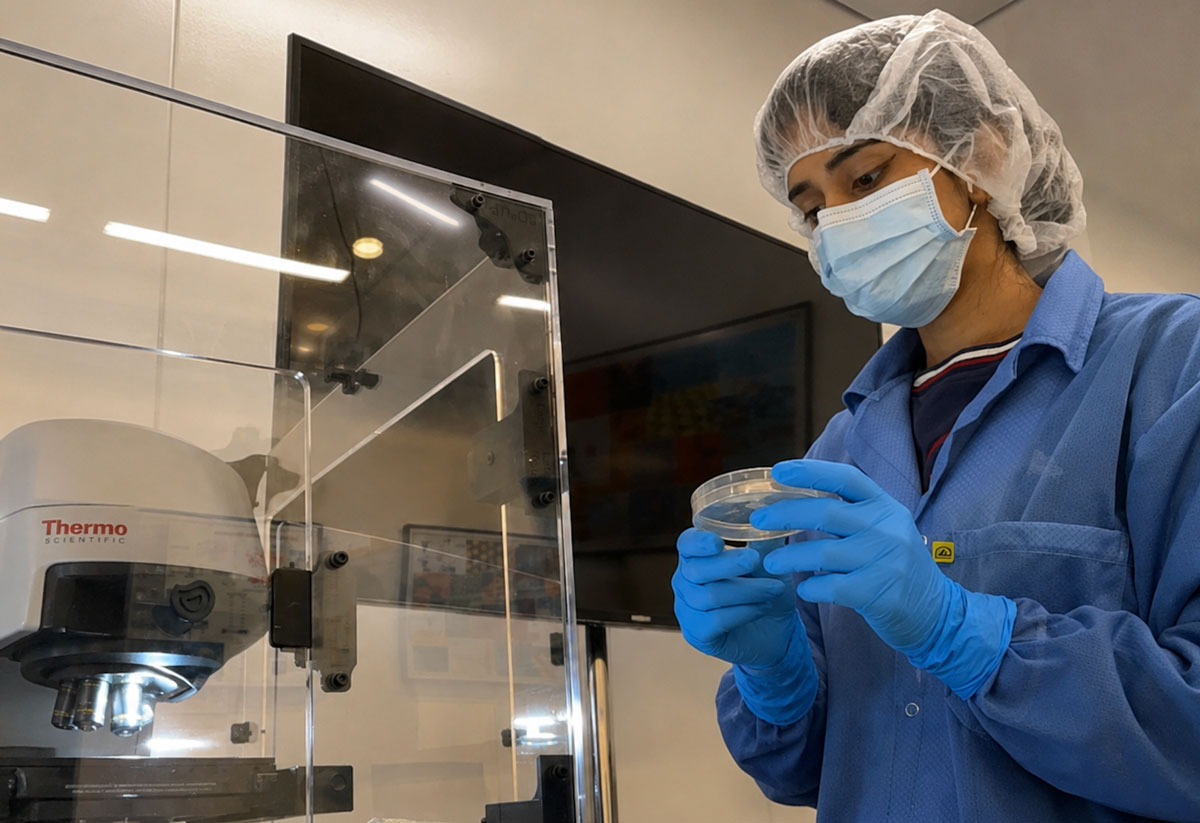
As Porandla dug deeper into her prior work at the Princeton Imaging and Analysis Center, however, she unearthed a troubling find: Two methodological errors. The mistakes affected the study’s conclusions, rendering the results inaccurate.
At first she struggled to accept the discovery.
“I found myself hoping the next experiments would explain away the inconsistencies,” she recalled. “I thought it might have been a calibration error in the Princeton experiment, not the one I did back in high school. I thought, ‘OK, this is a different facility, maybe I overlooked something when I replicated this procedure.”
But the more she examined the study, the clearer the reality became.
Porandla contacted DiGiorgio for guidance and started researching what to do, she told us. She read about authors submitting corrections or retractions after finding mistakes in published papers. Crestfallen but determined to do the right thing, Porandla contacted Wiley about the concerns and asked for guidance pursuing either a correction or retraction of the work.
“[It] was really hard because I had to let go of something that beyond just being a publication, beyond just being on my CV, was a full project that I really thought was part of my identity as a researcher,” she told us. “The paper represented years of work in high school [and] countless hours in the lab. It was one of the experiences that convinced me that I wanted to be a researcher.”
After a review by Wiley and the editors of Macromolecular Materials and Engineering, the journal retracted the paper in May.
Those familiar with Porandla’s case praised her candor to come forward, citing the rarity of self-retractions. A 2013 study of 1,423 retractions indexed by the Web of Science database found about 22% of retractions were self-reported, although that can be difficult to discern based on the content of retraction notices. The Center for Scientific Integrity, the parent nonprofit of Retraction Watch, recently announced the inaugural winners of a new effort to recognize scientists who self-retract. The annual Ctrl-Z Award honors researchers who discover errors in their published work and take meaningful steps to correct the record, recognizing that doing so can come with professional risk.
“Instances of authors proactively raising concerns about their own work are not the most common scenario,” David Huesmann, editor-in-chief of Macromolecular Materials and Engineering, told us. “This author, and others who do reach out to identify and correct mistakes in their work, show an honest commitment to scientific integrity.”
Huesmann confirmed Porandla reached out to the journal directly, and an evaluation of the concerns raised “ultimately led to the decision to retract.” The journal has since encouraged Porandla to resubmit an updated paper, Huesmann said.
Porandla described herself as a “very high-achieving student” in high school, conducting internship projects ranging from radio galaxy classification and supermassive black hole studies to climate and orbital dynamics modeling at the NASA Johnson Space Center in Houston. Her interest in electron beam research developed after a science competition where judges selected her proposal on beam therapy for osteosarcoma as a finalist.
Porandla later pitched an idea to her chemistry teacher about using high-energy electron beams as a degradation mechanism. She wanted to study whether infusing PVC with gold nanoparticles and then using electron-beam irradiation and near-infrared photothermal heating would improve the plastic’s biodegradability and make it less toxic.
Over the next two years, she studied how varying irradiation conditions affected key material properties of the plastic to maximize degradation. Teachers praised the work, and she received “pretty positive” feedback from the reviewers who conducted her International Baccalaureate assessment, she recalled.
“I actually got the referral to Wiley from my chemistry teacher,” she told us, who had found a paper on a similar topic in a different Wiley journal. “It was my own decision, but everyone was very supportive of me publishing.”
Looking back, Porandla said she doesn’t believe her teachers adequately advised her on the importance of rigorous experimental validation, replication, and independent verification before publication. At the time, she didn’t question feedback from teachers that her study was publication-ready.
Porandla was the sole author of the paper, which went through Wiley’s standard peer review process, she said. Based on her correspondence with editors, the journal had difficulty securing reviewers and the manuscript ultimately proceeded with a single reviewer. Her manuscript went through one round of revisions that primarily centered on presentation, figures and expanding the discussion in several sections, she told us.
“I did not receive any reviewer comments critiquing the study’s methodology or questioning the scientific content itself,” she said. “I feel that I would have felt more comfortable with publishing the work if there were more external reviewers or if more rounds of review were conducted.”
Porandla’s former chemistry teacher declined to comment for this story.
The problems Porandla later found in her paper related to the relationship between the programmed electron-beam exposure time and the actual delivered dose not being independently verified, she explained. Imaging and elemental mapping also revealed the gold nanoparticles in the study were not uniformly dispersed throughout the PVC matrix as originally assumed. Both “fundamental flaws” affected the reliability of the conclusions, Porandla said.
“I no longer felt comfortable having the paper remain in the scientific literature because I knew that other researchers could potentially cite it, build upon it, or use it to inform future work,” she told us.
DiGiorgio, the Princeton instructor, was impressed by Porandla’s decision to self-retract and the bravery it took to share her findings with the class. DiGiorgio herself once submitted a small correction to a published paper and called it “a terrifying process,” and one in which “you worry about your credibility, your reputation,” and “your future.”
“This is what makes Rishika’s self-retraction so important and such a show of integrity and respect for science,” DiGiorgio told us. “She could’ve been quiet about this and moved on to another project. But she made the right decision. In her reflections on the process, she discussed that getting the real results out there was more important than the personal stakes of a self-retraction.”
Porandla is now a rising junior at Princeton studying astrophysics with intended minors in materials science and engineering and engineering physics. She plans to pursue a career developing space plasma detector instrumentation for heliophysics projects.
Since the retraction, she has been conducting follow-up work to address the weaknesses in the original study and is working toward a corrected version of the article for the journal. The revised manuscript will incorporate a redesigned methodology, stronger validation procedures, and a more comprehensive understanding of the physical mechanisms involved, according to Porandla.
“I think this is an important part of my journey with this research because I see that retractions are often viewed as the end of a project,” she said. “In my case, the retraction became the starting point for a better study.”
She does worry that when applying to fellowships or graduate school, people might wrongly assume the retraction was linked to misconduct or carelessness, she said. But Porandla makes a point of bringing up the retraction when asked about her research and readily shares her story. She hopes such transparency will set the record straight. At least one researcher, Nathan Georgette, reported no harm to future job prospects after self-retracting. Ctrl-Z Award winner Kate Laskowski recounted the “overwhelmingly supportive” response she received in her field following her self-retraction.
“In my conversations with people, I try to make it known that this was a learning experience for me,” Porandla said. “I think that there’s a bit of flexibility that’s given if you have integrity and correct the record yourself.”
Update, August 11, 2026, 12:55 p.m. ET: After our article published, several commenters raised concerns on PubPeer about Porandla’s article, including possible citation irregularity, potential inconsistencies in some figures, and the suggested use of a large language model to generate an image.
Porandla responded that she hand-drew the figure in her Macromolecular Materials and Engineering manuscript and that it was not AI-generated. She noted the peer reviewer suggested some of the questioned references during the editorial process. (We have seen correspondence between Porandla and the editor confirming this.) She emphasized she conducted the project in high school without the level of oversight required for such work.
In a separate PubPeer post, commenters raised questions about citations issues and possible data problems in a 2024 preprint by Porandla and two others about autonomous navigation methods for hypersonic aircraft. One author, Sathvik Dasari, later published a similar paper at the Proceedings of the 57th Annual Precise Time and Time Interval Systems and Applications Meeting.
Porandla responded that Dasari performed the research and drafted the manuscript and that her involvement was “limited to overseeing the broader research program” in which Dasari was participating. Porandla was a 17-year-old high school student at the time and Dasari was in middle school, she told us. Porandla reached out to both Dasari and Engineering Archive (engrXiv) to request withdrawal or correction. The preprint server declined to withdraw the article but encouraged Porandla and Dasari to submit a correction, which they are working on, Porandla told us.
Since the Retraction Watch story was published, Porandla told us she has continued reviewing her high school research and responding publicly to substantive concerns.
“The aftermath has been difficult, particularly seeing work I did at a young age in informal environments like science fairs and research competitions scrutinized publicly while I am actively trying to address its shortcomings,” she told us. “However, I understand why these questions are being asked and do not want that discomfort to prevent me from engaging with legitimate criticism. I would rather acknowledge and correct problems now than allow unreliable work to remain unaddressed.”
Like Retraction Watch? You can make a tax-deductible contribution to support our work, follow us on X or Bluesky, like us on Facebook, follow us on LinkedIn, add us to your RSS reader, or subscribe to our daily digest. If you find a retraction that’s not in our database, you can let us know here. For comments or feedback, email us at [email protected].
Glad that a student got the experience but…. Injecting plastic with gold nano particles and then hitting it with an electron beam?
Maybe I don’t understand the broader use case in, for example medicine, but this seems like just doing science for the sake of doing science…. Fossil fuel plastic is already economically so cheap that no other plastics can rival it without subsidies, adding gold to it just seems ridiculous.
It’s only cheap if you ignore the externalities.
Anyway if you read the article, you would know the goal wasn’t to make it cheaper, it was to make it more biodegradable.
Also, if you read the article, you would see a valid main point. I see the larger takeaway here as a positive one: a student gained enough research experience to later recognize the limitations of her own work and correct the record.
I also think this raises a question for the rest of us as researchers: how are we holding ourselves accountable as mentors when encouraging students to pursue ambitious research and publication? It’s easy to celebrate or criticize young researchers, but we also have a responsibility to provide the guidance and oversight they need to do that work rigorously. And, when necessary, help them correct it.
How is an electron beam at all related to bio degredation. Thats chemical degredation not biological. And even if it was biological in origin what use case is there for gold – there are many other better options.
This is all moot as it turns out none of these experiments were ever performed.
This article sounds oddly contrived to me. Really, an overly ambitious high school student publishing in a journal (seriously, no parents involved whatsoever)? Then, reports serious errors in the research methodology? And getting commended for pointing out the error? Sounds like the article is trying to tug on too many heart strings.
Obviously she should have been shamed until she quit scientific work forever instead.
Well, she can always fall back on her college counseling business.
Anyway, something about this person is not passing the sniff test.
Oh well if she doesn’t pass Bill Jones’s sniff test she’s obviously a villain. Ban her from science forever!
Exactly.
See new comments:
https://pubpeer.com/search?q=Rishika+Porandla
It seems like the author left responses on both PubPeer comments explaining the discrepancies. Some methodological/data processing issues that were a main reason for the paper’s retraction, some faulty citations that were suggested by the editor, and some issues she takes ownership of, especially since she conducted the research as a high schooler.
She also identified that the second preprint was project conducted by a middle schooler at the time, who she worked with as a high school student herself, and she had little involvement in it beyond submitting the preprint.
https://pubpeer.com/publications/F9FE2AEE6C65C4A6CF1EBF2C204876
https://pubpeer.com/publications/2D2C688DCAA92D588B35E1C9C746B2
I think the responses add some important context to how these issues happened. A lot of it seems to come back to research being conducted very early on, without the level of methodological validation, oversight, and familiarity with the publication process that would normally be expected. That obviously doesn’t make the errors irrelevant, but I do think there’s a difference between trying to hide problems and going back years later, acknowledging what went wrong, explaining it publicly, and taking steps to correct the record.
The responses don’t actually explain *how* the numerous errors were introduced, instead handwaving them as passive “processing errors”. But I don’t understand how such an error would generate an entire fictitious trial wherein all values were “trial 3 + 1.28” without the author noticing?? Was there a real trial 4?
From the author’s post:
“During DSC processing, a temperature correction of approximately 1.28 °C was applied to the Trial 3 values and the resulting values were entered as Trial 4. These therefore were not independently validated measurements, despite being presented as a separate trial. The error was not caught because the processed trials were not systematically checked against their individual raw thermograms.”
Additional concerns in a different paper?
https://pubpeer.com/publications/D5BCE70A5C2BB4A49C60A7BE2D2A12
See also:
https://rishikaporandla.com/paid-services
On this website Porandla offers paid services “helping ambitious high school students build compelling, high-impact pathways to top universities.”. In https://pubpeer.com/publications/C8AF113FB5BB04BBE8EB07A4541CCC Cheshire comments on another odd pair of papers. The 2024 pre-print had 3 authors, including Porandla. The final 2026 publication only has one. That final author was an 8th grader when the pre-print was published and now is a sophomore. I guess this is a way of building a compelling CV for ambitious high school students…
It seems like the 2024 preprint came out of this informal research program that Porandla founded. Based on her PubPeer response, it sounds like she was supervising the program while she was still a high school student herself: https://spacetimearchives.com/research-fellowship
I think this speaks to the broader issue she raised in this article about students getting involved in research too early without enough formal training, validation, or experienced supervision in place.
Yikes. The real villain here is the admissions industrial complex that expects high school students to have published papers.
It’s exactly this.
I commend Porandla and I completely agree with Andrea DiGiorgio’s perspective here. This really is an example of integrity. Finding out that your own results don’t hold up is probably one of the hardest outcomes of doing research, but following the evidence anyway speaks volumes. The fact that she has self-reported, shared her story to Retraction Watch, is currently self-correcting, and continued addressing questions about her high school work publicly makes that lesson even stronger. This kind of public address is a lot for a student this young to handle on her own.
Reactions to this case fall in two categories. A group that sees a wizened person correcting a paper written with youthful hubris and unconscious incompetence (Morifolium, Allen, Quark, Thomas, …). And there is a group that feels more is going on (Bill Jones, Joelle, Cheshire?, me).
With respect to my position. The current paper has a detailed but (seemingly) very wrong description of the experiment. It also shows columns with measured values that show mathematical relationships (+1.28) and duplications. Even from an 18-year-old “very high-achieving student” it could be expected to get things more correct than that.
On top of this, she is also author of https://pubpeer.com/publications/D5BCE70A5C2BB4A49C60A7BE2D2A12 that has at least every citation wrong. And she is co-author on a now-published preprint with its own range of (citation and more) issues: https://pubpeer.com/publications/2D2C688DCAA92D588B35E1C9C746B2.
I certainly do not think that “she should have been shamed until she quit scientific work forever instead” (Anonymous Historian). But I do feel this article is somewhat naive and “is trying to tug on too many heart strings” (Bill Jones).
Interesting that few people responding to this post are questioning what her mentors were or were not doing. It is pretty unusual for someone in high school to submit a scientific paper to a journal.
As graduate and undergraduate advisors we make sure things are thoroughly checked all around when our students write and submit papers. This is particularly the case when it is their first one. There are a lot of things they need to know to get it right.
There seems to be something important missing from the story. What were her teachers doing during all of this? If they were out of their depth, then did they not try to find someone who could mentor her? How can you push a student into the deep end like that without some support? At face value this does not seem like a good advertisement for her high school…
As mentioned above, the author has a website listing consulting services. According to archived copies of the site, until recently services listed included “Research Topic Identification and Literature Search” and “Research Abstract and Paper Drafting.”
https://web.archive.org/web/20260313023426/https://rishikaporandla.com/paid-services
The current version of the author’s site includes, “Our counseling model integrates research development, publication-level writing, and competition preparation directly into the college admissions process.”
https://rishikaporandla.com/paid-services
As far as the practice of publications by middle- and high-school students, it seems to be a growing practice, if not a wise one. See https://www.propublica.org/article/college-high-school-research-peer-review-publications (from 2023). One of company’s mentioned in this article, “Journal of Student Research” was actually used by one of Porandla’s team members (first author Kumar) to publish a paper. I commented about that paper on PubPeer today (https://pubpeer.com/publications/B63835BB20D8B0FB9F6DA5C7101E89). After doing so, I was unable to find a working website for that company, so I’m not sure it is still active.
See also https://pubpeer.com/publications/8D3455E7DBC2A7DA5A56D875EBCB6E (sole author Sanjay) for another team member with a preprint about which I have expressed some concerns.
Huh. If we are going to discuss her non-research extracurriculars, it seems relevant to provide the fuller context. I was curious, so I looked at her LinkedIn bio, which states: “I am passionate about science policy and advocacy. I currently represent Princeton University as a 2026-27 American Physical Society Student Ambassador, and am an organizing member of the Scientist Network for Advancing Policy (SNAP), state lead for the Stance on Science congressional initiative, and Student Advisor and Summer Days of Action Team Lead to the American Geophysical Union. I am also a Princeton Correspondent on Undergraduate Research, Science Outreach Fellow, NASA AstroCamp Coordinator, and the STEM Lead of the Princeton Civic Leadership Council.” It looks like she cares about science and ethics more than some making a character judgement about her may claim.
Good point. Her current scientific work seems well-regarded. To shed some light on what she is doing now instead of when she was 15, I see she has received recognition for her undergraduate research from the American Physical Society, American Astronomical Society, Princeton University, etc.
Comments on this article are now closed. If you have additional feedback or information about this story, you may email it to the Retraction Watch team.