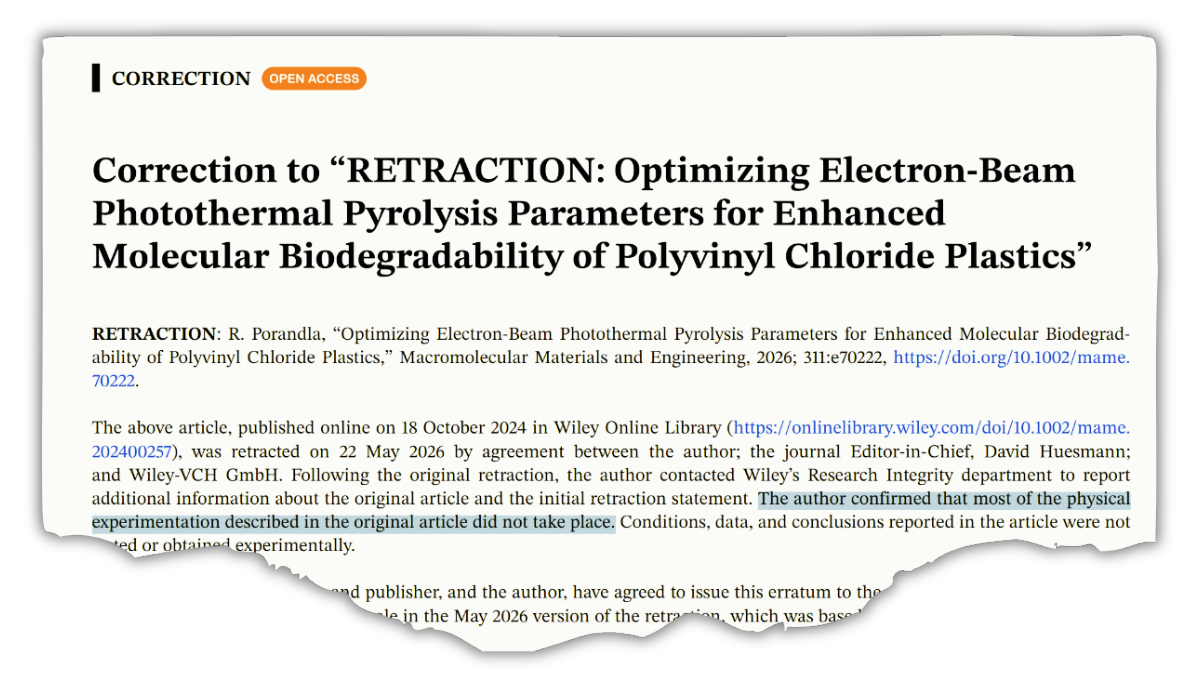
A Wiley journal has corrected a retraction notice to clarify the author, a Princeton student, never conducted the study in the first place, as the student has gained publicity for visits to the offices of Texas Congressional delegation.
The paper, by Rishika Porandla, purportedly described a new way to break down polyvinyl chloride plastic by mixing it with gold nanoparticles and blasting it with an electron beam. Macromolecular Materials and Engineering retracted the study this May after Porandla, an astrophysics student at Princeton who completed the study while in high school, notified editors of methodological errors in the work.
But following an Aug.10 Retraction Watch story highlighting Porandla’s decision to retract her own paper after she contacted us about her initiative to “correct the scientific record,” commenters on our site and on PubPeer raised doubts about whether the experiments described in the study were genuine. Porandla later told us she never conducted the experiments.
On Oct. 19, the journal added a correction to the retraction, clarifying that “most of the physical experimentation described in the original article did not take place” and that “conditions, data, and conclusions reported in the article were not tested or obtained experimentally.”
Porandla, who is currently on leave from Princeton’s department of astrophysical sciences, declined to comment for this story. She previously told us she contacted Wiley in August to explain the experiments did not occur.
“The beam experiment described in the paper was a proposed experimental workflow with associated calculated results,” she told us. “Public confusion led me to recognize and regret that this is not clear in the retracted publication, and I have included detailed clarification in an updated retraction statement to Wiley.”
The correction states the journal’s editor, publisher and author agreed to the erratum “to correct the retraction rationale in the May 2026 version of the retraction, which was based on errors that took place during a physical lab experiment.”
Wiley did not respond to an inquiry about the correction by our deadline. David Huesmann, editor-in-chief of Macromolecular Materials and Engineering, previously told us Porandla’s efforts to identify and correct her mistakes showed “an honest commitment to scientific integrity.”
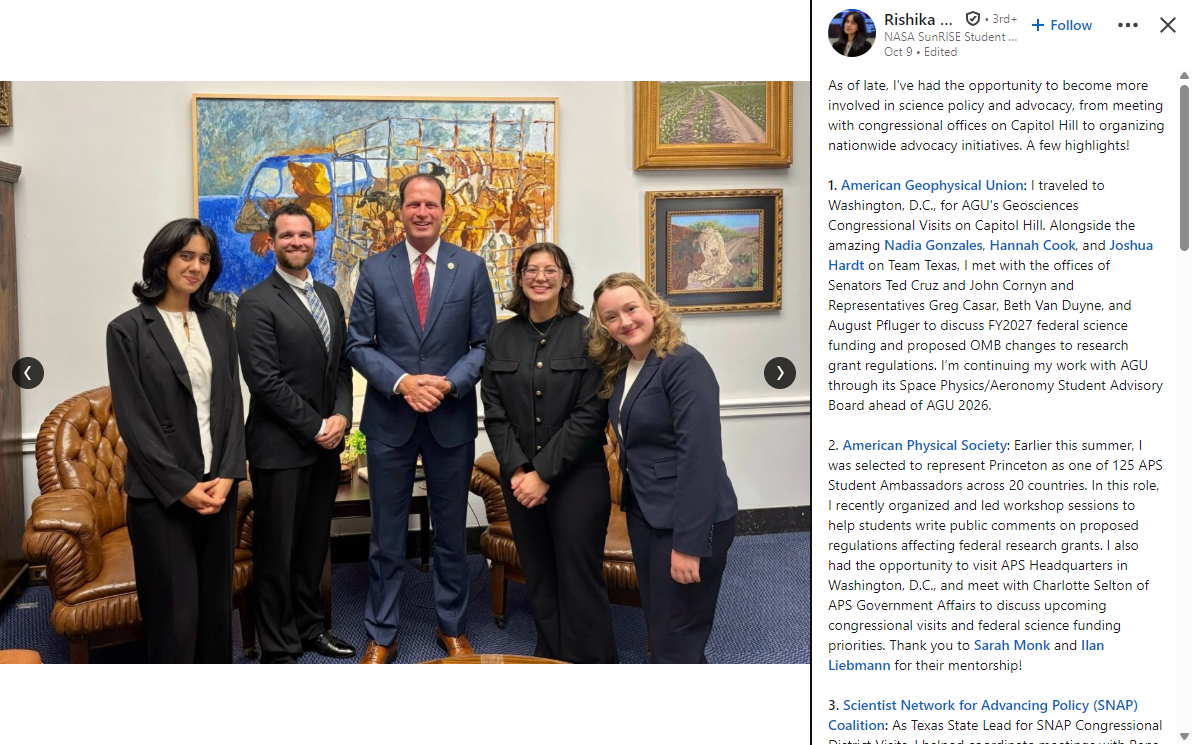
Since her leave from Princeton, Porandla has remained in the spotlight, recently meeting with Republican Congresswoman Beth Van Duyne from Texas’ 24th District to discuss American leadership in scientific research, according to a post on X by Van Duyne that has since been taken down. Van Duyne wrote that Porandla “shared her work advocating for the continuation of American leadership in scientific research and innovation” and “how policymakers can support STEM workforce development.”
The post drew many racist comments about Porandla and Van Duyne’s interaction with the student, the Times of India reported.
Van Duyne’s office did not return a message seeking clarification about the post.
In an Oct. 9 LinkedIn post, Porandla noted she has become “more involved in science policy and advocacy” from “meeting with congressional offices on Capitol Hill to organizing nationwide advocacy initiatives.” This includes being selected as a “research-to-policy implementation intern with Penn State’s EIC Collaborative” and traveling to Washington to “discuss federal science funding” and proposed Office of Management and Budgement changes to research grant regulations, according to her post.
Like Retraction Watch? You can make a tax-deductible contribution to support our work, follow us on X or Bluesky, like us on Facebook, follow us on LinkedIn, add us to your RSS reader, or subscribe to our daily digest. If you find a retraction that’s not in our database, you can let us know here. For comments or feedback, email us at [email protected].