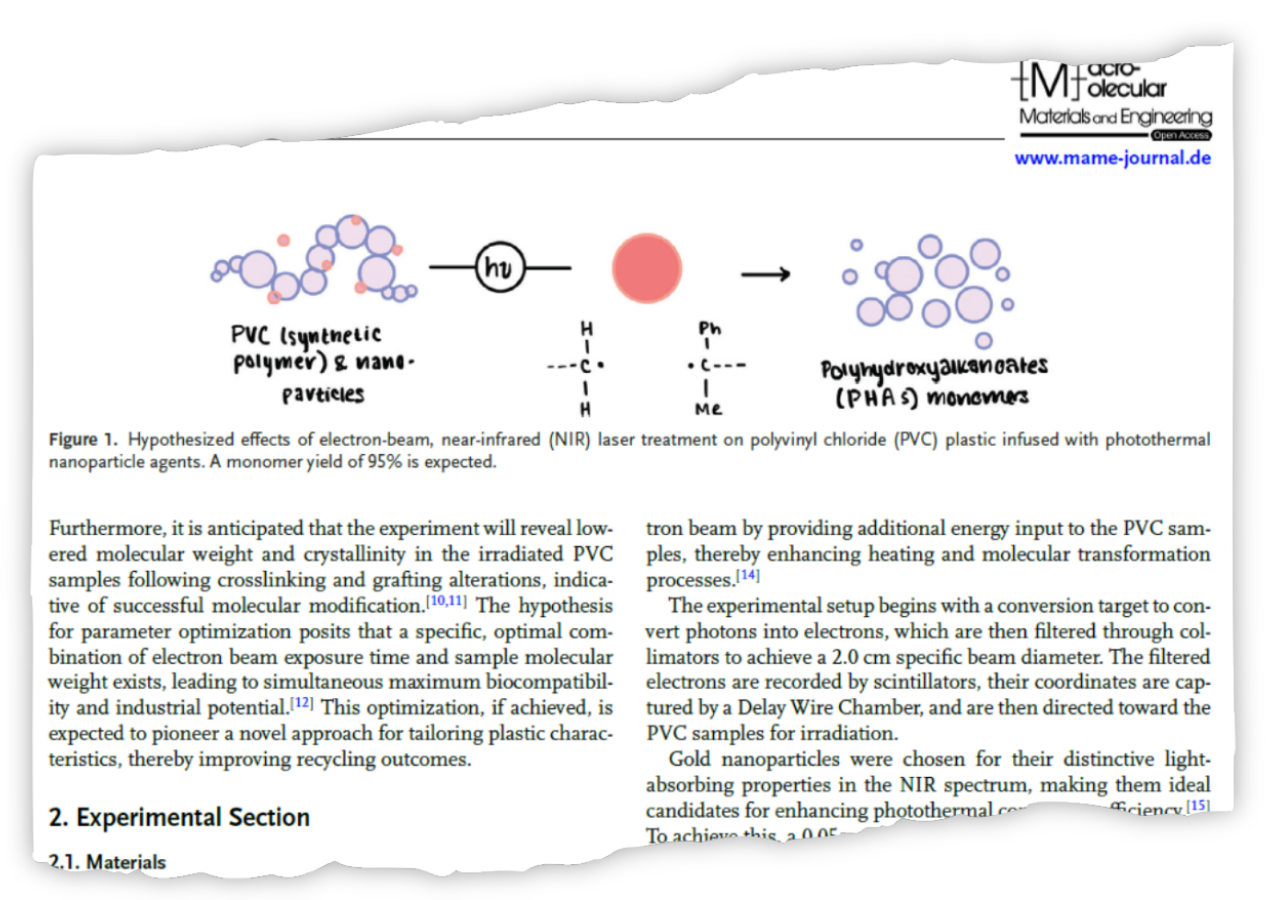
Earlier this week, Retraction Watch reported on a Princeton student’s decision to retract her own paper from an engineering journal due to “significant methodological errors.” The student, Rishika Porandla, now tells us she never conducted the experiments described in the study.
“The beam experiment described in the paper was a proposed experimental workflow with associated calculated results,” she wrote in an email. “Public confusion led me to recognize and regret that this is not clear in the retracted publication, and I have included detailed clarification in an updated retraction statement to Wiley.”
Porandla’s original article, published in 2024 in Macromolecular Materials and Engineering based on work she did while in high school, claimed to show it was possible to enhance the biodegradation of polyvinyl chloride, or PVC, by mixing it with gold nanoparticles and blasting it with an electron beam.
On May 22, Porandla reached out to Retraction Watch by email to share the news of her retraction because she felt it “highlights a broader issue involving student researchers entering the publication space before fully understanding experimental rigor and reproducibility standards.”
She also noted she had faced “significant pressure from mentors to move quickly toward publication before the work had been sufficiently validated.”
The retraction notice published by the journal indicated she had decided to retract the paper after conducting a follow-up study and discovering problems with “the calibration of the electron beam exposure time and the distribution of gold nanoparticles.”
While the original decision to retract the paper brought praise from one of her professors and the journal’s editor-in-chief, it also led to deeper scrutiny of the high-achieving student’s publishing record and a “research-driven college counseling” business she runs to help students gain admission to Ivy League colleges.
Shortly after our original story was published on August 10, commenters on PubPeer began raising doubts about whether the electron beam experiment occurred and pointing out problems with citations and other issues in a handful of other preprints and student publications she had posted online. (Our co-founder Ivan Oransky is a member of the PubPeer Foundation’s board of directors, but has no role in moderation or any other day-to-day operation of the site.)
“What concerns me more is the apparent failure of the ‘adults in the room’ and of the safeguards that are supposed to surround student research: teachers and advisors, mentors, and, where applicable, peer reviewers and editors,” Kevin Patrick, a sleuth who goes by “Actinopolyspora biskrensis” on PubPeer, told us. “The extraordinary pressure surrounding college admissions has created incentives that are worth examining here.”
There’s no question Porandla is an exceptional student. In 2024, when she was a senior in high school in Coppell, Texas, her school posted a video on YouTube of teachers and students gushing about her drive, generosity and intelligence.
The video ends with a statement from Mark Clampin, then the head of the astrophysics division at NASA headquarters, where she participated in five internships during high school. “Rishika is my hope for the future generation of science,” he wrote. “I cannot begin to imagine what discoveries and achievements lay in her future.”
By then, Porandla was hard at work on the Spacetime Archives, a website and outreach program she founded in partnership with the Junior Texas Astronomical Society. She conducted interviews for a video podcast and recruited other former NASA interns and other space nerds to create educational materials, blog posts, and even a student journal, The Physical Scientific Archives, where she served as the editor.
“AI-usage for paper writing, papers without references, or unethical experimental procedures are strictly prohibited,” the journal’s submission guidelines read.
Shruti Joshi, now an engineering student at the University of Texas at Austin, learned about the program in late 2023 as a junior in high school. One day at the Cozby Library and Community Community Commons in Coppell, she stumbled upon Porandla giving an astronomical presentation and sent her a message afterwards.
“She had a program to mentor students to write papers about certain topics,” Joshi said. Porandla matched Joshi with two other students and helped the group conduct a study on black holes using open-source data.
In February 2024, their study appeared in Volume 1, Issue 3 of Porandla’s journal, and it was later uploaded to the SSRN preprint server.
“This is just a notice that your Spacetime Archives paper has been published on SSRN,” Porandla wrote in an email to her coauthors on July 13, 2024. “Two of you have ‘no affiliation’ next to your names and that is because your schools are not registered with SSRN. Over the next week, I’ll be working on that issue!”
That year, Porandla founded Counseling by Rishika which features nine consultants — several are also coauthors — to provide one-on-one college advising for $950 over five weeks.
These consultants, her website said until recently, have “conducted and published original research in fields spanning medicine, astrophysics, quantum mechanics, and computer science.”
Porandla and her mentees and consultants have shared their wide-ranging work in student journals, conference proceedings, preprint servers, and at least one open access journal published by OMICS International, which has been previously fined for deceptive tactics.
How many paid for the help is unclear, but the website for her firm says it has advised “more than 100 students.” Joshi said she didn’t pay to work with Porandla.
“My consulting work aims to help students conceptualize and develop projects for middle and high school science fairs and competitions,” Porandla told us.
Her single-author paper in Macromolecular Materials and Engineering, published during her freshman year at Princeton, appears to be her only publication in a widely recognized, peer-reviewed journal.
She previously told us that it represented “countless hours in the lab” and “was part of my identity as a researcher.”
She originally said she decided to withdraw the paper after discovering methodological errors during a class with Princeton professor Andrea DiGiorgio.
DiGiorgio told us she remained confident in Porandla’s integrity but declined to comment on the new concerns beyond a brief statement.
“The beauty of science and scholarship is that they are self-correcting, they have to be, and negative discourse around self-correction only impedes this process and sows fear into future researchers who are faced with this difficult decision,” she wrote in an email.
Like Retraction Watch? You can make a tax-deductible contribution to support our work, follow us on X or Bluesky, like us on Facebook, follow us on LinkedIn, add us to your RSS reader, or subscribe to our daily digest. If you find a retraction that’s not in our database, you can let us know here. For comments or feedback, email us at [email protected].
I’m viewing these articles about the author together and I’d like to repost what I commented on the original article: Huh. If we are going to discuss her non-research extracurriculars, it seems relevant to provide the fuller context. I was curious, so I looked at her LinkedIn bio, which states: “I am passionate about science policy and advocacy. I currently represent Princeton University as a 2026-27 American Physical Society Student Ambassador, and am an organizing member of the Scientist Network for Advancing Policy (SNAP), state lead for the Stance on Science congressional initiative, and Student Advisor and Summer Days of Action Team Lead to the American Geophysical Union. I am also a Princeton Correspondent on Undergraduate Research, Science Outreach Fellow, NASA AstroCamp Coordinator, and the STEM Lead of the Princeton Civic Leadership Council.” It looks like she cares about science and ethics more than some making a character judgement about her may claim.
It is also worth including Quark’s reply: “Her current scientific work seems well-regarded. To shed some light on what she is doing now instead of when she was 15, I see she has received recognition for her undergraduate research from the American Physical Society, American Astronomical Society, Princeton University, etc.”
To me, such an extensive list of concurrent leadership-role extracurriculars suggests someone who is enthusiastic about *portraying themselves* as a scientist, not about actually doing (or understanding) the science. A “hat collector”, to borrow Wikipedia parlance. Who even has time for all of that on top of 6 hours/day of school + 2+ hours/day of homework/studying + 19+ hours/week doing research?
Also, the paper was published in 2025, when she was already in college. She, as an adult, allowed publication of entirely fabricated data and continued to misrepresent the project as if she had actually done the experiments *up until yesterday*! If she was already performing such sophisticated falsifications to the scientific record as a high schooler/undergrad, what kind of misconduct might have occurred before and after in less public domains (e.g. cheating on tests, using AI to write papers, creative bookkeeping)?
A cynical view is that her initiating the retraction (and then actively *advertising it*) was a strategic move to disguise the paper’s issues as relatively minor validation errors borne of juvenile incompetence in the hope that this would preempt potential external critiques in the future that would reveal the fraud, and then wrap it in a very public narrative of laudable self-correction and sincere penance. This would actually be impressively savvy…
Either way, there’s no doubt she’s a very bright, ambitious person who could achieve a lot if she were to focus her drive into actual research rather than scattered performative roles. Perhaps being caught out so early will steer her into a fastidiously honest career; who knows, maybe tyro cheaters having this kind of experience before their identities become too inextricably linked to fraud is the best way to block the tech startup grifter pipeline.
That’s what I just wanted to comment. The paper was submitted in 2024. I’m not sure about the timeline, but she was presumably already in Princeton at that point, and it was long after the high school experiments actually took place.
There is absolutely nothing in the paper that would suggest these are only simulated, calculated data, the paper is clearly trying to convey the impression this was a real experiment.
This reeks of her trying to pad her resume with fraudulent high school “research” without giving it much though, later realizing other people would eventually caught up with it and her trying to get ahead of the issue by self-retracting.
In a world where most high school students are just wasting their time on TikTok, it’s refreshing to see somebody with a talent for fraud giving something back by teaching other kids sophisticated falsifications to the scientific record. 🤮
“The beauty of science and scholarship is that they are self-correcting, they have to be, and negative discourse around self-correction only impedes this process and sows fear into future researchers who are faced with this difficult decision,” she wrote in an email.
The arrogance and lack of self awareness is strong in this one. Another stark failure by an “adult in the room.” Do better, Princeton.
“… highlights a broader issue involving student researchers entering the publication space before fully understanding experimental rigor and reproducibility standards.” ”
This does highlight a broader issue: the length to which highschool students and/or parents are willing to go to further their career of that of their children.
is the length to which highschool students and/or parents are willing to go to further their career of that of their children longer than other people?
This whole episode is beginning to develop a bad odor.
Yeah, now it is definitely failing the sniff test.
It’s interesting when the high-minded reach for the ‘incentives are the pwoblem!’ Excuse, when it’s only a small small minority who work to cheat.
I’m sorry, what? A small minority cheating doesn’t mean the incentive structure isn’t critically flawed. You’re thinking of this from too much of a black and white perspective. Yes, this incentive structure may encourage cheating. Want to know what else it encourages? Lack of cooperation, developing research in secret, rushing papers to publication without a full understanding of what it implies, hat/credential collecting, undermining/stealing peers research in order to be “the first to publish,” etc etc. The “small minority” you refer to gets progressively larger and larger the longer you analyze the problems with the system at hand. Not saying that this lady shares no fault of her own, but the fact of the matter is that our current “publish or perish” culture objectively incentivizes people to cut corners, because often times it doesn’t matter if you’re right, only if you’re the first one to say it.
Any single author paper from somebody this age alleging they conducted electron beam experiments with gold nanoparticles is obviously fraud. Shame on Princeton for promoting it and defending it. She should be expelled.
What about the journal that published it? The editor was running some kind of cracker Jack review again???
Some characters on the journals “International Advisory Board,” or whatever they call their editorial body. Draw your conclusions.
Manjusri Misra: https://pubpeer.com/search?q=authors%3A%22manjusri+misra%22. A modest PubPeer record including a bad retraction.
Holger Ruckdäschel: https://pubpeer.com/search?q=authors%3A%22holger+ruckd%C3%A4schel%22. He is an associate of Mohammad Arjmand. The same Arjmand who once teamed up with Masoud Afrand to co-edit a disastrous special issue – more in the commentshere and in references therein.
Seeram Ramakrishna: https://pubpeer.com/search?q=authors%3A%22Seeram+Ramakrishna%22. Someone with a big and bad PubPeer record. Also, a “Seeram Ramakrishnan” from the same department accidentally edited a topical collection full of articles for sale.
People are pretty harsh here. I think retractation is a good move regardless.
You don’t retract to gain, you retract to correct your mistakes. There’s still a record of said retractation.
I don’t think she had any expectations of being praised, but there is a difference between criticizing the original paper and methodology and criticizing the character of someone based on a few factors that are seldom a window into their life. The information we have about her is that paper, retractation, and LinkedIn profile. None of those represent who she is as a person, especially not LinkedIn.
People here still claim to know exactly who she was in highschool, who she is now, and why she does what she does.
Precisely. I see a lot of envy here, no offence.
Harsh? This is the highest level of scientific heresy. She should be lucky to get a job in science in a high school. There is always the trump administration.
Obviously you don’t retract to gain. You publish to gain. The problem isn’t the retraction, it’s the reason for the retraction (publishing a lie). And I’m not saying anything about this girl personally. The fact is she took an incredibly valuable and scarce spot at Princeton. She should lose it for lying, plain and simple. That’s not a punishment for retraction, it’s a punishment for publishing a lie. If there are no consequences for that our academic system has failed.
The principal of retracting a paper is crap. There has always been a scientific process in which errors are published as errata, updates are published as updates, revisions are published as revisions, reexamination are published as reexaminations, rebuttals as rebuttals, comments as comments, responses as responses, admissions as admissions, and apologies as apologies .Retractions violate the scientific process as much as piltdown man, which was never retracted, was subject to a long series of these follow ups and remains one of the most horrendous examples of falsified research. Retractions Do nothing but hide the scientific process and protect publishers who do bad oversight. No paper is perfect, but if the person didn’t do the study, that is literally scientific heresy. If someone something is in error, the original should remain in the literature. While I commend her for fessing up that she never did the study, it is literally inexcusable.
At no point in my career, all the way back to my first published data originating when I was pre-highschool did I ever under any circumstances consider ever ever ever faking data or a study. In over a decade as an editor did I ever allow a faked study to be published by others. In fact, I even alerted the editorial staff of one journal that a paper was likely fabricated and recommended rejection. It wasn’t, the journal published it, then it became an international incident leading to several Retractions and loss of the investigators research chair. In the publishing process I was the only one questioning it. I even used it in class ass an example of a questionable study and teach the students why. If a journal published massively over the top crap, it needs to lose its impact rating immediately. The peer reviewers should be investigated for conflicts of interest and if so, need to be reported to their employers for sanction. I have caught peer reviewers misrepresenting their conflicts of interest. About a half of them were minor. Most of them still conducted a fair review when I found a replacement who actually concurred with their assessment. Others were mixed. But one was actually the submitters graduate advisor. The only one of three who recommended publication. Yes, this should receive the highest level of disgust from real scientists.
.
I’m sorry, was this article written about Malcolm L McCallum? Who asked for your experiences and how are they at all relevant to the article? You could have gone to some bottom of the barrel state university on an editorial for a junk paper. You could be a highly privileged person who doesn’t need the credentials in order to be trusted or listened to. You could literally be so many goddamn things that your own thought process literally means nothing because the context of why people do what they do is everything. You’re the type of person who looks at a starving person stealing food from Walmart and calls them a dirty criminal as you drive past them in a Bugatti your daddy bought you. You have absolutely no authority as to claim who a “real” scientist is or what they should be thinking.
I hope Retraction Watch, and others operating in this space, will take the death of Jason Arday as an occasion for serious reflection about where responsible scrutiny and discourse ends, and where a public pile-on begins.
I firmly support exposing possible and actual research misconduct. Scientific integrity depends upon people being willing to identify problems, investigate them, and correct the record. Retraction Watch in particular generally approaches this work with considerably more balance and adherence to journalistic standards than the deliberately inflammatory blogs devoted to research misconduct. For this they should be commended.
But accountability should also be proportionate. Once credible allegations have been brought to the attention of journals and institutions, or the work has been corrected/retracted, there should be some consideration of what exactly is gained by continuing to amplify every allegation, development, speculation, and accusation to an enormous online audience. At some point, additional exposure contributes little to protecting the scientific record. It only increases human consequences for everyone (not just the lead author) involved. I feel that concern is particularly relevant here.
The author wrote the work in question while she was a MINOR. Whatever mistakes or poor decisions may have been made deserve appropriate examination and correction. But this is still a young adult whose actions as a youth are now being dissected before an internet audience. I hope she has the emotional resources to withstand that degree of scrutiny.
People make mistakes and exercise poor judgment. Science has mechanisms for identifying and correcting this. We should leave additional room for people, especially young people, to acknowledge errors, correct the record, learn, and move forward. Accountability should not require permanent public humiliation.
I would encourage Retraction Watch, and even more strongly other outlets and blogs read by this community, to reconsider how reader comments are moderated. There is an important distinction between reporting information relevant to research integrity and providing a venue in which an individual becomes the object of escalating ridicule, speculation, or personal attack.
The events surrounding Jason Arday should at minimum remind us that the subjects of these stories are human beings. Protecting scientific integrity and exercising humanity are not competing objectives and we are capable of doing both.
@ResearHER
I agree with you on balance and proportionality arguments regarding public exposure, especially when it concerns (just-not) underaged. However, your third paragraph seems to suggest you would rather have Retraction Watch stop their coverage after their first report of the retraction:
> Once credible allegations have been brought to the attention of journals and institutions, or the work has been corrected/retracted, there should be some consideration of what exactly is gained by continuing to amplify every allegation, development, speculation, and accusation to an enormous online audience.
Assuming I did not misunderstand: Porandla appears to have knowingly and willingly abused Retraction Watch here. In the above story you can read how “On May 22, Porandla reached out to Retraction Watch by email to share the news of her retraction“. She told the RW reporter about her “countless hours in the lab” and how the paper was “part of my identity as a researcher“. The resulting article is super-sweet and understanding, and even mentions the Ctrl-Z award that “honors researchers who discover errors in their published work and take meaningful steps to correct the record“.
After this, evidence (or, according to taste, speculations and accusations) surfaced that they had been led by the nose in their coverage. With, after some questioning, the author admitting that the results were not produced in a lab. In this situation it seems not more than logical for RW to amend their reporting ASAP: they had fallen for the lies of a young author, resulting in them writing a picture-perfect PR story to be added to a seemingly well-curated online image.
When it comes to the comment sections: I feel that most comments are factual and quite polite. Except for Corgi maybe, but that comment does not address the author.
I think if Retraction Watch had had a better peer-review system, they would not have published the original puff piece to begin with.
Otherwise, I agree, you don’t get to manipulate your public perception via a media source and then complain about that media source covering (or, better, owning up to their part in) that manipulation.
The analysis and comments at PubPeer lead me to tentatively conclude that the entire paper is an AI hallucination. I hope Ms. Porandla’s friends and family are keeping in close contact with her. As we saw with Jason Arday, fabulists do extreme things when the jig is up. This whole situation is just very sad.
Do we expect more such papers from young prodigies? I expected this to happen because you don’t need to run an experiment and write a paper on an imaginary one (AI will assist you). It is the same as undergraduate students writing systematic reviews/meta-analysis/, or structured reviews on a topic in which they haven’t done anything (I know this is not a popular view, and there will be responses to my comment). I don’t favour such trends; I agree there are smart young ones. As a handling editor of a couple of traditional journals, I do see such manuscripts. What about brain development? Are they mature enough (I know AI may help accelerate maturity)? I agree with Cheshire’s comment – what is the role of the “adult in the room”? It is important to check what her parents’ motivation is. What is their role here?
Moreover, in this case, a high school student conducting experiments on “beam irradiation” – what about safety and ethical issues here? How did the department allow a high school student to conduct these experiments on her own with/without proper supervision? In my institution, this is not allowed…
After reviewing over 200 articles, I am convinced that the peer-review system is struggling due to a widespread lack of reviewer expertise and engagement. While many journals are shifting to open access, the current model fails to motivate reviewers to invest their time. If authors are required to pay publication fees to make their work accessible, it is unreasonable to expect reviewers to perform the critical task of quality control for free.
Comments on this article are now closed. If you have additional feedback or information about this story, you may email it to the Retraction Watch team.