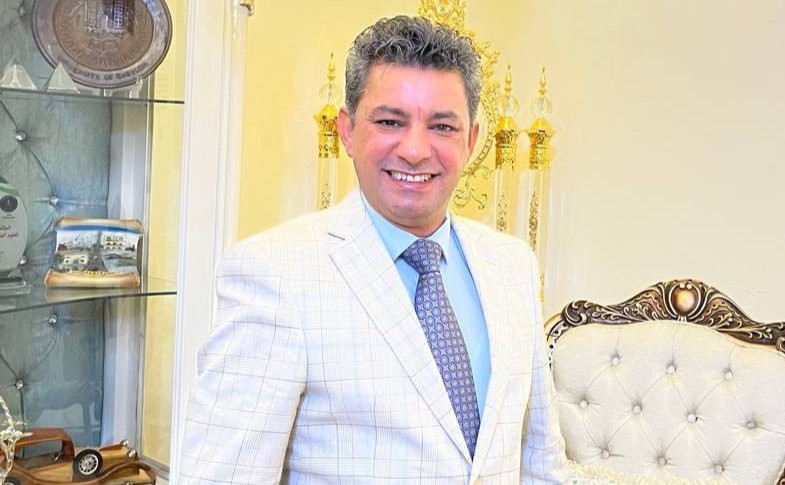
Five months after he was fired by ministerial order, an Iraqi professor of physics at the center of a massive publishing scam submitted a manuscript to a Wiley chemistry journal claiming affiliation with Columbia University in New York City.
The paper also stated the physicist, Oday A. Al-Owaedi, was affiliated with the University of Babylon in Hilla, Iraq, although he was permanently dismissed from his position last year.
As we reported at the time, Al-Owaedi defrauded “researchers by collecting money from them under the pretext of publishing their papers in reputable international journals as promised, while in fact falsifying and forging publication in fake websites,” according to a ministerial order we obtained.
Al-Owaedi, who is corresponding author on the new paper, told us the Columbia affiliation “was a mistake” and that the journal was “currently correcting the article.” As to the University of Babylon, he said he hadn’t “completely severed ties with” the institution.
“This week, a court ruling will be issued acquitting me, and I will return to teaching,” Al-Owaedi, who is also a politician, wrote in an email. “According to the Iraqi judiciary, and since my case is still in court, I am still an employee and research professor at the University of Babylon, and I have the right to use my affiliation with the university.”
He also repeated earlier legal threats against Retraction Watch, stating he would come to Denmark, where one of our contributors is based, and “file a lawsuit against you in the Danish courts, and then in the United States and everywhere else where I can obtain justice because you have wronged me, defamed me, and tarnished my reputation.”
Al-Owaedi, who is still listed as a faculty member on the University of Babylon’s website, added: “And please know that if I have only one day left to live, I will take all my rights from you, through the law.”
The scam that led to Al-Owaedi’s dismissal centered on a conference organized by a prominent association of Iraqi academics. Al-Owaedi chaired the organizing committee for the event and told prospective attendees he had made a deal with Elsevier to publish hundreds of papers at discounted prices.
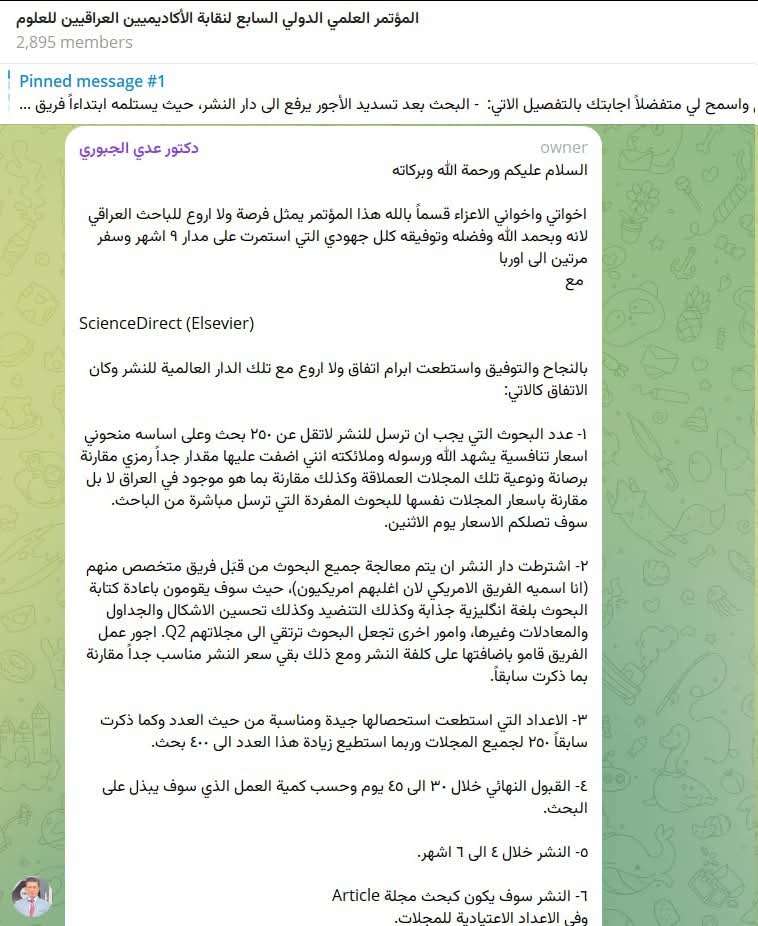
In reality, however, the agreement was with an agency that bore all the hallmarks of a full-fledged paper mill, our investigation found. A journal website and several acceptance letters provided as evidence of successful publication turned out to be forged.
The publishing scheme involved hundreds of thousands of dollars paid into Al-Owaedi’s bank account by unwitting researchers, according to documents we obtained. It is unclear what happened with the money, which Al-Owaedi claimed he transferred to the agency.
A Wiley spokesperson said the company is “currently investigating this article in accordance with COPE guidelines and will take appropriate measures once the investigation has concluded.”
The spokesperson also said all manuscripts submitted to Wiley journals “undergo a robust screening process, which includes 25+ automated integrity checks, including for institutional email addresses, existing affiliations, and other author verification checks.”
The email address listed for Al-Owaedi is a personal Gmail account. According to the spokesperson, the publisher performs “additional checks when authors do not provide institutional email addresses. However, a non-institutional email on its own is not an integrity concern and authors generally may hold several affiliations.”
Like Retraction Watch? You can make a tax-deductible contribution to support our work, follow us on X or Bluesky, like us on Facebook, follow us on LinkedIn, add us to your RSS reader, or subscribe to our daily digest. If you find a retraction that’s not in our database, you can let us know here. For comments or feedback, email us at [email protected].
Oday is no longer a professor at the University of Babylon, so he cannot legitimately list the University of Babylon as his affiliation on current publications. He has also done this before, claiming affiliations with Spanish, British, and other reputable universities without legitimate institutional ties.
Honestly, I’m baffled by Retraction Watch. This is the second time they’ve attacked me, tried to smear my reputation, and attempted to tarnish it.
The question that comes to mind is: why are they doing this?
The only answer I’ve come up with boils down to two possibilities:
First, this organisation, its employees, and those who run it are people who exploit anything for blackmail (extorting others), and that’s a crime, not journalism. So, they’re criminals, not journalists.
The second possibility is that they’re mercenaries (working for whoever pays them to smear others). That’s also a crime, and therefore, this organisation is a criminal enterprise run by criminals.
Now, why am I making this comment and speaking so harshly?
The answer is: I’m saying this for the following reasons:
First, Retraction Watch contacted me about ten days ago via email, asking me about the mention of the Babylon and Columbia Universities as my affiliations.
I answered them with complete honesty and transparency, explaining that the name of the University of Babylon was included because it is my affiliation, and that I am still, according to Iraqi law, a professor at the University of Babylon, as evidenced by the facts.
While, the name of Columbia University was included in error, and I have informed them that I notified the journal of the mistake just two days after publication and requested that they remove my affiliation with Columbia University, as well as I have informed the Columbia University, and I introduced my apology. The publisher also contacted me, requesting some information and confirmation of my desire to remove the affiliation (Columbia University). I provided them with the requested information and evidences that I am still affiliated with the University of Babylon, and I reiterated my desire to remove the name of Columbia University because it was included in error and unintentionally.
Retraction Watch was aware of all of these information. Although, they published this article. Here I am asking WHY???
Is there any justification for publishing this? Does it serve the public interest? Do they have any good intentions?
The answer is a resounding no. In fact, it is a criminal organisation, and everyone who works there is a criminal.
What is the solution?
The answer is that I will file a lawsuit against them in Denmark and the United States, and I will obtain my full rights from them. This will happen very soon.
As for the commenter who is ashamed and afraid to reveal his name (he used fake name, which is ”Mohd”), I would like to tell you that I know you very well, and the time will come to hold you accountable according to Iraqi law. Why? Because you are a liar, a defamer, and an extortionist.
All my previous published articles (except for the most recent) were under my only true affiliations: the University of Babylon at Iraq and Lancaster University at the UK.
I had a PhD degree in physics from the Lancaster University at the UK, and I had published several articles when I was a PhD student at the University, as shown in the links below.
I challenge you to show a single article for me with affiliations other than those I have mentioned.
Finally, I would like to reiterate and emphasise to this criminal institution and its employees: the law and the judiciary will be the judge between us, and very soon you will see and experience what I will do.
Websites:
Lancaster University, UK
https://research.lancaster-university.uk/en/searchAll/index/?search=Oday+A.+Al-Owaedi&pageSize=25&showAdvanced=false&allConcepts=true&inferConcepts=true&searchBy=PartOfNameOrTitle
University of Babylon, Iraq
https://csg.uobabylon.edu.iq/staff_profile.aspx?staff=565
Strange you insist you are still working there while there are official documents claiming the opposite: https://ibb.co/VW6DhTWs
As the corresponding author, it seems possible that you were personally responsible for submitting the manuscript. If not you, in the interest of transparency, could you share who did?
I ask, because the Columbia University affiliation is not merely a typographical error. It also includes a specific department: Department of Applied Physics and Applied Mathematics, Columbia University, New York, USA.
Further, the acknowledgment section also states: “Oday A. Al-Owaedi expresses a deep thanks to Columbia University, US for the kind support.”
It is difficult to understand how both of these issues can be attributed to a clerical error.
Where is my paper??
Where is my 800$ that you took because you fooled me into thinking that my paper was accepted by a good journal??
Where is the conference you said it will be held somewhere??
Can you answer???
Integrity Commission will be the judge in this, and we will get our rights back
And will sue you for emotional damages also
Stay tuned
You’re accusing Retraction Watch of blackmail/extortion, and yet you have not even described what benefit they have requested or demanded of you, much less provided evidence for such a request or demand, a necessary condition for the crime.
The link you provided from the University of Babylon shows that you got your PhD from Iraq not UK!
Funny how Oday has time to chase down every page that mentions him and threaten lawsuits across three countries, but no time to actually refund the thousands of dollars he took from PhD and MSc students who trusted him to publish their work. If you’re so confident in your innocence, start by paying people back instead of writing essays about how everyone’s a criminal except you. Students were pressured by their own universities to publish with zero financial support, scraped together their own money, and got nothing but a fake website and broken promises in return. That’s the part you keep skipping over.
I am not really surprised because I noticed some are doing it “legally.” PhD holders from emerging countries do an MBA in the West Hemisphere then they use the student email for affiliation on the papers and Google Scholar.