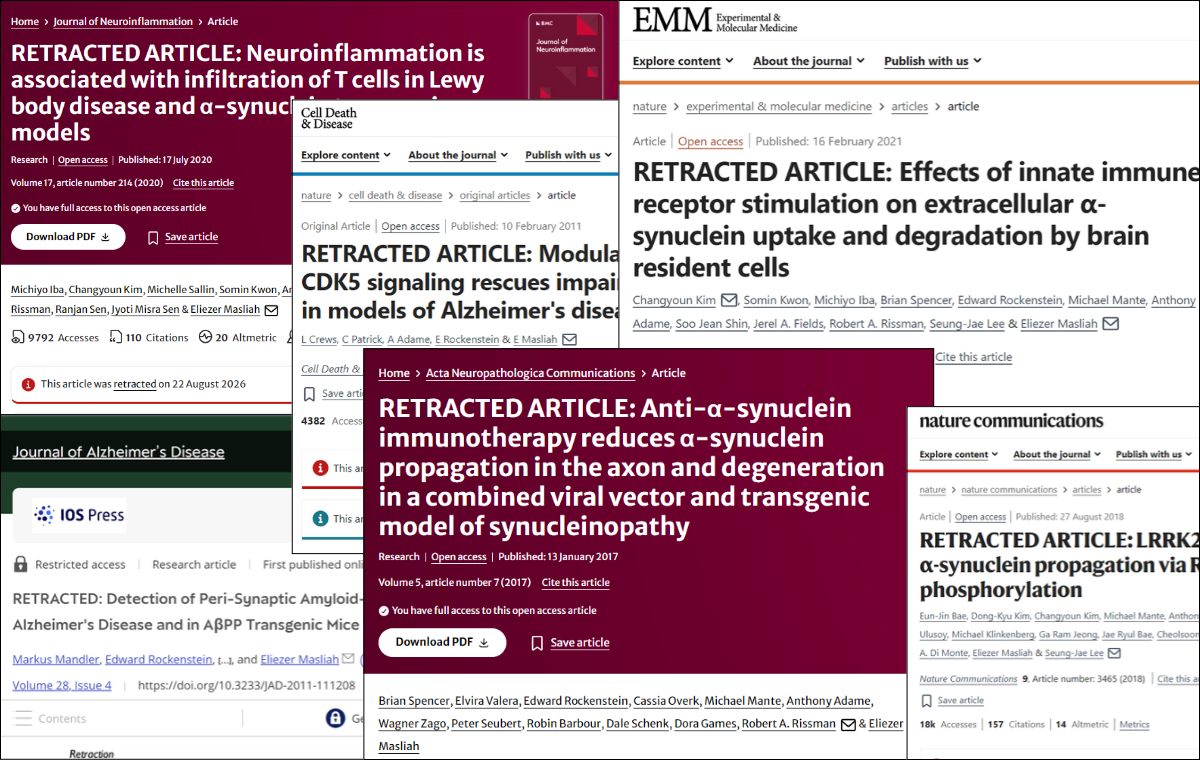
Investigations into the work of a former top neuroscientist at the National Institutes of Health have left the researcher, Eliezer Masliah, with 32 retractions to date. Fifteen of them came this year, as journals continue examining his work following allegations — and findings — of scientific misconduct.
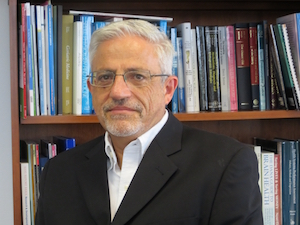
Masliah was the director of neuroscience at the National Institute on Aging from 2016 until 2024, where he led the division overseeing a research portfolio worth nearly $2.6 billion a year. Before joining NIA, he was a professor at the University of California, San Diego. He is a coauthor on more than 800 papers, with much of his career focused on alpha-synuclein, a protein that plays a key role in Parkinson’s disease. His work has been cited by researchers over 147,000 times, according to Clarivate’s Web of Science, and includes work on the development of experimental immunotherapies and animal models to study neurodegenerative diseases and test potential treatments.
Masliah’s work was the focus of a 2024 article in Science by investigative journalist Charles Piller, who, with a team of sleuths, uncovered signs of data and image manipulation in over 130 of Masliah’s papers across the breadth of his career.
Nearly three dozen of those articles have now been retracted, including works published from 2008 to 2022. Among the recent retractions was a 2018 paper in Nature Communications. According to the Oct. 5 retraction notice, several figures in the article were questioned over apparent image irregularities. Seung-Jae Lee, a professor at Seoul National University, and the paper’s corresponding author, told Retraction Watch that Springer Nature first contacted him in 2024 over concerns raised on PubPeer. The authors provided the journal with what original images and raw data they had.
“Upon our request for the raw images, Dr. Masliah explained that some could not be retrieved because the research had been conducted many years earlier and the facility had since closed. The group provided the original images for the figures requiring correction, and these materials remain available,” Lee said in an email.
Lee said Masliah had provided the representative images and graphs from the mouse studies, while his own team had conducted the remaining experiments including biochemistry, cell biology and C. elegans work. “I take responsibility for the integrity of the work from my laboratory and regret the errors in the published figures. I regret that the journal decided to retract the paper, even though I do not believe the errors undermine its central claim.” he said.
Another paper, published in Cell Death & Disease in 2011, was retracted on Nov. 6 for similar concerns. Two authors, including Masliah, disagreed with the retraction, while others did not respond to the publisher. The retraction notice cited apparent inconsistencies and possible image duplication.
Masliah declined our request for comment on concerns raised about his research and the subsequent retractions.
Sleuths found dozens of papers with similar signs of image manipulation, said Matthew Schrag, a neuroscientist at Vanderbilt University in Nashville, Tenn., and one of the four sleuths who compiled the dossier of possible issues in over 100 of Masliah’s papers. “We saw a lot of manipulation of those images, reused in different contexts, changing the intensity of channels, changing the features within an image,” Schrag said. “There’s a surprising amount of internal editing of images across his work. We saw some things we hadn’t seen before.”
Masliah had been the subject of an investigation by the NIH in 2023, prompted by allegations made to the U.S. Office of Research Integrity the previous year. NIH’s announcement of its findings appears to have been prompted by Piller’s inquiries while reporting his own investigation.
Piller began looking into concerns of research misconduct in Alzheimer’s research in 2023, looking to PubPeer to “determine which authors were most cited with concerns of image integrity.” He focused on researchers with at least five articles in question, when he noticed Masliah’s papers had been flagged multiple times on the website.
“In many ways, he became the most vivid, elaborate and concerning example of such manipulations,” Piller told Retraction Watch. Due to the prestigious positions Masliah then occupied, Piller enlisted the help of the four experts: Schrag; Mu Yang, a neurobiologist at Columbia University; Kevin Patrick, an independent forensic image analyst; and the microbiology and research integrity expert Elizabeth Bik. Together the group amassed a 300-page dossier that detailed suspect images in 132 papers.
They found consistent irregularities throughout his work, including very early studies, from the late 1990s. “I think there was quite a substantial diversity in his portfolio,” Schrag said, referring to the types of irregularities. For example, they found multiple instances of spliced plots of western blots, with duplicated lanes. Blots reappeared in multiple places, being identified as different experiments, sometimes separated by quite a substantial period of time across papers.
“Not just mild irregularities, but things that were really quite objectively problematic. And we saw a lot of the manipulation of histological images,” Schrag said.
Some of Masliah’s work was later cited in studies examining potential treatments for neurodegenerative diseases, including Cerebrolysin, a mixture of peptides derived from pig brain tissue that is used in some countries to treat neurological conditions. The drug is not approved by the FDA.
“Masliah had important relationships with different illustrious scientists,” Piller said, referring to Masliah’s relationship with collaborator Dale Schenk, a neuroscientist and pharmaceutical executive who helped pioneer immunotherapy approaches to neurodegenerative diseases. The two coauthored several studies on alpha-synuclein, including research into whether antibodies targeting the protein could slow or prevent disease progression. Schenk later cofounded Prothena, a biotechnology company developing the Parkinson’s drug candidate prasinezumab with Roche.
NIH’s investigation identified two counts of research misconduct, finding “falsification and/or fabrication involving re-use and relabel of figure panels representing different experimental results in two publications,” according to the 2024 statement. Masliah was no longer at NIA as of the date of the statement.
NIH did not respond to Retraction Watch’s request for comment for this story.
Piller and the sleuths shared their dossier with NIH before it announced its findings. But the agency did not comment on the dossier or say whether they would look into the allegations of image manipulation. “It was obvious that they were overwhelmed by the magnitude of problems uncovered by our investigation,” Piller said.
Masliah took action on the team’s reports, Schrag said, “and has issued a large number of corrections, some of which themselves introduced more problems.”
Piller anticipates retractions of Masliah’s work will continue. “We will see more of it as time goes by because the number of papers is so huge.”
Like Retraction Watch? You can make a tax-deductible contribution to support our work, follow us on X or Bluesky, like us on Facebook, follow us on LinkedIn, add us to your RSS reader, or subscribe to our daily digest. If you find a retraction that’s not in our database, you can let us know here. For comments or feedback, email us at [email protected].