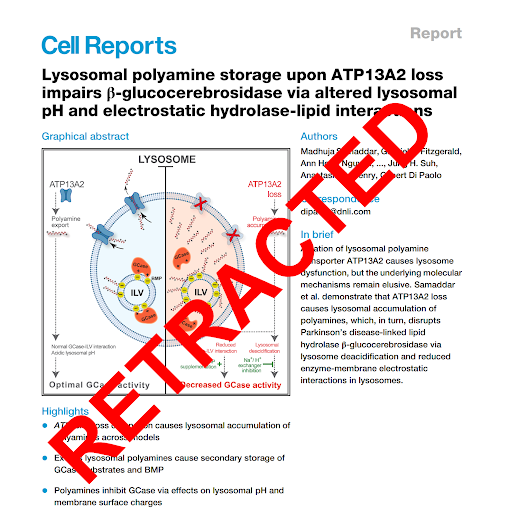
A Cell Press journal has retracted a paper on Parkinson’s disease following the discovery that the first author manipulated data in the work.
The retraction notice in Cell Reports states one of the coauthors found the first author, Madhuja Samaddar, changed data points to reduce variability and improve statistical significance in ways that affect some of the figures and conclusions.
The authors, all scientists at Denali Therapeutics in South San Francisco at the time of publication, studied how a buildup of molecules called polyamines interferes with an enzyme that breaks down fat, specifically in cell and mouse models of neurologic diseases like Parkinson’s.
The study, published in 2025, also focused on a link between lysosomal dysfunction — which occurs when the body lacks enzymes needed to break down some fats and sugars in cells — to neurodegeneration.
Samaddar was a scientist at Denali for almost five years. This paper is the only one on which she was lead author during her time there. None of the authors responded to requests for comment.
A Denali spokesperson called the issue “isolated” and said the research was “not used to support the development of any of Denali’s therapeutic programs.”
“Research findings are subject to regular review, even after publication, as part of our systematic data oversight and verification protocols,” the Denali spokesperson said in an email to Retraction Watch.
A spokesperson for Elsevier, which owns Cell Press, declined to answer questions from Retraction Watch, pointing to the retraction notice and the publisher’s correction policies.
The retraction notice states the manipulated data affects the authors’ findings in “cells in vitro but do not affect the major conclusions of the in vivo data.”
“You often see some data… that’s too good to be true,” said Marja Jäättelä at the Danish Cancer Society in Copenhagen, who works with lysosomes but had no part in the study. “I suppose there are persons under pressure to produce something.”
Beyond the data manipulation, the paper didn’t stand out to her, Jäättelä said. What the authors had potentially added to the literature, before the paper was ultimately retracted, were mechanistic explanations of why a defect in the polyamines might cause lysosomal dysfunction.
Jäättelä called the data points “very even,” which might have stood out to a reviewer.
“In biology, you always have variation,” she said. “With a little data modification, it might look better. … But we have very strict rules when you can exclude a data set. You can’t exclude a data set because it doesn’t fit your hypothesis.”
Marc Tessier-Lavigne, the former president of Stanford University who stepped down following an investigation that found misconduct by some researchers in his labs, is a cofounder of Denali. Tessier-Lavigne was on the board of directors at Denali when Samaddar worked there but did not conduct or oversee research at the company.
Prior to working at Denali, Samaddar was a scientist at Calico Life Sciences, a Google-backed company focused on anti-aging. She has no other retractions in the Retraction Watch database.
The Cell Reports paper is not the first of her papers to face scrutiny. Before working in South San Francisco, Samaddar trained in Patrick D’Silva’s lab at the Indian Institute of Science. The pair published a study in 2014 that was flagged for potential image manipulation on PubPeer.
D’Silva acknowledged a “minor error” in a response on PubPeer, but said it had “zero impact on our results and their interpretation.”
Another study coauthored by D’Silva and Samaddar, published in 2015, was also flagged on PubPeer for alleged image duplication.
D’Silva has not replied to requests for comment from Retraction Watch.
Like Retraction Watch? You can make a tax-deductible contribution to support our work, follow us on X or Bluesky, like us on Facebook, follow us on LinkedIn, add us to your RSS reader, or subscribe to our daily digest. If you find a retraction that’s not in our database, you can let us know here. For comments or feedback, email us at [email protected].