The top publishing executive at the American Diabetes Association has resigned over how the organization has handled an editorial boycott at one of its journals following a protest at its annual meeting earlier this year.
Christian Kohler, vice president for professional publications, submitted his resignation on Nov. 6, “after considerable reflection and with profound disappointment in ADA’s handling of the events of June 5 in New Orleans, its subsequent responses to and justifications for those events, and its continued failure to articulate a credible path toward resolving the resulting crisis of confidence within the diabetes research community.”
Kohler has been with ADA for more than 20 years, according to his LinkedIn profile, and in his current role since 2022.

“My hope is that openly sharing my resignation letter and why I made this decision, particularly from the perspective of a long-time ADA employee, helps get an honest conversation moving forward, brings ADA and the diabetes professional community closer to resolving the boycott, and results in meaningful reforms at ADA,” Kohler said in a statement to Retraction Watch. “There’s too much at stake, and ADA staff are eager to get back to doing what they do best: supporting people with diabetes, their caregivers, and the diabetes professionals they rely on.”
“We thank Chris for his years of service,” an ADA spokesperson said in a statement to Retraction Watch late Saturday. “It is unfortunate that the boycott targets a resource that provides critical value and support to healthcare professionals.”
The turmoil began at the ADA’s Scientific Sessions conference in June in New Orleans, where National Institutes of Health director Jay Bhattacharya was scheduled to speak. Five attendees were ejected from the meeting for distributing copies of a Diabetes Care editorial on the impact of NIH funding cuts outside the hall where the NIH director’s talk was to take place.
ADA released a summary of an independent review of the incident on Sept. 1, which concluded the five attendees were removed because their actions violated the conference’s code of conduct, not because of the nature of the material they were distributing. (ADA released the full report on Oct. 23.)
In response, several members announced a boycott of ADA activities including presentations, grant reviews, manuscript reviews, journal management and manuscript submissions.
“In line with the contents of the call for action, until the impasse is resolved or the editors are replaced, [the editorial leadership of Diabetes Care] will not be performing their duties, and therefore the journal will no longer be accepting new submissions,” Steven Kahn, editor-in-chief of Diabetes Care and professor of medicine at the University of Washington — and one of the five kicked out of the New Orleans meeting — wrote on LinkedIn in September.
The journal’s editors placed a notice on the submission page for Diabetes Care notifying authors and reviewers “the editorial leadership of Diabetes Care has suspended its editorial review of new manuscripts submitted to the journal from September 10, 2026.” But the notice was later removed without the editors’ knowledge.
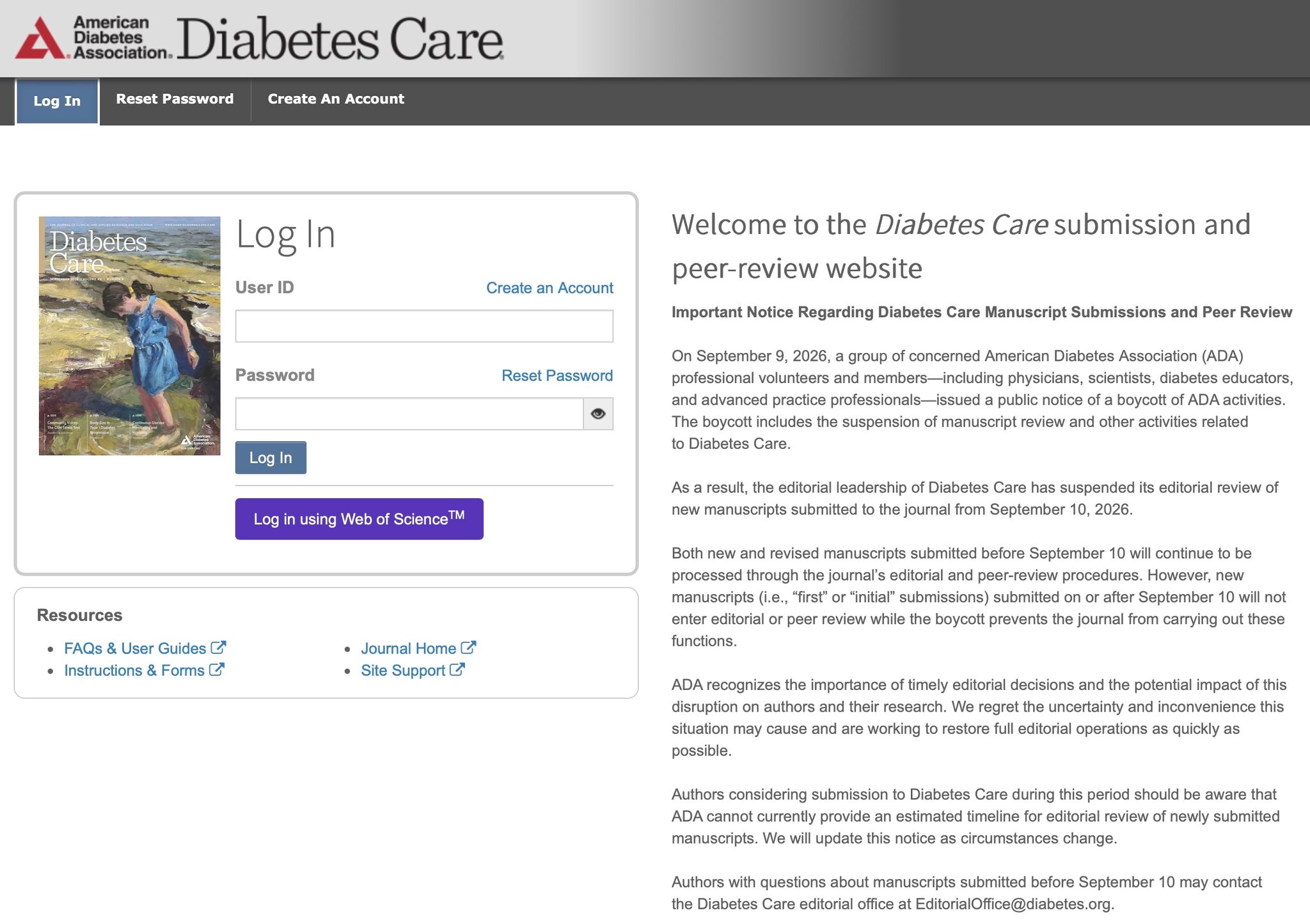
Kahn told us about 400 manuscripts have been submitted since the boycott began that haven’t been handled.
According to Kohler’s resignation letter, his “immediate decision to resign” stemmed from “ADA leadership’s determination to appoint an interim editorial team for Diabetes Care, despite my repeated and strongly expressed objections.”
He was concerned, he said, about appointing people “to perform essential editorial functions without an established Editor-in-Chief who assumes ultimate responsibility and accountability for the journal’s editorial governance and decision-making.” He also had concerns about a lack of formal process for vetting the interim editors’ “suitability for handling the breadth and complexity of research submitted to Diabetes Care.”
“Throughout my nearly three decades in scientific and medical publishing, I have worked to uphold the principles of editorial independence, scientific integrity, transparency, and accountability. Based on that experience, I believe the proposed interim editorial arrangement presents serious ethical, operational, and reputational risks,” Kohler wrote.
The ADA spokesperson told us Kohler’s letter “does not accurately reflect the caliber or qualifications of the individuals involved. The interim editorial board for Diabetes Care is comprised of highly experienced and respected healthcare professionals who have dedicated their careers to caring for people living with diabetes.”
Kohler’s resignation has “shown this industry what you do when you really care about what you’re doing from a publications perspective,” Kahn told us. “Him resigning shows you what sort of ethical approach he has to life.”
Following the independent review of the New Orleans incident and fallout from it, “the ADA has outlined the next steps that we plan to take to learn and improve based on the facts that came to bear from the review,” the spokesperson told us. They did not immediately respond to questions on what those next steps are.
In 2017, Retraction Watch cofounders Adam Marcus and Ivan Oransky gave ADA the inaugural Doing the Right Thing Award for defending their right to issue expressions of concern on problematic papers when one of the authors sued them. In July of this year, the organization “now finds itself mired in a self-made mess,” Marcus and Oransky wrote in STAT. “If the ADA is willing to muzzle its members for fear of costing the field government funding, how far is it willing to go? And what might it do to get more money?”
As for the boycott and the fallout from it, Kohler was out of options, he said in his letter. “I have exhausted every avenue available to me to help resolve the editorial boycott while protecting the journal’s integrity, but I cannot, in good conscience, endorse or assume responsibility for an approach that I believe will compound the very problems it is intended to solve,” Kohler wrote. “ADA staff should not continually be placed in the position of having to protect the credibility and integrity of the Association’s peer-reviewed publications from decisions made by the Association’s own leadership. Yet, that is increasingly the position in which we find ourselves.”
Like Retraction Watch? You can make a tax-deductible contribution to support our work, follow us on X or Bluesky, like us on Facebook, follow us on LinkedIn, add us to your RSS reader, or subscribe to our daily digest. If you find a retraction that’s not in our database, you can let us know here. For comments or feedback, email us at [email protected].