Tensions between the American Diabetes Association and several editors of its flagship journal — who have boycotted the group over its handling of a protest at the association’s June conference — have again boiled over, this time on the website of the journal.
Steven Kahn, editor-in-chief of Diabetes Care and professor of medicine at the University of Washington, was one of five researchers ejected from the association’s June meeting in New Orleans for distributing copies of a Diabetes Care editorial on funding cuts outside the hall where National Institutes of Health director Jay Bhattacharya was scheduled to speak.
On Sept. 1, ADA announced the results of an independent review, which concluded the five attendees were removed because their actions violated the conference’s code of conduct, not because of the nature of the material they were distributing.
“The investigation has been a sham, and the report is in line with that; i.e., it tries to exonerate those in charge of the ADA,” Kahn wrote in a Sept. 10 post on LinkedIn, with a link to a letter to ADA’s board of directors announcing a boycott of ADA activities.
The boycott includes all ADA activities, including planning or attending any of its scientific meetings as well as “other ADA activities, presentations, fund raisers, grant reviews, manuscript reviews, journal management, manuscript submissions, or position statements,” the letter reads. “This boycott will remain in place until the ADA Board of Directors allows a formal review of the overall structure and function of the ADA led by an independent academic leader and focused on having the ADA properly represent its professional membership.”
“The editorial leadership of Diabetes Care, the ADA’s flagship journal devoted to clinical diabetes research, has signed the letter,” Kahn wrote. “In line with the contents of the call for action, until the impasse is resolved or the editors are replaced, they will not be performing their duties, and therefore the journal will no longer be accepting new submissions.”
The journal’s editors placed a notice on the submission page for Diabetes Care notifying authors and reviewers “the editorial leadership of Diabetes Care has suspended its editorial review of new manuscripts submitted to the journal from September 10, 2026.”
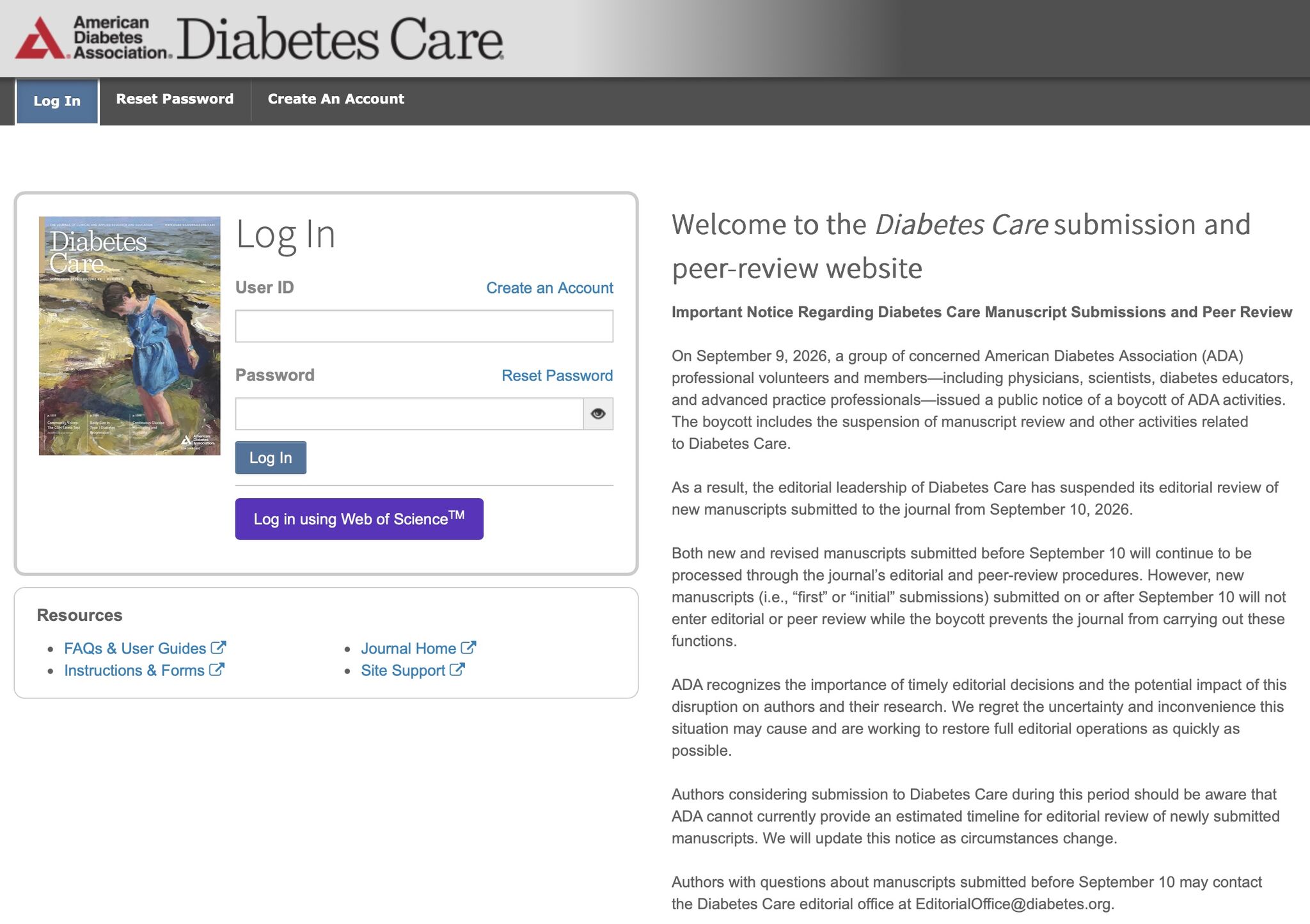
“We regret the uncertainty and inconvenience this situation may cause and are working to restore full editorial operations as quickly as possible,” it continued.
Kahn wrote in a comment that someone from ADA called a journal staff member late on Sept. 10 asking that the message be removed.
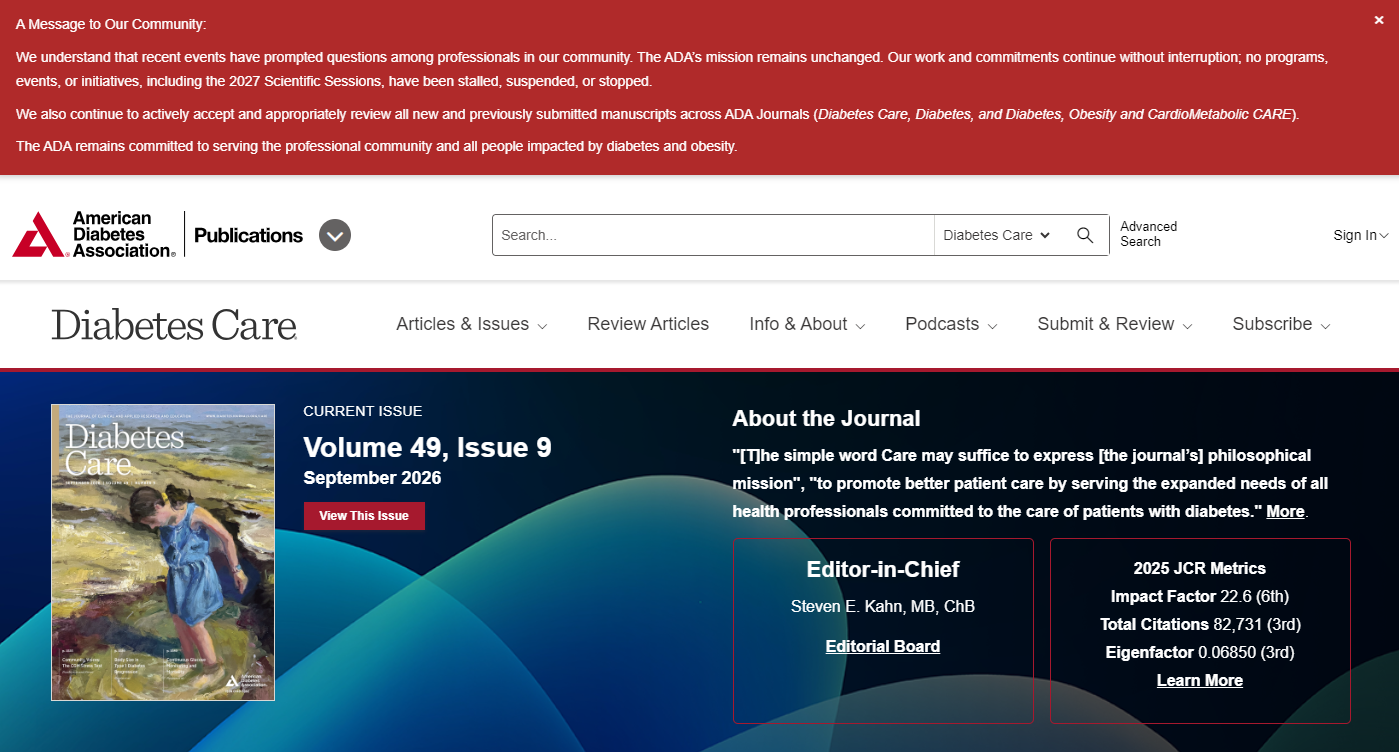
At some point that message was removed, and over the weekend a banner message appeared on the ADA website for professionals as well as all of its journals:
A Message to Our Community:
We understand that recent events have prompted questions among professionals in our community. The ADA’s mission remains unchanged. Our work and commitments continue without interruption; no programs, events, or initiatives, including the 2027 Scientific Sessions, have been stalled, suspended, or stopped.
We also continue to actively accept and appropriately review all new and previously submitted manuscripts across ADA Journals (Diabetes Care, Diabetes, and Diabetes, Obesity, and CardioMetabolic CARE).
The ADA remains committed to serving the professional community and all people impacted by diabetes and obesity.
The editors had agreed in advance to the statement about the boycott on the journal website but weren’t involved in the banner message, said Michael Haller, a pediatric endocrinologist at the University of Florida and an associate editor of Diabetes Care. “How exactly does the ADA think any meaningful editorial work is going to happen when the entire editorial board is boycotting?” Haller wrote on LinkedIn.
Haller told Retraction Watch he and others support what ADA is supposed to represent. “We do not want to see the ADA dismantled but rather we need it to be reimagined to reflect the goals and interests of its members and the people with diabetes who it is supposed to represent,” Haller said. “Our efforts are aimed at rescuing the organization from failing leadership. We hope this boycott is short term and hope it forces the board to meet our demands of a truly independent review of what happened in New Orleans as well as the organization’s overall leadership structure.”
The ADA did not respond to a request for comment.
In 2017, our cofounders bestowed ADA with the inaugural Doing the Right Thing Award for defending their right to issue expressions of concern on problematic papers when one of the authors sued them. In July of this year, the organization “now finds itself mired in a self-made mess,” our Adam Marcus and Ivan Oransky wrote in STAT. “If the ADA is willing to muzzle its members for fear of costing the field government funding, how far is it willing to go? And what might it do to get more money?”
Like Retraction Watch? You can make a tax-deductible contribution to support our work, follow us on X or Bluesky, like us on Facebook, follow us on LinkedIn, add us to your RSS reader, or subscribe to our daily digest. If you find a retraction that’s not in our database, you can let us know here. For comments or feedback, email us at [email protected].
I quite frankly do not believe the ADA.
I think we see a lot of major institutions and pillars of our society, like science and our government, tired of this constant capitulation to business/government interests. Many of these institutions no longer belong to the public and are only supportive as far as it benefits them.