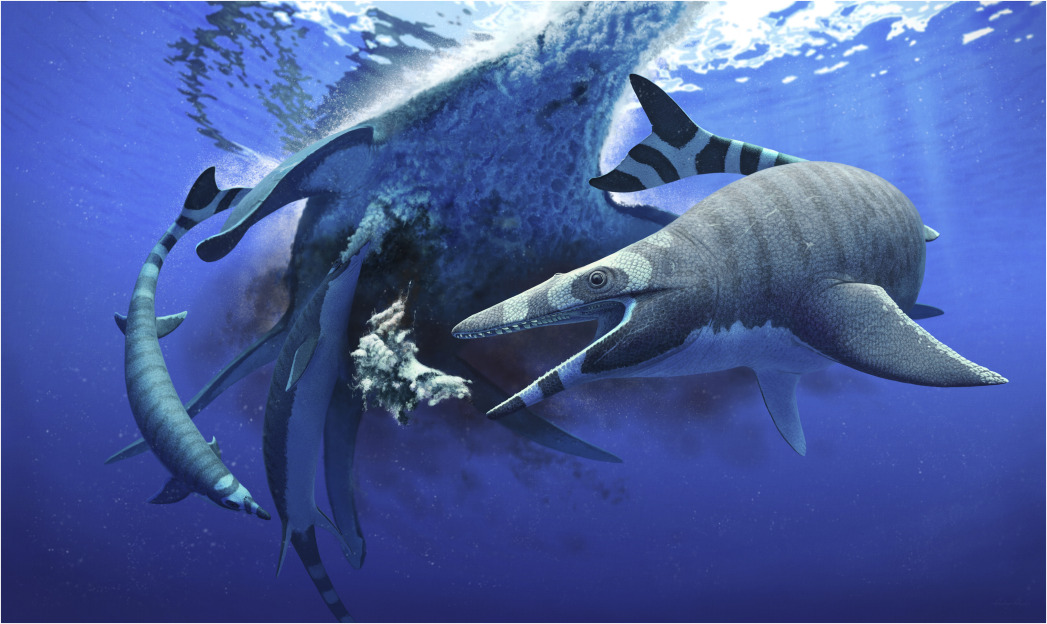
by Andrey Atuchin, 2020, in: N.R. Longrich et al/Cretaceous Research 2021
Nicholas Longrich would like to set the record straight.
The paleontologist at the University of Bath in England and his colleagues described what they believed to be a new species of marine reptile in 2021, based on a Moroccan fossil found in a mine. But in 2024, another group of researchers questioned the fossil’s authenticity, pointing out the arrangement and orientation of its teeth “most likely result from forgery” based on published photos and documented alteration in other specimens from that region.
Late last year, Longrich and colleagues published CT scans of the original fossil as well as a new specimen of the species, saying it demonstrated their discovery was genuine. Longrich told us he sent the raw CT data confirming the sample “is authentic” to The Anatomical Record, which had published the critique, seeking an expression of concern or retraction of that paper.
“And then they refused,” he said. The Anatomical Record, its publisher and the authors of the paper maintain a retraction was not warranted.
“Being concerned about a forgery is a legitimate concern in paleontology,” said Michael Caldwell, a professor at University of Alberta and coauthor of the 2024 paper. Longrich and his coauthors addressed “that perfectly legitimate concern by doing what they should have done in their original study,” he said: “They published CT scans in the second paper to indicate that the type specimen was not forged by the fossil seller.”
But producing the scans “does not mean that our concerns that the specimen might have been forged were wrong or unethical, and that they merit a retraction of our paper,” Caldwell said.
In an emailed statement, Heather Smith, the editor of The Anatomical Record, told us “changes in knowledge don’t conflict with the integrity of the scientific record. In fact, disproving earlier work is a fundamental part of the scientific method. It’s not the same thing as the earlier work being flawed or in major error. It wouldn’t make sense for the publication industry to go back into the record to publish corrections or retractions every time new evidence comes to light.”
Xenodens calminechari was a small mosasaur with an unusual row of saw-like teeth that lived 66 million years ago. When Longrich and his colleagues first described it in 2021 in Cretaceous Research, the discovery drew a lot of attention, as the specimen had a unique set of teeth that had never been seen before in tetrapods. The paper has been cited 25 times, according to Clarivate’s Web of Science.
Longrich has named more than a dozen species of dinosaur and mosasaur in recent years. He has also faced scrutiny over his conduct; in 2018, the Leverhulme Trust revoked a £1 million (about $1.3 million USD) grant awarded to him, following an investigation that found he had breached the anti-harassment policy at the University of Bath.
Shortly after the Xenodens paper was published, a group led by Henry Sharpe, now at Harvard University, became concerned about modifications to the specimen, a partial jaw piece bearing just four tooth crowns, due to the unique placement of teeth and inconsistencies in the nomenclature used to describe the species. They took a close look at the specimen photos in the original paper, as well as at photos of another mosasaur fossil known to have been altered that was purchased from the same area in Morocco.
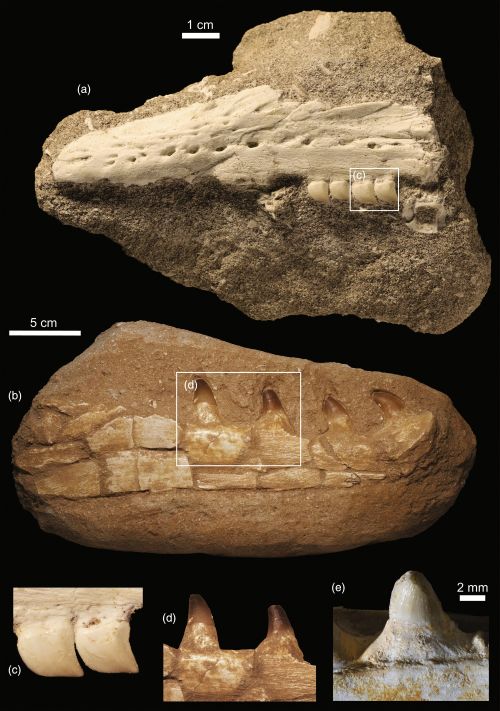
H.S. Sharpe et al/The Anatomical Record 2024
Such specimens “don’t come from a place where the fossils coming out are scientifically collected, consolidated and prepared,” Sharpe added. “They’re excavated by miners,” and such fossils are then sold to scientists, museums and collectors, and so should be carefully examined.
Questions about the authenticity of commercially sourced fossils are not new to the field of paleontology. Researchers in the past have documented fossils that were artificially enhanced or assembled from genuine but unrelated pieces. To combat this issue, techniques such as X-rays, CT scans and chemical analysis have become the standard to identify alterations.
“The main problem is when it comes from commercial sources, mainly from Morocco, which is a big producer of these items, is that the fossil is not fake in a sense that it is a true fossil,” said Octávio Mateus, a paleontologist who has written about determining the authenticity of fossils. “The problem is that they are assembled in a fake way.”
“The handicraft is excellent for a non-expert, and even for some experts, it’s sometimes hard to tell. Basic forgeries are easy to detect but the exquisitely well done ones, those are more challenging,” he continued. “So if you are publishing something from the commercial sources in Morocco, as in a scientific paper for a new species, in that particular case, I would say you should verify it and double verify all the time.”
Longrich acknowledged issues with fossils coming from Morocco, with the specimen in question being collected from the Sidi Chennane phosphate mine. But Longrich maintains that the CT scans prove the authenticity of the fossils.
Sharpe, Caldwell and Mark Powers, of the University of Alberta, wrote up their concerns and submitted a paper to The Anatomical Record. In the peer review process, reviewers pointed out the paper lacked evidence the authors had examined the specimen. Sharpe reached out to Longrich seeking access. In response, Longrich asked, “Can I ask what your interest in the specimen is, i.e. are you writing a paper and if so what’s your angle?” according to emails reviewed by Retraction Watch.
Sharpe told us they “viewed his request as unethical.” Caldwell separately reached out to Nour-Eddine Jalil, a coauthor on the original paper, for access to the fossil, and was denied.
“We were contacted about the specimen,” Longrich acknowledged. “And I got this email about it and they were talking about tooth implantation, but they were asking about where this specimen came from. And well, this is kind of odd.”
In the December 2024 paper, the team questioned whether teeth in the Xenodens specimen were native to the jaw, citing CT scans of another Moroccan mosasaur fossil from the same region that showed artificially implanted teeth, using a “gummy” substance to glue the teeth in place. They called for CT scans of the original reference fossil, or holotype, to resolve the question. “The holotype material of X. calminechari is likely a forgery,” they wrote.
The paper drew its own media coverage, with headlines like “Fossil claimed to be new species of mosasaur is suspected forgery.”
Longrich told us he didn’t know their paper was being published, and when it was, his university email wasn’t working due to “administrative dysfunction,” so he “didn’t see the emails and didn’t get to respond to it,” he said. “And it’s not that I wouldn’t have said anything.”
“I used to believe that you let the evidence speak for itself. And the thing is, evidence can’t speak. So somebody’s got to speak for the evidence,” Longrich said.
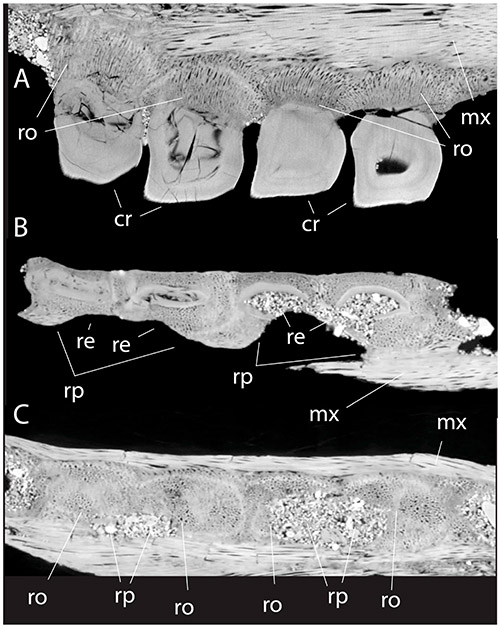
N.R. Longrich et al/Diversity 2025
Longrich and his colleagues published CT scans of the holotype and a second additional Xenodens specimen in Diversity in 2025, saying the scans confirmed the teeth were original to the jaw and the material Sharpe et al. had identified as a possible adhesive was fossilized tissue covered in Paraloid B-72, a standard conservation material.
Longrich reached out to Smith, editor-in-chief of The Anatomical Record, to ask for a retraction or an expression of concern on the 2024 paper. The journal denied both options. “A thorough investigation of the available evidence indicates that the peer review process for the Sharpe et al. Xenodens paper was fair and objective, the analyses conducted on the comparative specimen were sound, and that no official action is warranted on the part of the journal,” according to emails seen by Retraction Watch.
Sharpe and his coauthors stand by their work. “I think our paper speaks plainly to itself, and the fact that Anatomical Record and Wiley have both looked at it speaks to the fact that our paper is sound,” Sharpe said. “Why get rid of the paper criticizing you if you were right in proving the criticism wrong?”
Acknowledging that the CT scans proved the fossil was authentic, Caldwell said, “but proving it was not a forgery is not science. It is merely a factual proof of object integrity.”
Smith told Longrich he was welcome to submit a response or follow-up study with new data to the journal, “but he did not take me up on the offer,” she said.
About the process of debate and rebuttals, Caldwell told us, “I genuinely do, at the level of philosophy, think that these sorts of conversations in the literature are critical. If you aren’t testing other people’s ideas and their approach to data, then you’re not actually performing philosophically and methodologically, what I think, science is all about.”
Like Retraction Watch? You can make a tax-deductible contribution to support our work, follow us on X or Bluesky, like us on Facebook, follow us on LinkedIn, add us to your RSS reader, or subscribe to our daily digest. If you find a retraction that’s not in our database, you can let us know here. For comments or feedback, email us at [email protected].
Obligatory historical reference: https://en.wikipedia.org/wiki/Piltdown_Man
(In fact, mentioned as such in at least one of the linked articles – but it’s worth a brief notice here).