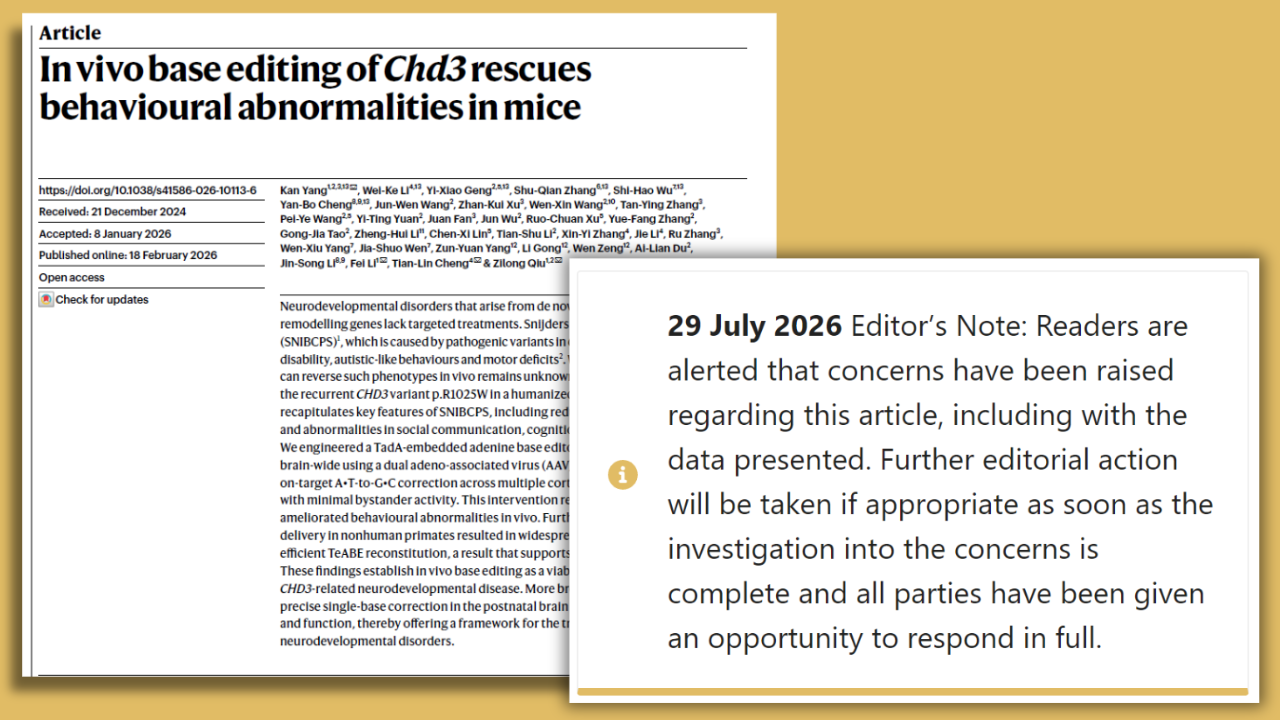
Nature is investigating concerns surrounding a paper at the heart of a news story published last week on the death of a 6-year-old girl following a gene therapy treatment in China.
The paper, published in February by a team led by neuroscientist Zilong Qiu of Shanghai Jiao Tong University School of Medicine in China, described preclinical work for a gene-editing treatment for Snijders Blok-Campeau syndrome, a neurodevelopmental disorder.
As we reported in collaboration with Science, the work was funded in part by the family of a 6-year-old girl with the condition. The family had approached Qiu based on work he had done with gene therapy for Rett syndrome, a disorder that also causes developmental delay. The parents ended up paying $860,000 to fund preclinical work for a gene-editing treatment for their daughter, who died of a severe immune reaction to the therapy seven days after receiving it.
The paper did not disclose the girl’s death or the family’s financial contribution, even though a preprint of the work did “thank the families with SNIBCPS patients for their participation and support in this study.”
In addition, several experts interviewed for the article questioned some of the study’s efficacy data.
Victoria Aranda, deputy editor of Nature, said no information about a planned trial in people was ever shared with the journal or mentioned in the submitted study. “The manuscript that was submitted to us … described preclinical feasibility work only — a mouse model and non-human primate experiments,” she told Retraction Watch by email. “We are now investigating concerns that have been raised around this manuscript and an Editors’ Note has been placed on the paper to reflect this.”
The editor’s note, dated July 29, states:
Readers are alerted that concerns have been raised regarding this article, including with the data presented. Further editorial action will be taken if appropriate as soon as the investigation into the concerns is complete and all parties have been given an opportunity to respond in full.
Qiu’s university has also launched an investigation, Science reported earlier this week. Shanghai Jiao Tong University School of Medicine said in a statement it would establish “a special task force to conduct a comprehensive investigation into the incident.”
Neither the university nor Xinhua Hospital, where the young girl was treated, responded to requests for comment prior to the publication of the story in Science.
The story has attracted international coverage by news outlets including the New York Post, Bloomberg, Times Higher Education, Southern Weekly and the South China Morning Post.
Like Retraction Watch? You can make a tax-deductible contribution to support our work, follow us on X or Bluesky, like us on Facebook, follow us on LinkedIn, add us to your RSS reader, or subscribe to our daily digest. If you find a retraction that’s not in our database, you can let us know here. For comments or feedback, email us at [email protected].
Chinese and the world should stop behaving like cannibals in the name of scientific progress. Learn to come clean. People will naturally respect you more. Ethical culture defines whether a society is civilized or not, not how advanced you are materially. Advancement in technology and engineering do not imply scientific advancement. For example, chimps are technologically more advanced than macaques, but this does not imply chimps are civilized or less aggressive. True scientific progress (as opposed to technological advancement) means the need to understand the true nature things, and act accordingly, by upholding humanity at all cost. Think about it.
There’s nothing specifically Chinese about this. A doctor in the United States, Stanislaw Burzynski, has been using the excuse of “clinical trials” to get patients and their families to pay for unproven cancer treatments since the 1970s.
Qiu at least submitted a paper for publication.
Thank you.
It was a combination of multiple factors that led to this tragedy: (1) researchers eager to achieve a world first, (2) parents desperate for hope, (3) inadequate independent oversight, and (4) poor transparency. Scientists often want to make breakthroughs, and patients often want cures, both are natural and necessary drivers of medical progress. Perhaps the question this case leaves us with is: How do we balance scientific ambition with scientific responsibility?
The answer is straightforward, and the answer exists even before this question is asked. The researchers knew the answer, which was why they did not report everything that should have been reported. And now, they refused to respond because they know the answer for that question.