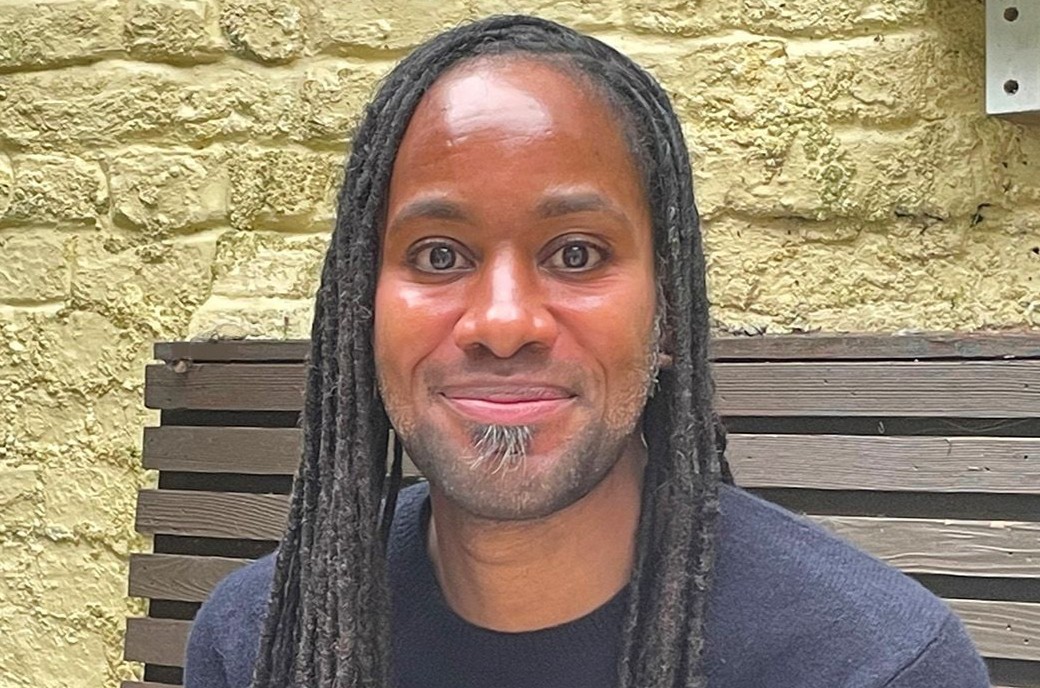
Jason Arday
In September 2025, Times Higher Education had a bombshell story in the works: A star sociology professor at the University of Cambridge had allegedly plagiarized parts of his Ph.D. thesis and several journal articles. In one of the articles, the borrowed text appeared in quotes from subjects the professor, Jason Arday, claimed to have interviewed himself.
But after Arday enlisted Carter-Ruck, one of the United Kingdom’s leading defamation law firms, to send Times Higher Education a letter, the publication spiked the story, according to three sources who spoke to Retraction Watch.
One of the sources was David Sanders, a biochemist at Purdue University in Indiana, and a sleuth who contributes to the Times Higher Education on topics related to academic misconduct. He reviewed a 63-page dossier of text comparisons prepared by the publication last year and came back with his own findings. “There is no question that there is extensive plagiarism,” Sanders told us.
The allegations against Arday finally emerged last week following a Substack post from Nathan Cofnas, a philosopher at the University of Ghent in Belgium. Cofnas, who is known for his controversial writings on racial differences, independently identified dozens of passages in Arday’s 2015 dissertation that were taken nearly verbatim from the 2009 dissertation of Paula Zwozdiak-Myers, a reader at Brunel University of London. Cofnas says he learned about the unpublished Times Higher Education story only after he began working on his own piece about Arday.
Arday is known for his work on topics related to race, inequality and education. His interest was more than scholarly: From humble beginnings as a nonverbal autistic kid in South London, he became, at age 37, the youngest Black person appointed to a professorship at Cambridge.
That achievement was covered by the BBC, CBS News, and Good Morning America. He is listed as a collaborator on more than $10 million in recent grants from two U.K. funding agencies, U.K. Research and Innovation and the National Institute for Health and Care Research.
Arday’s achievements have not been limited to academia. He has said he has raised more than $8 million for charity and performed impressive athletic feats, including running 30 marathons in 35 days. His forthcoming memoir, Great and Unfortunate Things, is slated to be published next month by Simon & Schuster.
Arday did not respond to three requests for comment sent to his Cambridge email address, but during a plenary he gave at the British Sociological Association conference in Edinburgh this April, he spoke vividly about recent attacks on Black academics.
“You get the email and they say you conducted academic misconduct. And you think to yourself, ‘Well this is incredible. I’m on the back foot here. How do I defend myself against this machine?” he said. “The instruments that are designed to protect academic integrity, designed to protect our wellbeing and our intellectual property, are weaponised.”
A spokesperson for Cambridge told Retraction Watch that Arday was a “victim of a vile campaign to undermine his credibility” and that he had been cleared of “allegations of plagiarism regarding his thesis and journal publications.” (See an update at the end of this story.)
Carter-Ruck and Times Higher Education did not respond to emailed requests for comment.
In interviews, Arday has said that his path to academic publishing was a rocky one, in part, because he only learned to read and write at the age of 18. “The peer review process was so cruel, it was almost funny, but I treated it as a learning experience and, perversely, began to enjoy it,” he told the BBC in 2023.
Within months of the media attention around his appointment at Cambridge, questions began surfacing about the caliber of that work. On May 4, 2023, Dave Harris, an emeritus professor at Plymouth Marjon University in England, sent Arday a lengthy email. He explained that he had been posting summaries evaluating articles related to critical race theory on his personal website, and he wanted to clear up a few things about Arday’s own work, including a 2018 study in the journal Social Sciences.
In the study, Arday said he conducted focus groups with 32 Black and minority university students in April 2017 to understand the mental health issues they were facing. Although Arday wrote he obtained “informed consent” for the interviews, the article did not include a statement indicating whether his study was approved by an ethics board, as was required by the journal at the time.
Harris wanted to know if Arday could explain some “puzzling similarities” between sentences in that article and a BMJ Open study from epidemiologist Anjum Memon about mental health services in Black and minority communities. Arday ignored his first email, but when Harris followed up several days later, Arday was blunt. “Instead of spending your time trying to dismantle racism and ableism, you have spent what I assume is hours combing through my work looking for mistakes,” he wrote. Arday told Harris not to contact him again: “Anything further from you will be considered bullying and harassment.”
Harris soon recruited a colleague, Martyn Hammersley, a sociologist at Open University, to review the Social Sciences article himself, and he, too, was concerned. On May 19, 2023, Hammersley sent an email to Hilary Cremin, the Head of the Faculty of Education at Cambridge, and to Rhys Morgan, the university’s Head of Policy, Governance, and Integrity:
There is substantial plagiarism from one source, and some from another. It is also the case that a considerable portion of the article follows the structure of the paper by Memon et al: even where their words are not used exactly, these are paraphrased (though also elaborated). It even looks as if a couple of the quotations from informants may have been derived from Memon et al. Both of these articles are cited by Arday, but the quotes from them are unattributed.
In a response dated June 21, 2023, Cremin wrote that Arday had agreed “to take the article down from the journal online platform in order to address these concerns” but Arday had the department’s “full support.” Morgan, meanwhile, noted that because the alleged plagiarism occurred prior to his arrival at Cambridge, “we do not consider it within our remit to investigate the paper to which you refer.” (Morgan did not respond to our request for comment, and our email to Cremin received an out-of-office response.)
Six months later, in December 2023, Social Sciences published a correction, adding new citations to make it “clear where ideas were adapted from past research.” A second article, published in Educational Philosophy and Theory, was corrected the following year for text overlap with the Memon paper and other publications.
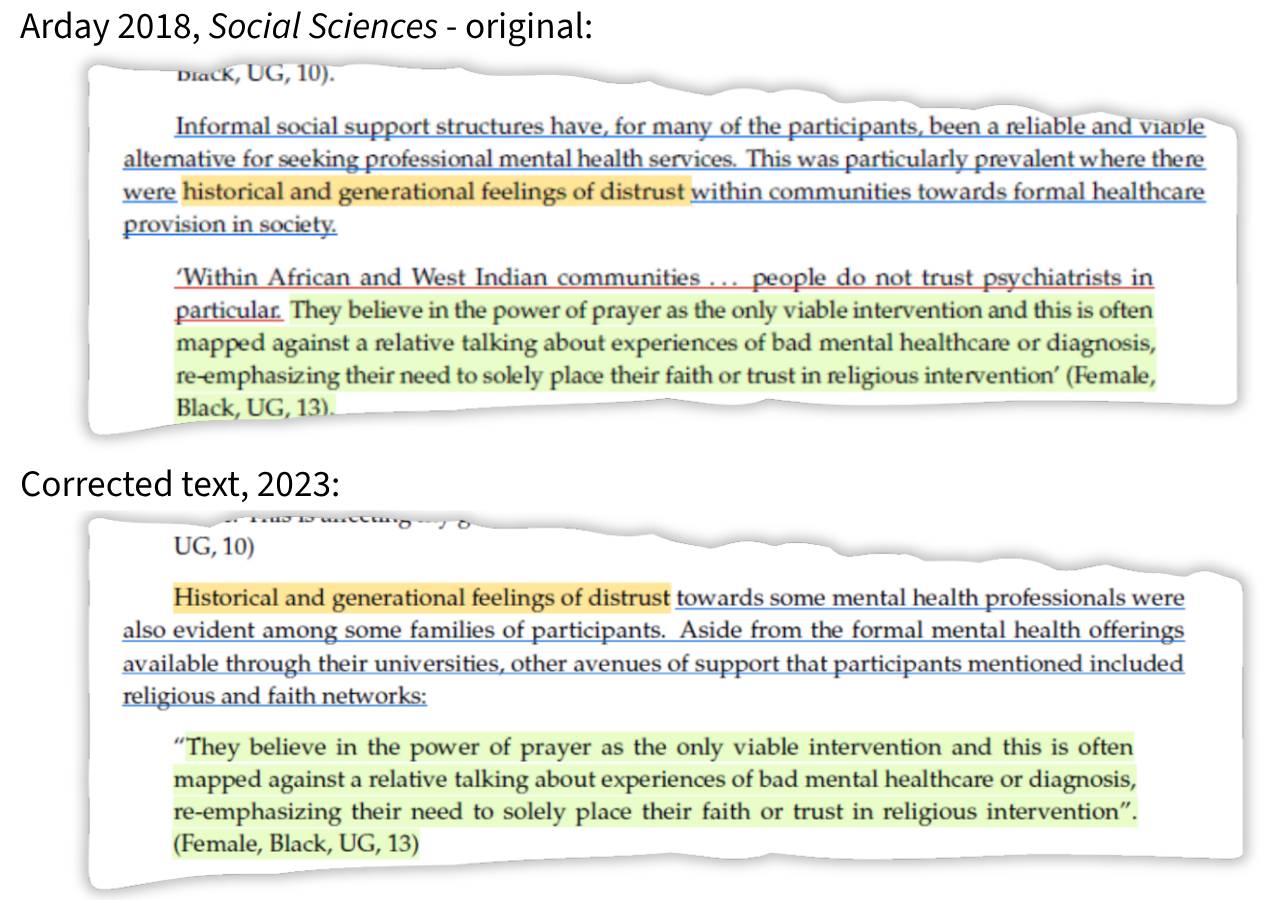
But the Social Sciences correction notice glossed over the most significant post-publication changes Arday actually made to the text. He removed claims that he analyzed the transcripts from interview subjects with “an iterative coding scheme using NVivo qualitative data analysis software” and had a second researcher “independently read the scripts” and code the data to “enhance the validity of emerging themes and claims.” Instead, he said, he recorded the interviews, transcribed them verbatim and identified salient themes through “review and reflection.”
In addition, Arday changed or removed quotes that had previously been attributed to his interview transcripts. Out of 31 quotes in the original manuscript, he trimmed or reworded 12 of them, and cut 6 of them entirely. Some of the original quotes appear to have been patched together from subjects in Memon’s BMJ Open paper.
Arday numbered his participants from 1 to 32, but there were actually two 13s: One of them he described as a Black female undergraduate and the other as a Black male undergraduate. The Black male undergraduate, according to Arday, viewed clinicians as being instruments of oppression:
Let’s face it … with the stroke of a pen you could be sectioned or sent away for some counseling. Or … have administered some ridiculous dose of whatever kind of medicine.
A similar quote about clinicians appears in Memon et al. attributed to Male D in focus group 1:
With the stroke of a pen to decide whether you are going to be sectioned or whether you are going to be sent away for some counselling. Or … administered some really, really high doses of whatever kind of medicine.
The Black female undergraduate in Arday’s study expressed similar distrust toward the healthcare system:
Within African and West Indian communities … people do not trust psychiatrists in particular.
This sentiment, too, appears to come from Male D in Memon et al:
In the West Indian community … people do not trust psychiatrists particularly.
In the corrected version of Arday’s paper, the quote from the female 13 has been trimmed of the overlap, while the quote from the male 13 has been cut entirely. None of this is described clearly in the correction notice.
“Bloody awful work creeps in when standards are relaxed … in ‘special editions,’ often devoted to ‘activist’ issues like racial inequality,” Harris told us.
The unpublished article in Times Higher Education was bylined by Jack Grove, who has written extensively about the challenges faced by minorities in U.K. institutions, according to Harris, Hammersley and Sanders.
After Grove sent Arday a detailed email in September 2025 offering him an opportunity to respond to the allegations, Times Higher Education received a letter from Carter-Ruck, a law firm known for defending clients ranging from the Church of Scientology to the Russian oligarch Boris Berezovsky.
Private Eye, a British satire magazine that once tangled with the firm, refers to them as Carter-Fuck.
In its letter, the firm wrote that the allegations were false and they would damage Arday’s reputation. The publication subsequently killed the story.
At the British Sociologists Association meeting, Arday said that he and his colleagues needed to create “their own playbook to combat” the attacks on Black scholars. “The ultimate tragedy is not the oppression and cruelty by the bad people, but the silence of good people,” he said. “Darkness cannot drive out darkness, only light can do that.”
Cofnas told us he first began looking into Arday’s case on June 13 of this year, when he was contacted by a faculty member at Cambridge who was disappointed by the university’s wan response to the Arday situation. In 2024, Cambridge’s Emmanuel College cut ties with him just two months after he aired his controversial views on race and the meritocracy on his Substack.
In his new post, Cofnas alleged that Arday was hired “to advance the cause of racial diversity” and wrote, “by hiring Jason Arday and refusing to investigate credible accusations against him, isn’t Cambridge making a statement that the only way to have black professors is to abandon all standards?”
Sanders said that what happened at Cambridge is part of a broader phenomenon that has nothing to do with race, which is that journals and universities across the board “do not regard plagiarism by researchers as actionable.” While he abhors “the singling out for investigation of particular members of the academic community because of their ethnicity,” he said that “sometimes the allegations are true, and they need to be addressed fully.”
In one of his follow-up emails to Cambridge, Hammersley had noted that he hoped there had been “a systematic investigation of Professor Arday’s other publications to check for plagiarism … since these were presumably a major part of the basis on which he was appointed at Cambridge.”
He told us he believes that Cofnas’s Substack post was just about the worst place for them to emerge. “It’s an unfortunate situation because it could have been dealt with by Cambridge,” he said. “The result of that is that it means that the only people who will take it up are the people on the radical right.”
Update, 1645 UTC, 8/5/26: The University of Cambridge announced that it “has begun an investigation following new information about Professor Arday’s academic qualifications and honorary appointments” and that “a number of ongoing complaints regarding academic misconduct…are being handled in line with our Misconduct in Research policy.” News outlets including The Guardian and The Telegraph have reported new information about this case following this story.
Update, 1930 UTC, 8/5/26: Arday has resigned from Cambridge.
Update, 8/17/26: As noted elsewhere, Arday died on August 14.
Like Retraction Watch? You can make a tax-deductible contribution to support our work, follow us on X or Bluesky, like us on Facebook, follow us on LinkedIn, add us to your RSS reader, or subscribe to our daily digest. If you find a retraction that’s not in our database, you can let us know here. For comments or feedback, email us at [email protected].
For context I provide my complete statement. “I have reviewed a number of the cases where scholars of African origin have been accused of plagiarism. I deplore the singling out for investigation of particular members of the academic community because of their ethnicity. Many times the accusations are false or exaggerated. They are being made by people who don’t understand academic standards and have political objectives. Nevertheless, sometimes the allegations are true, and they need to be addressed fully.”
Yes, repeat no.
There are many points here:
1) if the PhD thesis contains a level of plagiarism then the awarding university could withdraw the award which then has knock on effects.
2) if published works contain plagiarised works then surely they should be retracted or expression of concern marked on the published paper.
3) the fact the individual claimed harassment when legitimate concerns were raised is worrying and possibly a “playing the race card” as a defence
4) claiming affiliation to other institutes, when they don’t exist is academic fraud. Lying on a CV can be considered fraud under the Fraud Act 2006 if an individual knowingly provides false information to gain employment. This can lead to serious legal consequences
re 1) Arday did the research for his PhD while he was a student at Liverpool John Moores University (LJMU). LJMU has stated that it has investigated Arday’s thesis and has found no signs of plagiarism. That claim looks problematic in the light of at least three other investigators finding widespread plagiarism in the document.
Yes, that is putting it kindly. The thesis is a travesty: sentences that make no sense, grammatical mistakes throughout, padding and verbiage.
I wish the good work you are doing could also address judicial fraud, i.e., judicial decisions that grossly and obviously misstate facts in order to corruptly “fix” court cases. There is virtually no one who publicizes this fraud by the lower federal courts in the USA.
Maybe it’s time to look into other aspects of this person’s remarkable career. People who respond to criticism with legal threats often have more than one skeleton in their closet.
https://www.justgiving.com/fundraising/jasonjogs30in35
The impossible feats of athletic prowess and goin from being a nonverbal autistic child to a career in academia show this guy is a colossal fabulist.
Don’t forget he also claimed to be a professional snooker AND soccerplayer. It appears he did a professional snooker match in his younger years. As he himself said in a BBC interview: “I remember thinking if I don’t make it as a football player or a professional snooker player, then I want to save the world.”
How this matches his claims that he only learned to speak and write later in his teens remains a mystery. How very interesting.
It doesn’t sound like he’s claiming to have been those things, just recounting childhood dreams of being a professional athlete or superhero.
Yes, this might prove a fruitful exercise.
https://pubpeer.com/publications/E4B1E99E835D72A2D0AB4E2DF22EF7
One clause in an abstract? Not exactly a scandal.
Of course it isn’t. It is however an illustration that responsible parties with access to plagiarism checking tools should probably look further. This sentence was taken from an abstract to a paper that was not even cited.
So do absolute racists who try to take advantage of power mechanisms to push their agendas and are scared off by law firms. If they are convinced about the strength of the claims, they should publish regardless right?
Absolute racists like the Times Higher Education? That’s who Arday sent Carter-Ruck after.
And now we have those horrible racists at the Guardian:
https://www.theguardian.com/education/ng-interactive/2026/aug/01/playbooks-plagiarism-pigs-head-new-claims-surrounding-cambridge-professor-jason-arday
> “To be honest with you, I thought you’d just believe me,” he said. “Why would I lie?”
No, the process is the punishment. Responding to a frivolous lawsuit still costs money and time.
Nope. Libel cases cost a huge amount of money to conduct and are notoriously difficult to predict. The risk for THES to publish and be damned (or sued) were far too great, especially since Carter-Ruck are well known for their ultra-aggressive approach to matters.
No that law firm represents people like Tesco, Al Jazeera Media Network, BLOM Bank, and Chelsea Football Club. Standing up to this massively expensive lawyers firm would cost millions!!!!!
There is plenty about this in various articles on the BBC website. Claims made by Arday which have been shown to be false or at least implausible include :
1) “Did his PhD viva a fortnight after surgery to remove a brain tumour”. Very difficult to prove or disprove this, but it is normal to obtain a postponement in the case of ill health.
2) “Did not learn to read or write until he was 18.” Passed at least two GCSE (public) exams at age 16, each of which included at least two 3-hour written papers.
3) “Spent much of his youth as a snooker hustler in the halls of South London and won a lot of money doing so.” There is no evidence anywhere to support this claim.
4) “Went through the soccer academy system and played semi-professional football.” He played a few matches in tier 8 – the lowest tier with any semi-professional players is 6.
5) “Ran 30 marathons in 35 days, raising £1 million for charity.” The only charity mentioned on the relevant JustGiving page reports a donation of around £10,000.
6) “Has raised £5 million for various charities in the last 20 years.” When challenged, added that over 100 other participants were involved in the fund raising. Claimed that he could not name them due to the existence of NDAs (Non-Disclosure Agreements).
7) “Ran from Edinburgh to London (400 miles) in 4 days for charity.” No records anywhere that this happened, even though such charitable efforts usually seek to obtain maximum publicity.
8) “Ran 600 miles in 6 days for charity.” As above, no records anywhere that this happened. Later changed the claim to 12 days.
There’s more.
A clinical psychologist friend of mine said “he might be in need of a diagnosis”.
Cambridge really messed up with their response here
How odd. According to this piece, “a spokesperson for Cambridge told Retraction Watch that Arday … had been cleared of ‘allegations of plagiarism regarding his thesis and journal publications.’”
I suppose “cleared of” (which is not in quotation marks above, so it’s not necessarily the verb Cambridge used) could be true in the sense that some authority figure concluded or decreed that no policy had been violated, rather than “didn’t plagiarize.” It’s the difference between “not guilty” and “didn’t do it.” Or between sophistry and truth-seeking. The situation reminds me of a famous exchange early in Plato’s Euthyphro:
Socrates: Suppose, my friend, that you and I disagreed about which of two numbers was greater. Would disagreement about such things make us enemies and angry with one another? Or would we not quickly settle the matter by resorting to calculation?
Euthyphro: Certainly.
Socrates: And if we disagreed about which of two things was larger or smaller, would we not quickly put an end to the disagreement by measuring them?
Euthyphro: Yes.
Socrates: And I suppose that if we disagreed about which was heavier or lighter, we would settle the matter by weighing them?
Euthyphro: Of course.
Socrates: Then what subjects are there about which, if we disagreed and could not reach a satisfactory decision, we would become hostile and angry with one another? Perhaps you cannot immediately say, so consider whether they are these: the just and the unjust, the noble and the shameful, and the good and the bad. Are these not the subjects about which, when we disagree and cannot arrive at a satisfactory judgment, we become enemies whenever we do become enemies—you and I and everyone else?
Euthyphro: Yes, Socrates. Those are the subjects about which we disagree.
***
In this case, though, Cambridge University is implying that we do indeed disagree about differences that could be resolved by calculation, measurement, or weighing them.
Cambrige’s answer is clearly disingenious when Rhys Morgan, the university’s Head of Policy, Governance, and Integrity says that because the alleged plagiarism occurred prior to his arrival at Cambridge, “we do not consider it within our remit to investigate the paper to which you refer.”
The absurdity of such a statement is clear when one notes that a PhD is always written before becoming professor. Same with many journal articles.
Just think of havrad’s president shown to have plagiarized papers and led to resign…
A PhD is not a”conditio sine qua non” to become a University Professor, but if it is proven that the degree has been obtained through plagiarism then the University has the absolute duty to revoke the professorship.
No. In the academic world, it is conventional for the publishing institution (Liverpool John Moores University) to investigate claims of misbehaviour. However, Morgan’s expression of “full support” without any form of qualification is not appropriate given the circumstances.
In my experience, no university will investigate anything that a senior person did either before arriving or after leaving there. So someone who changes institution every three years or so can avoid any sort of formal scrutiny more or less for ever, because the publication/investigation cycle is longer than that.
Brian Wansink committed some egregious fraud at UIUC, which was the “fake it until you make it” part of his career, but that will never be investigated and most of it will never be retracted.
Prof. Cofnas is doing the University and scholarship at large an enormous favour by forcing them to reckon with this.
And yes, ‘wokeness’ may go some of the way to explain their reluctance to act on the overwhelming evidence they’ve had for a year now, but most of it is simply that no one ever likes to admit they’ve been made a fool of.
Dr Cofnas, who managed to offend many of the undergraduates at Emmanuel College Cambridge despite having signed an undertaking to treat students with respect, is not a ‘professor’ He is however, generously supported by Toby young’s Free Speech Union.
Oh no! He offended someone! Lock him up and throw away the key
There’s enough here without platforming this pseudo-scientist/”race-realist”. He’s not doing anyone an “enormous favor” other than his ilk.
“You can only wish you were as virtuous as we.”
“Star sociology professor” and it’s just grievance studies slop.
It should be very straighforward to run the PhD thesis through a plagiarism software
https://researchonline.ljmu.ac.uk/id/eprint/4552/1/158222_Jason%20Arday_%20Final%20PhD%20Thesis%20Vesrion%20Final%20Draft%20Oct%202015.pdf
What about the University he did his thesis at to do a formal investigation?
This warrants another investigation. But I am disappointed in this post.
There’s no mention of the university where he did his doctorate (LJMU) or the first investigation. But there is more than enough discussion around his race / racial views and Cambridge.
Unbalanced reporting by Retraction Watch. I’m not surprised it has stirred up hateful comments on social media.
Are you saying that if mentioning Arday’s doctoral institution would have mitigated hateful comments on social media?
Private Eye refers to Carter-Ruck as Carter-F*** and quite rightly so.
It seems so is your biased, disrespectful title given to a business that is successful at protecting many from slander and libel from those who fear retribution and accountability for incorrect statements. I was accused twice, vindicated, only one apology received, other than the magistrate, but out of legal fees I had to shoulder to present my cases.
Where is my justice? Yet, you anonymously want to “bitch”? Stop talking.
Why are you coming out of nowhere to defend a legal practice which seems to not have served you that well?
And also being completely ignorant of the disastrous nature of UK libel laws, which are essentially a blank check for the rich and powerful to engage in what are usually referred to in America as Strategic Lawsuits Against Public Participation.
Putting aside the issue of plagiarism I am at a loss to understand how this individual could be a superstar professor at all. His PhD was from a middling institution at best. He works in a field that appears to require no skills whatsoever. Auto ethnographies, ad hoc interview rosters with weak experimental design, and it doesn’t appear that he has more than elementary school mathematics. His publication record is impossibly weak for his position let alone Superstar status.
I was struck by this as well. Even if the work *weren’t* plagiarized, this guy has a fraction of the publications I would expect from someone who would have a Cambridge chair. I skimmed his pubs, and the work he has done is mostly literature reviews, or have him as a secondary author, or have very broad, uninteresting arguments that add up to simply repeating “there’s racism in education” (note: this is a completely valid area of research and there is lots of interesting work that could be done on it….but he’s not doing it). There’s just nothing approaching original research and argumentation (again, even setting aside the plagiarism claims). Also, and this isn’t the most important thing, but it REALLY bothered me–he is just a terrible, terrible writer. I am not exaggerating when I say he would be in the bottom quarter of the undergraduate classes that I teach. How is he supposed to teach undergraduates to think and write (let alone graduate students)? The whole thing is just really weird and depressing and suggests to me that the people who appointed him were not thinking about whether he had the skills to do basic parts of the job. It’s particularly difficult to stomach, too, in a moment when places like Exeter are firing whole departments full of good scholars.
Well he mainly got hired for his backstory most likely. Also, it’s a field that’s quite different from exact sciences in terms of publishing output.
I second all your comments.
This JM University gave a person a PhD that was clearly unwarranted.
I would question and investigate all education programs there.
By the way, race has nothing to do with this situation.
Race was a distraction to cover those universities’ failures.
I published a YouTube video on this very question on my own channel about six months ago. The autoethnography needs to be squelched. It is not a rigorous research method and allows professors to punch out research articles almost effortlessly. And you nailed it when you said that his field requires no skills. I’ve always wanted to ask professors in these fields “What you are good at”? My gut feeling is that I will get nothing but blank stares in response.
There are plenty of fields that allow researchers to punch out research articles almost effortlessly – mainly in STEM. And doing auto ethnography, or ethnography, well does require skill. And no, I do not use those methodologies myself.
Prof. Jason Arday is unique and one of a kind. At a time when universities face immense financial difficulty yet HEI academics instead of supporting their own students try and find avenues to smear Jason’s reputation!
This is completely outrageous!
What it appears to me is lots of white academics trying to call out a single Black academic. Have we seen examples of this before? Yes, we have it happens daily in the Public Services!
You can’t cheat an honest man. Perform your research rigorously and you foil the evil plot against your reputation.
I don’t think being “unique and one of a kind” is some sort of a green light to lie and cheat. He’s an Oxford professor not a burger flipper.
A Cambridge professor, actually (a former Cambridge professor as of today).
You might be mixing up academic embarrassments at top UK institutions. Oxford was involved with the Naomi Wolf “death recorded” fiasco a few years back.
Jason Arday is a fraud and did a great disservice to all those who struggle to find employment in academia, especially black scholars.
I beg to disagree. No White scholar would have been given such leeway as this black former-prof.
This very white scholar provably stole his student’s work but barely got a slap on the wrist and is still a professor at Cambridge:
https://www.varsity.co.uk/news/26105
https://goodlawproject.org/petition/stand-in-solidarity-with-jason-arday/
Please sign this petition
Why? Do you truly believe retraction watch is just some right wing rag? Can you provide some counter evidence as to why these plagiarism claims are completely unfounded and just a smear despite the wealth of evidence?
The man plagiarized, color of skin has nothing to do with academic dishonesty
Yes, the truth is rarely pure and never simple.
Is something rotten in the State of Denmark aka The University of Cambridge ?
Every credible accusation of plagiarism and academic dishonesty of any kind must be investigated, but this article was weird.
I don’t know if it’s the title or the prose, but this feels far more “clickbaity” than usual retractionwatch articles.
Also, it brings up race so much, which feels somewhat unwarranted as universities are quite famous for trying to hush up plagiarism accusations directed at their professors, of any background, as it reflects badly on them that they didn’t do a proper background examination! Not to mention ones they know are dodgy, but bring some big grants with them so it’s overlooked.
Totally agree. And using Cofnas as an authoritative source only lends to that icky feeling.
There could have been non-“icky” reporting about this months ago, but instead of providing a response like a professional, erstwhile Professor Arday decided to go the legal intimidation route, giving him lead time to build up a defense for when the house of cards finally starts collapsing. It worked for him for a few days, and I’m sure there are enough people who forever will hold on to their initial commitment to his innocence. I imagine he could live off their indignation and pity for a while yet.
The corrections to the Social Sciences article detailed here, in particular, are certainly concerning. However, I agree with the comments saying that the tone of this post was weird. I’m surprised, for example, that Cofnas’s views are glossed over as ‘controversial writings on racial difference’. Cofnas has literally argued that black people are less intelligent on average than white people. Dave Harris is presented as a neutral third party looking to summarise research for students, but he has self-published a critique of critical race theory (which was itself part of a right-wing media circus when it led to him having his emeritus status first revoked, and then restored). It is not surprising that someone who works on CRT would be wary of being contacted by him.
These details are omitted, though certainly relevant to the motivation behind these individuals’ investigation of Arday’s work. On the other hand, Arday’s personal background, racial views and tone of correspondence are put under immense scrutiny, when they are not relevant to his academic conduct in these cases.
I would expect better from this blog.
I also kind of don’t care if he lied about playing snooker, and don’t necessarily see what that has to do with questions about plagiarism (which seem completely open and shut anyway–it took me three minutes of reading the dissertation to unambiguously see that most of it was plagiarized). But it’s tricky because Arday himself seems to have made his biographical claims central to his professional identity at every turn. It’s not that people are invasively digging all this private information about him up–every interview with him is framed as an inspirational story about his early life and background (and, tellingly, in those settings there’s basically nothing about what he researches or has proven/shown…his life experiences are kind of substituting in for any research or academic work). Live by the sword of using your sympathetic life story as a substitute for doing actual academic work, die by the sword of using your sympathetic life story as a substitute for actual academic work…..
In the UK it’s a criminal offence to lie on your resumé (fraud by false representation). It’s been rarely prosecuted, perhaps it would be a good idea for a few high-profile cases to come before the courts pour encourager les autres.
“Cofnas has literally argued that black people are less intelligent on average than white people.”
Well … is this wrong? Maybe google “black-white IQ gap”.
I fundamentally believe that there are race gaps–just as different ethnicities require different forms of treatment, express different genetic disorders (rates of sickle cell disease, Tay-Sachs, etc.) race isn’t just a coat of paint over a single person. It shapes your appearance, even between ethnicities. It’s way more than just skin deep.
The question which comes into play, though, is–how much should that affect people’s treatment by society? That I think is where people who immediately get their hackles up about scientific racism are coming from.
Yeah, except that according to race “science”, Tay-Sachs distribution makes no sense, as it’s more common among Ashkenazi Jews, but also among French Canadians, Cajuns, and Irish Americans. Meanwhile, people of the same “race” as Ashkenazi Jews like Sephardi and Mizrahi Jews have baseline prevalence.
What shapes is genetics and environment, “race” is just a superficial and very unreliable way of grouping people with certain phenotypes that look similar to any given observer together. There is no reason to give it the time of day as some scientific principle, as the people responding to throwbacks like Cofnas have repeatedly explained.
Your arguments have literally nothing to do with Arday’s dishonesty and the shambles of his flabbergasting appointment at Cambridge.
I understand Proof Reader’s concerns. But I think Cofna’s views are adequately addressed in the article to the extent that is necessary (e.g., there’s a link to an article about Cofna’s views). There’s even a quote in the article lamenting how unfortunate it is that action wasn’t taken earlier rather than leaving it to “radical right” types like Cofna who seized the opportunity to turn Arday’s fraud into ammunition for their agenda. Ultimately, the article is about Arday, not Cofna.
I also don’t agree with the statement that “Arday’s personal background, racial views and tone of correspondence are put under immense scrutiny, when they are not relevant to his academic conduct in these cases.” The article doesn’t dwell on Arday’s “racial views” from what I can tell. It mentions his research area, but that seems reasonable. And certainly it makes sense for an article about Arday’s lies to mention the things that he apparently lied about (including his “personal background”).
Are we not going to talk about the fact that Cofnas is a white supremacist? https://philarchive.org/archive/LARMTP-2?
But is Cofnas a plagiarist?
One thing about this has driven me absolutely bananas. Other coverage of the Cambridge plagiarism scandal has reprinted an email sent by Hilary Cremin, the Head of the Education Faculty at Cambridge, responding to someone’s concerns that Arday had plagiarized an article (note: this is the article plagiarism, not the dissertation plagiarism). Here’s what she said about the meeting where they discussed it:
“During our meeting Prof Arday spoke movingly about his ongoing experiences of direct and indirect racism, and the conditions that he was living in whilst the 2018 article was being prepared (in 2016). At this time he was early career and living away from home whilst dealing with significant health issues.”
Hilary Cremin’s claim: experiencing racism and/or health issues exempt faculty from their ethical obligations. Even if Arday were telling the truth about these things, it is an insane statement for someone in charge of a Cambridge department to make when confronted with clear faculty wrongdoing. Also, this is classic manipulation, familiar to anyone who has ever had to discipline students for plagiarism: the immediate response from students is invariably “I know I plagiarized, but I simply can’t be held accountable because of [insert excuse about health problem/anxiety/personal situation]”. Enforcing professional standards is not easy–it is often actually quite unpleasant. But it is a core, necessary part of our jobs, and I’m surprised to see someone in Professor Cremin’s position fall for the oldest trick in the book and to abdicate her professional responsibilities so quickly.
Gee, I wonder why she did that….
I mean honestly this is huge. Regardless of the politics. How on earth these persons end up being profs in a top UK university. If the guy is indeed a fraud (that is to have plagiariazed his thesis) why then are there so many people defending him? Plagiarism is easy to investigate.
I was expecting RW to do at least the easy part: run the thesis (which is in the open domain) through, say Turnitin, and present the results. Then ask the university for a comment, or at least check who the supervisor was (it is in the acknowledgements), send them an email or at least google them. Oh… there is more to the story, right?
Indeed: I try to stay away from these politically hot topics, but the evidence put forward was pretty damning, with politics or without politics. In other words, someone has already ran it through Turnitin, and much more, I suppose.
You cannot say regardless of politics if he got the job because of politics. What we have here is an Academia captured by the left side of politics so deeply that it is already destroying any basic checks and balances.
If you think the biggest threats to science and education are coming from the left, you are not paying attention at all.
Cambridge is deservedly getting a lot of the flack for this entire situation, but I’m also very surprised that the journal Social Sciences hasn’t yet pulled the 2018 article. There’s clear-cut evidence in this piece that the article had fabricated data (a substantially worse breach of standards than plagiarism)–how on earth can the journal let it stand? Daniel McCarthy at Surrey appears to be the editor–what is the editorial board *thinking*? And what on earth are the standards at that journal like?
Exactly. The lack of action by SS suggests a rather too relaxed attitude to accuracy and standards.
It is, after all, an MDPI journal.
This issue has a rancid ring of pathological resentment based on envy and jealousy. It also brings to light some of the challenges faced by those have neurodivergent needs. I think the general expectation that many of you have of someone who has been diagnosed with autism is that they should be in some medium secure unit on the outskirts of Valhalla. Many years ago, i taught at a school for children with special education needs and twenty years later, whenever i see them in the streets, they are NEET. Life is very cruel indeed.
People do not have a “neurodivergent need” to repeatedly plagiarize and find excuses (and defenders!) for not facing consequences for it. I’m sure there are plenty of neurodivergent people who have figured out you have to do your own research when you claim you’ve done your own research.
“This issue has a rancid ring of pathological resentment based on envy and jealousy. It also brings to light some of the challenges faced by those have neurodivergent needs.”
Is there independent confirmation for the ‘neurodivergent childhood’ aspect of Arday’s autohagiography?
Plenty of neurodivergent academics, including those with ADHD and Autism spectrum disorders produce astounding, original work free of plagiarism. There is no reason a person with autism needs to plagiarise text, fabricate work or engage in other academic fraud.
If, hypothetically, a person has a neurodivergence that compels them to plagiarise then a career in academia is unfortunately not for them. Just like if blood makes you squeamish, then a career in surgery probably isn’t for you, sad as that may be.
Ethically worse than plagiarism is the proven fabrication of research results. He stole supposed interviewee quotes from other papers. He stole supposed interview quotes from his own papers and used them in other papers. The guy is a pathological lier and also cannot write, reason or think beyond high school level. Did you see the latest in the Guardian about the pig’s head and the masked, knife-wielding men, undetectable by CCTV stalking him in his office? Anyone who defends Jason at this point is waving a big red flag about their own ethics, intelligence and scholarship. And yes I am referring to people in the comments above.
What on earth is going on here? The man is a cheat and a liar and hiding under the blanket of his own short comings!!
The focus about Professor Arday’s academic work has been on plagiarism, for obvious reasons. But if you look at his primary research, there are problems there too.
In the article “‘More to prove and more to lose’: race, racism and precarious employment in higher education” there are some obvious concerns, similar to the issues around participant quotes mentioned in the post here. Five of the participants are given conflicting descriptions of their backgrounds (5, 6, 11, 13 and 16) when the professor quotes them. For example, P11 is described on p521 as black, female and an academic, on p522 as Asian, female and professional services and on p526 as mixed heritage, female and an academic. At the very least, this smacks of extreme carelessness, especially when the context is that only two participants are cited more than once and consistently (2 and 8). Here’s a link if you want to check for yourself: https://www.tandfonline.com/doi/epdf/10.1080/01425692.2022.2074375?needAccess=true
The article in Social Sciences discussed in the post also has problems, even after being corrected following a previous complaint. Participant 2 is quoted three times, first being described as female, mixed heritage and a post-grad, then as male, mixed heritage and a post-grad, then as male, Asian and an under-graduate (pages 13, 14 and 15 respectively). Only one other participant is quoted more than once, in this case consistently. Excluding participant 2, the quoted participants comprise 15 females and 2 males. This is odd because the participants in total were 18 women and 14 men. So either the men were cited far, far less than one would expect, or there is some other problem. It’s also hard to understand the selection of participants who are quoted, especially how nobody numbered 21 to 28 inclusive is quoted at all and why only two people are cited more than once (16 are quoted just once). In practice, I’d have expected a more random selection and more people quoted more than once.
Unfortunately, the journals do not provide any links to the primary research material, even though it should be simple enough to do this without compromising any participants (as the data should be available in an anonymised form).
Other people have noted how the methodology for both these pieces of research is so similar and described in almost identical words. As you can’t plagiarise yourself, that’s fair enough. But my question would be why use such a labour-intensive approach, with “semi-structured interviews and unstructured focus groups”, especially with the same people? One of these methods would involve a lot of work, two would be a huge amount and the second method would really add very little. As it is, the published article leaves the reader to guess whether any particular quote comes fron an interview or a focus group. There are other obvious causes for concern, such as all participants seemingly speaking with a uniform voice – in reality, there should be some people who disagree on something at least. If not, how was the sample chosen or the material analysed? And when everyone agrees and the findings are wholly consistent with previous research, is the work of much value? I say this as someone who taught research methods to business students for 16 years and therefore has a lot of experience of social research and also of people cheating.
Whether there is any malpractice in the primary research reported in these two articles, I cannot say. But it would help dispel any unfair criticisms if the transcripts were now published alongside the articles.
All the points you bring up can be understood by referring to his reaction to the journalist who questioned some of his other claims: “To be honest with you, I thought you’d just believe me.”
The focus in all the stories about this sorry affair has been plagiarism. However, as highlighted in this article, taking a quote from a participant in someone else’s study and claiming it to be a quote from a participant in your own study is academic fraud.
I suppose that I’m as ‘loony lefty’ as they come, and I have opinions that many here would find ridiculous. I’m still capable of objectively looking at the facts here and deducing that there has been academic misconduct and plagiarism. It also seems likely that there has been academic fraud and that the professor is, frankly, a fabulist. I certainly wish that this had come from a different quarter. I really wish it hadn’t happened at all, because it has the potential to be deeply destructive. However, the cause of this entire situation is Jason Arday himself and it does no one any favours to pretend otherwise.
“However, the cause of this entire situation is Jason Arday himself and it does no one any favours to pretend otherwise.”
I disagree, Jason Arday is the least of problems here.
Fabulists, frauds are everywhere and since beginning of times.
The problem is when institutions and in this case a very preeminent and very rich institution with significant resources is apparently unable to detect something very obvious and also unable to react to warnings 3 years ago. This affair turns it into a corrupted institution.
It would appear that you’ve hit the nail on the head to a degree. Although I wouldn’t say Jason is solely at fault, the university must also shoulder blame for not bothering to perform even the most basic academic rigour that they are supposed to do. That quote from the department chair springs to mind. It’s basically lazy all around. From Mr Arday (rest in peace sir) to the university.
Times Higher Education’s editor Chris Havergal responds to the situation, but without mentioning the legal threat, or otherwise explaining why they decided not to publish:
https://www.timeshighereducation.com/opinion/editors-note-jason-arday-case-and-times-higher-education
And now the reporter in charge of the spiked story, who was referred to the police for harassment before that investigation was closed, has had his say:
https://www.timeshighereducation.com/opinion/i-was-reported-police-over-arday-case-i-was-just-doing-my-job
There is clear evidence of plagiarism and there is a massive lack of evidence of the threats and racism allegedly directed towards Arday, with no eye witnesses and no CCTV.
Everything points to Arday being a class one fantasist and A Fraud, who even puts Walter Mitty in the shade.
Sometime big institutions need to accept that they have been hoodwinked and take the appropriate disciplinary action, just as happened with the ex-Chief Constable of Northants Police – Nick Adderley, who has been charged and will be at Court next year.
I would remind you (and everyone) that Jussie Smollett never retracted a word of his own preposterous tale, and once sentenced to prison decided he really didn’t like it there so he was released after three days. Two-tier justice, at best.
https://batheticfallacy.substack.com/p/jason-ardays-phd-turnitin-report
Here’s a link to a Turnitin analysis and related discussion of his thesis.
And now he’s resigned, hours after Cambridge announced they’re opening “a new investigation into his qualifications and career”:
https://www.theguardian.com/education/2026/aug/05/cambridge-professor-jason-arday-resigns-amid-accusations-of-plagiarism
As Mary McCarthy famously said of Lillian Hellman: “Every word she writes is a lie – including ‘and’ and ‘the’.”
Jason Arday flagrantly defends his lies – – then claims to be a victim. Has anyone verified his account of his life before the age of 20?
Immaculate conception
24% similarity report on a PhD is fail major re-write or complete fail no re-summation.
For masters students >10% similarity is suspect.
A PhD is an original research project and similarity of >20% is unacceptable to award a PhD
Can’t imagine why anyone would care; it’s sociology.
People care, not about the (ex) professor or the subject, but about the institution. If it had been “Eminent, Unaccredited” institution, we wouldn’t even be having this conversation.
Sociology is part of academia, is it not?
Clearly the rule “Nullius in Verba” was not adhered to. It’s a prime rule in Science but is applicable to all areas of life. Hitchen’s Razor likewise: “What is asserted without evidence can be dismissed without evidence”. A failure here of due diligence explains a lot here.
As an undergrad a while back, when computers were powered by steam, our work was submitted online through a website that checked for plagiarism. Of course we often cited the work of published professionals – books and thesis and therefore a small percentage of our work would come back as that of others. We gave proper credit of course. Even people with what seems to be an true original idea often had influence from others. Darwin gave credit on his theory of evolution. I guess the higher you go up the educational ladder the trust must get higher and higher too.
One note by way of epilogue: Jason Arday’s public letter of resignation has been tested and shown to have been composed almost entirely by AI.
Just wanted to be the first to say: RIP Jason Arday (1986–2026).
As the dust is yet to settle on his misconduct investigations, he was still a human being.
May the light of academic integrity continue to shine.
Cambridge should have handled the allegations before they became a right-wing media firestorm. What a tragic and horrible ending to this situation.
Yes, because The Guardian is such a right-wing outlet
Follow up to my comment: news of Jason’s death as reported by the BBC:
https://www.bbc.com/news/articles/c1j1ye6n30no
Agreed. He may have lied and cheated his way through academia, or he may not have. He WAS however a human being, and human beings are well known to do stupid stuff occasionally. Rest in Peace Jason.
As a journalist, Jack Grove seems morally obliged to publish about Arday sending the cops after him, which likely triggered some outrage over the last week.
“Mark Rowley, Commissioner of the Metropolitan Police, later acknowledged that the complaint about Grove should not have been taken forward.” (wikipedia)
If Arday had never sent Carter-Ruck and the police after Grove, or if police had never launched an investigation into Grove, a reporter, then Arday would not have faced the blow back from that investigation over this last week.
As others said, Cambridge could’ve handled this years ago, but Carter-Ruck and MET were somewhat negligent here too.
For me, the “investigation” carried out by LMJU is at the heart of this episode. That is was ridiculously easy for others to quickly determine plagiarism in his work tells me lots about the “investigation”.
I hope more comes to light about what happened here.
https://goodlawproject.org/petition/jason-arday-letter/
Please sign this petition.
Dear Adam Marcus and Ivan Oransky,
I am writing to you as the co-founders of Retraction Watch following the death of Professor Jason Arday. Having revisited Retraction Watch’s reporting and, particularly, the extensive comments hosted beneath that reporting, I believe there are serious questions about proportionality, moderation and Retraction Watch’s own editorial responsibility.
I want to make one point clear at the outset. Legitimate concerns about plagiarism and research integrity should be investigated. Professor Arday was not entitled to exemption from academic scrutiny because of his race, disability, position or public profile.
However, scrutiny of evidence is not the same thing as providing a platform on which unresolved allegations become declarations of guilt, attacks upon someone’s entire career and character, and racial or ideological commentary.
Retraction Watch knew the racial and ideological context
Of particular concern is that Retraction Watch cannot reasonably claim to have been unaware of the racial and ideological context in which these allegations were being promoted.
Your own 27 July reporting identified Nathan Cofnas as the person whose Substack brought the allegations into the public domain. You informed your readers that Cofnas was known for his controversial writings on racial differences and that Emmanuel College, Cambridge, had cut ties with him after he published his views on race and meritocracy.
More importantly, your own article reproduced the explicitly racial framing Cofnas applied to Professor Arday. He alleged that Professor Arday had been appointed “to advance the cause of racial diversity” and asked whether Cambridge was effectively demonstrating that “the only way to have black professors is to abandon all standards.”
Retraction Watch therefore knew that these allegations were not emerging in an ideologically neutral environment.
Indeed, your article contained an extraordinary contemporaneous warning from Martyn Hammersley, an academic who himself believed that concerns about Professor Arday’s scholarship warranted investigation. Hammersley nevertheless told Retraction Watch that Cofnas’s Substack was about the worst possible place for the allegations to emerge. He explained why:
“The result of that is that it means that the only people who will take it up are the people on the radical right.”
That warning was published by Retraction Watch itself.
David Sanders, another academic who believed there were legitimate questions to investigate, similarly told you that he deplored the singling out for investigation of particular members of the academic community because of their ethnicity and observed that accusations against scholars of African origin can be false or exaggerated and advanced by people with political objectives.
Professor Arday himself asked in your article:
“How do I defend myself against this machine?”
These warnings were therefore not made retrospectively, following Professor Arday’s death. Retraction Watch knew about and published them while Professor Arday was alive.
What Retraction Watch then hosted
Against that background, I am troubled by what Retraction Watch subsequently permitted to develop in its comments sections.
There is an important difference between discussing specific evidence of possible academic misconduct and making sweeping attacks on an individual’s character, abilities and entire academic career.
Yet comments hosted beneath your coverage moved well beyond discussion of particular allegations.
Professor Arday was described as a “fraud” and a “colossal fabulist.”
One commenter wrote:
“Maybe it’s time to look into other aspects of this person’s remarkable career.”
The discussion subsequently expanded from particular academic-integrity questions into Professor Arday’s sporting activities, childhood, writing ability, field of research, qualifications and whether he deserved to be a Cambridge professor at all.
One contributor dismissed his scholarship as:
“‘Star sociology professor’ and it’s just grievance studies slop.”
Another questioned how Professor Arday could be a professor at all, disparaged the institution that awarded his doctorate and stated that his field “appears to require no skills whatsoever.”
Another described Professor Arday as a “terrible, terrible writer” whose work would place him in the bottom quarter of their undergraduate classes.
More seriously, contributors repeatedly presented unresolved allegations as established facts.
One stated simply:
“Jason Arday is a fraud.”
Another declared that Professor Arday “flagrantly defends his lies” and then invited other readers to investigate his life before the age of 20.
Another stated:
“Everything points to Arday being a class one fantasist and A Fraud.”
Another asserted that there had been “academic fraud”, described Professor Arday as a “fabulist”, and concluded that “the cause of this entire situation is Jason Arday himself.”
These are not merely comments examining whether particular passages meet an academic definition of plagiarism. They are sweeping assertions about Professor Arday’s honesty, character, qualifications and professional legitimacy. Some appear to present highly damaging and unresolved allegations as established facts.
Racial and ideological commentary
The discussion also included explicitly racial and ideological material.
One contributor characterised concerns about Professor Arday’s treatment as potentially “playing the race card.” Discussion also developed around supposed racial differences in intelligence and genetics.
This is particularly concerning given that Retraction Watch had already documented the racial and radical-right context surrounding the allegations.
Indeed, one contributor challenged Retraction Watch about precisely this problem on 30 July. They pointed out that your article had softened Cofnas’s views into “controversial writings on racial difference”, while Professor Arday’s own personal background and correspondence were subjected to extensive scrutiny. They concluded:
“I would expect better from this blog.”
Another commenter described the reporting as unbalanced and observed that they were unsurprised that it had generated hateful responses on social media.
Again, these warnings appeared while Professor Arday was alive.
Comments following the announcement of Professor Arday’s death
What I find even more troubling is that this did not end when Professor Arday’s death became public.
On 15 August, Retraction Watch announced that Professor Arday had been found dead, stating that you were “shocked and saddened” and that your thoughts were with his friends and family.
Yet comments questioning his academic legitimacy continued to appear or remain publicly available.
Beneath the original July investigation, a commenter continued attacking Professor Arday’s doctoral thesis, calling it a “travesty.”
Another asserted that Liverpool John Moores University had awarded Professor Arday a PhD that was “clearly unwarranted” and suggested that all of its education programmes should consequently be investigated.
More strikingly, on the Retraction Watch post announcing Professor Arday’s death, one contributor argued that Cambridge had recruited him simply to “tick a box.”
Another responded:
“He didn’t deserve to get the position in the first instance.”
That was followed by:
“And he didn’t deserve his previous positions and before those a PhD.”
Another comment stated:
“He may have lied and cheated his way through academia, or he may not have.”
This was written about a man who had just died, while simultaneously acknowledging that the writer did not know whether the allegation was true.
As of 17 August, further commentary remained publicly visible alleging that Cambridge had exploited Professor Arday while he had exploited the university’s supposed lack of interest in whether his academic achievements were genuine.
I find this juxtaposition extremely difficult to understand.
Retraction Watch expresses shock and sadness at Professor Arday’s death at the top of a page while, beneath it, hosting comments questioning whether the deceased academic deserved his doctorate, his previous employment or his Cambridge professorship, and entertaining the proposition that he may have “lied and cheated his way through academia.”
There is an important difference between preserving a historical record of discussion and continuing to approve, publish or retain comments of this nature after a person’s death has been announced.
Retraction Watch’s editorial responsibility
I appreciate that these comments were written by readers and do not necessarily represent the views of Retraction Watch.
But that does not resolve the issue.
Retraction Watch chooses to operate a comments section. It establishes its moderation rules. It decides what material is acceptable and what remains publicly available. These comments appear directly beneath Retraction Watch journalism and benefit from the platform, credibility and audience Retraction Watch provides.
This raises questions that I believe Retraction Watch should now answer.
Where was the boundary between legitimate scrutiny of Professor Arday’s scholarship and the public denigration of Professor Arday as a person?
At what point did discussion of specific academic-integrity allegations become an invitation to scrutinise and discredit virtually every aspect of one academic’s career and life?
Was it acceptable under Retraction Watch’s moderation standards for commenters to declare as fact that Professor Arday was a “fraud”, that he “flagrantly defends his lies”, or that his PhD was “clearly unwarranted”, when the relevant institutional processes had not established those sweeping propositions?
Why were contributors permitted to encourage investigation into unrelated aspects of Professor Arday’s personal history?
Why was racial commentary permitted to develop in a discussion concerning a Black academic when Retraction Watch’s own reporting had already identified the racial and radical-right political context surrounding the campaign?
And, perhaps most urgently:
Why, after Professor Arday’s death had been announced, were comments questioning whether he deserved his PhD, previous academic positions and Cambridge professorship still being published or retained beneath Retraction Watch’s coverage?
The question Retraction Watch should now ask itself
I am not suggesting that Retraction Watch caused Professor Arday’s death. It would be irresponsible to make such a claim without evidence.
I am asking a different question:
Did Retraction Watch, however unintentionally, contribute to an environment in which legitimate scrutiny of academic work developed into a disproportionate, personalised and potentially racialised campaign against Professor Arday himself?
That distinction matters.
It matters particularly because Retraction Watch had identified and published the warning while Professor Arday was alive.
You knew that a person central to promoting the allegations had framed Professor Arday’s professorship explicitly in terms of race and supposedly abandoned academic standards.
You knew that an academic who himself believed there were legitimate concerns about Professor Arday’s work had warned that the allegations were being taken up by people on the radical right.
You knew that Cambridge had characterised what Professor Arday was experiencing as a “vile campaign to undermine his credibility”.
And you published Professor Arday’s own question:
“How do I defend myself against this machine?”
Given that knowledge, what additional editorial or moderation safeguards did Retraction Watch put in place to prevent its own platform from becoming another venue for precisely the personalised and racialised campaign that your own sources had warned you about?
If no additional safeguards were introduced, why not?
A request for review
Retraction Watch has built its reputation on requiring universities, journals, publishers and researchers to confront uncomfortable evidence about their own conduct. I hope you will now apply that same principle to yourselves.
I therefore ask Retraction Watch to undertake and publish a review of:
• its reporting on Professor Arday and whether the extent and framing of that reporting were proportionate;
• its moderation of comments concerning Professor Arday;
• the publication or retention of categorical and potentially defamatory assertions about his honesty, qualifications and professional legitimacy;
• the racial and ideological commentary permitted within those discussions;
• the moderation of comments submitted after Professor Arday’s death had been announced;
• whether Retraction Watch’s existing comments concerning Professor Arday should now be reviewed individually against its moderation standards; and
• whether Retraction Watch’s moderation procedures adequately distinguish legitimate discussion of research-integrity evidence from personalised attacks upon the researcher concerned.
I also hope you will consider publishing a substantive reflection on these issues.
An expression of shock and sadness at Professor Arday’s death is appropriate. But it cannot be the end of Retraction Watch’s reflection on this matter.
Professor Arday’s scholarship was legitimately open to scrutiny. His entire life, character and humanity were not fair game simply because allegations had been made about his academic work.
Your own website now contains a contemporaneous record of how easily that distinction disappeared.
I would welcome a substantive response.
Yours sincerely,
A Concerned Academic
Comments on this article are now closed. If you have additional feedback or information about this story, you may email it to the Retraction Watch team.