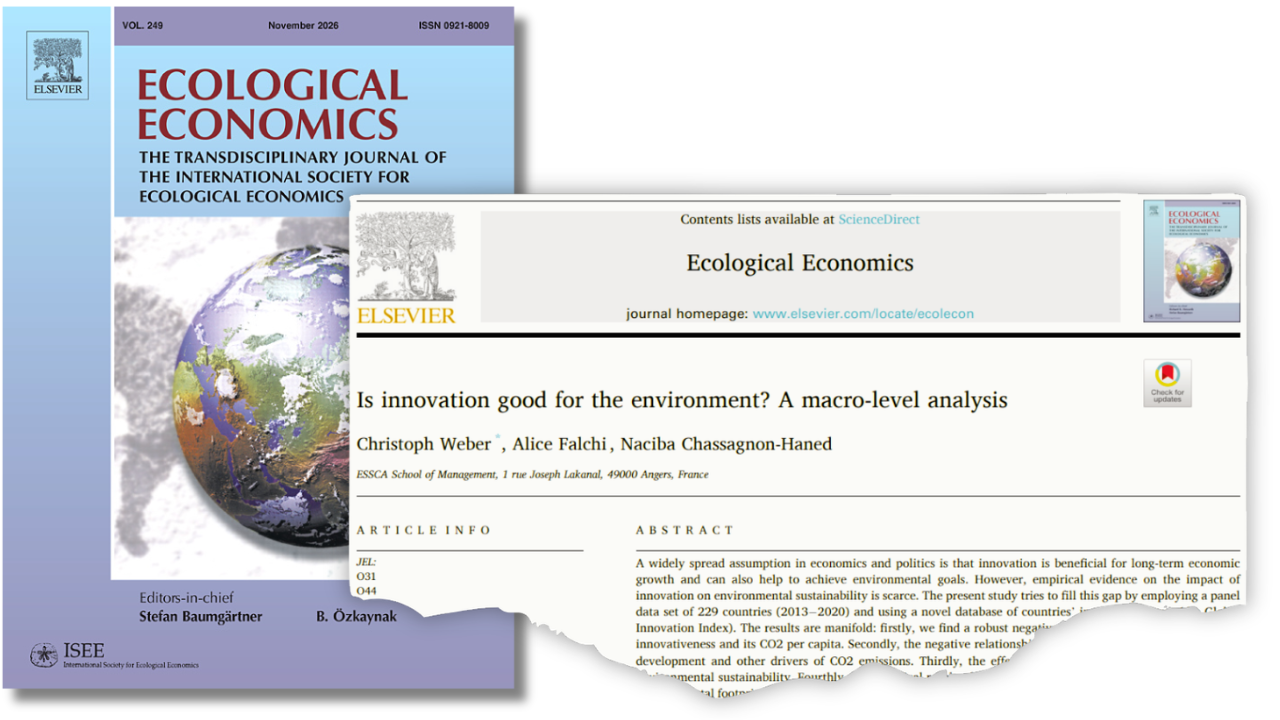
A leading environmental economics journal is looking into claims that a 2025 study linking national innovation to lower carbon emissions contains data that does not match its source, after an expert in the field requested the paper be retracted.
The article appeared in Ecological Economics, the journal for the International Society for Ecological Economics and published by Elsevier. The authors, three researchers at ESSCA School of Management in Lyon, claimed to draw on data from 229 countries between 2013 and 2020 and reported a negative relationship between a country’s “innovativeness” and its carbon dioxide emissions per capita. The paper has been cited five times, according to Clarivate’s Web of Science.
But three months after it was published, in October 2025, the journal began investigating anomalies in the dataset, although the authors maintain none of it was fabricated. In a letter to the journal’s editors requesting a retraction last October, seen by Retraction Watch, an academic with expertise in the field who reviewed the dataset said the paper had “serious data integrity concerns” and described a “clear case of research misconduct.”
These allegations derived from the study’s data, which uses the Global Innovation Index (GII), an annual ranking of the innovation performance by countries around the world. The authors said their analysis included 229 countries. But in the years used in the study’s analysis, 2013 to 2020, the GII reports available online only show the performance of 126 to 143 global economies.
Around 80 additional entries don’t correspond with the underlying GII data, despite there being no disclosure of the use of additional data — additions that inflate the sample by about 60 percent, and skew the study’s statistical results, according to the complaint.
Many of these entries used identical innovation scores within a given year. “The uniform nature of these values demonstrates intentional manipulation rather than error,” according to the email.
The authors denied the allegation in an email to Retraction Watch. “No data has been fabricated, as shown by the documentation provided to the editor,” Naciba Chassagnon, an economist at the ESSCA School of Management, wrote on behalf of the three authors. She said the team had answered the journal’s queries promptly and didn’t “wish to pre-empt the editor’s review of the matter.” Chassagnon declined to explain why the dataset differed from the source material.
Stefan Baumgärtner, co-editor-in-chief of the journal and an economist at the University of Freiburg, said the journal had opened a “thorough and detailed investigation,” and would take action depending on the outcome, in response to the original complaint. He said the authors had submitted a “detailed answer” that editors were reviewing.
“We would prefer not to comment further on the dataset question at this stage, out of respect for the ongoing editorial process,” Christoph Weber, an economist at ESSCA School of Management and the author responsible for data curation, according to the paper’s CRediT statement, told us by email. “No data has been fabricated.”
Despite initially agreeing to explain the discrepancy, the authors declined to provide further information after finding out the journal was investigating.
“When I responded to your initial message, I did so in good faith and with a willingness to be available for clarification,” Chassagnon wrote. “However, since then, I have been informed that the journal is currently reviewing the matter and that the editorial assessment is ongoing.”
He said they would “reconsider whether a conversation would be appropriate,” once any editorial decisions were clearer.
Like Retraction Watch? You can make a tax-deductible contribution to support our work, follow us on X or Bluesky, like us on Facebook, follow us on LinkedIn, add us to your RSS reader, or subscribe to our daily digest. If you find a retraction that’s not in our database, you can let us know here. For comments or feedback, email us at [email protected].
This does not seem to have any possible innocent explanation, except perhaps utter incompetence