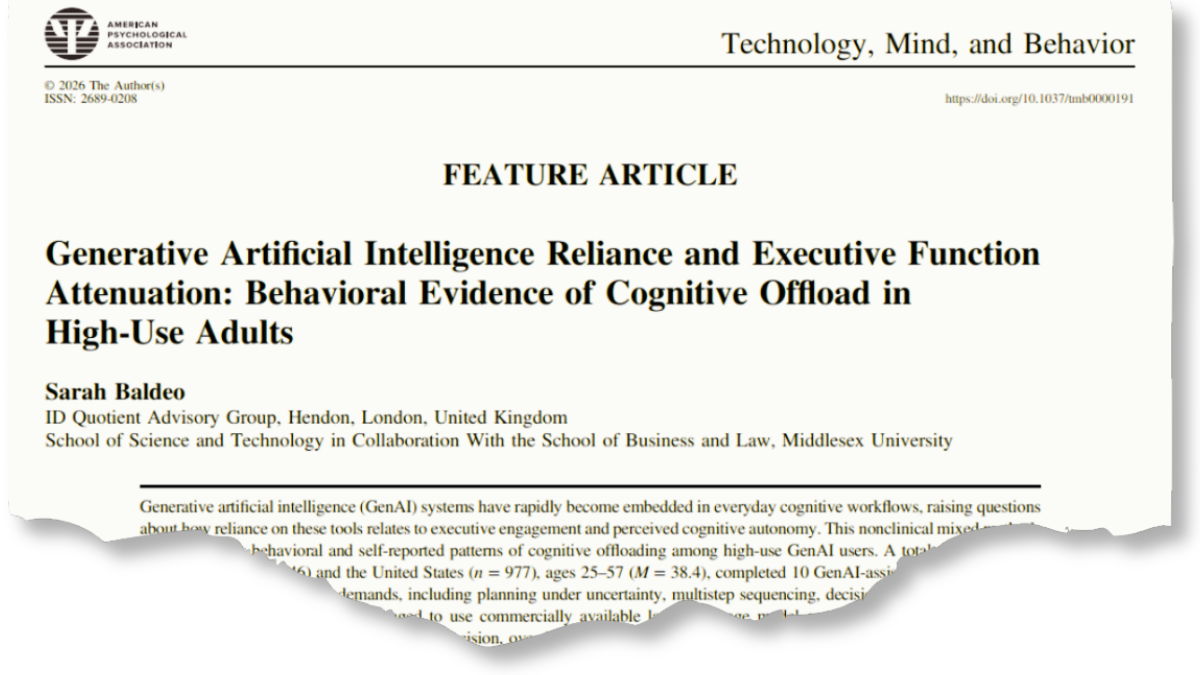
Journal investigating paper on cognitive impact of generative AI

A paper about the effects of generative AI use on confidence in work tasks is under investigation after critics raised questions about the study design, data analysis and ethics approval for the research.

The study, published in April in Technology, Mind, and Behavior, included 1,923 adults recruited online from the United States and Canada to perform a battery of work-like tasks assisted by AI. It garnered a press release from the American Psychological Association, which publishes the journal, and coverage in Time and Futurism.

Sandra Grinschgl of the University of Bern in Switzerland, who studies technology-driven cognitive offloading, got an alert about the study shortly after it came out. She told Retraction Watch she was initially puzzled by the vague descriptions of data collection from online participants in the study. When she looked closer at one of the bar charts, she noticed the lengths of the bars didn’t match the actual value of the labels.

Continue reading Journal investigating paper on cognitive impact of generative AI

Economist outs another Indian university’s rankings-boosting scheme when they refuse to pay him

Mohd Asif Shah

On May 9, a university administrator in Afghanistan threatened in a LinkedIn post to expose what he called a publishing scam by private universities in India.

“These institutions contact academicians globally, promising payment for publishing research papers that will boost their national and international rankings,” Mohd Asif Shah, dean of the faculty of economics at Kardan University in Kabul, alleged.

The following day, Shah elaborated in a new post: “Four years ago, Woxsen University asked me to publish papers and file patents under their affiliation. I agreed, delivered, and they proudly displayed those publications on their website. Now, after four years, they are denying payment for that work.” He also complained his “patent incentives were being unilaterally reduced” from 40,000 Indian rupees (US$420) to 17,500 rupees (US$184) per patent — “a reduction of over 56%.”

Continue reading Economist outs another Indian university’s rankings-boosting scheme when they refuse to pay him