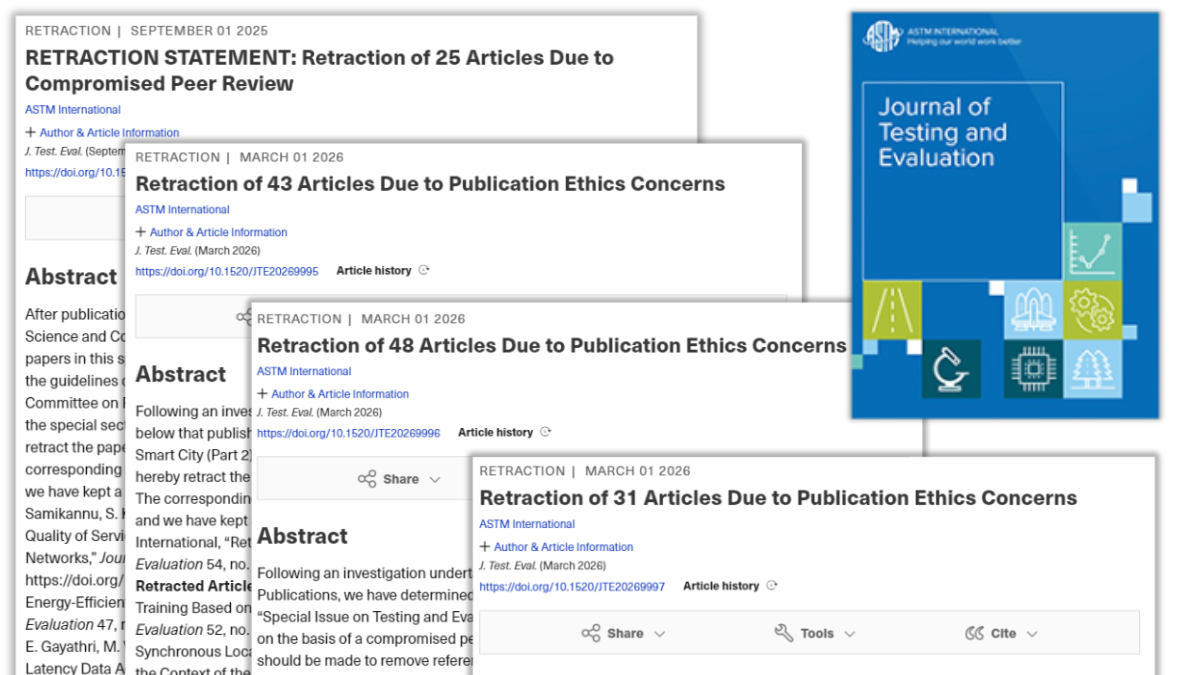
A journal published by an organization that develops technical standards is retracting 147 papers for problematic peer review — and the publisher expects more to follow.
The American Society For Testing And Materials (ASTM) International started an investigation into its Journal of Testing and Evaluation after an ASTM vendor noticed some “irregular patterns in the peer review” in a special issue, spokesperson Gavin O’Reilly told Retraction Watch. When the publisher confirmed those patterns, ASTM decided to investigate several related issues, he said.
The investigation revealed the peer review process in the special sections or issues had been compromised, each of the retraction notices says.
“We have been informed that those patterns of compromised peer review could indicate a paper mill, though it’s outside of our scope of work to make that determination,” O’Reilly told us. “We’re continuing to focus on early and proactive measures, from technology to procedures, to ensure the integrity of our journal peer review process.” The journal has issued four batch retraction notices so far. O’Reilly told us they expect at least one more to come.
The papers were published between 2019 and 2024 in the journal, which began publishing in 1973, according to its website. The journal joins 75 others with at least 145 retractions.
The mass retraction includes 48 papers in its “Special Issue on Testing and Evaluation of Internet of Things for Smart City” and another 43 articles in the “Special Issue on Advanced Internet of Things for Smart City (Part 2). The publisher retracted two more batches from a special issue on the future of cognitive computing in healthcare, and a special section on advanced intelligence in information science and communication systems. Guest editors oversaw all of the issues and sections facing retractions.
The journal typically publishes 200 to 300 articles per year. The retracted papers represented 9 to 25 percent of the articles published in a given year.
| Year | Total articles published | Articles recently retracted | % of total |
| 2019 | 279 | 25 | 9% |
| 2023 | 304 | 79 | 25% |
| 2024 | 192 | 43 | 22% |
In the first batch of 25 retracted papers, seven affiliations show up more than once, including Vellore Institute of Technology University in India, which is listed 23 times among the retracted papers.
Subbiah Janakiraman of Pondicherry University in India is an author on three of the retracted papers. Janakiraman did not respond to our requests for comment. An S. Janakiraman with the same affiliation had a 2022 paper in Journal of Sensors retracted as part of a mass retraction of nearly 12,000 articles by Hindawi to address an infiltration by paper mills of its special issues.
K. Chandraprabha was a coauthor on the same three retracted papers. He is listed with two different affiliations in the articles: R.V.S College of Engineering and Technology and JPJ Lending Library, both in India. Chandraprabha did not return messages seeking comment.
The 25 articles in the 2019 special section were cited a total of 62 times, the 31 articles in the 2023 special issue on the future of cognitive computing garnered 37 citations, the 48 papers in the 2023 special issue were cited 62 times, and the 43 papers retracted from the 2024 special issue were cited a total of 19 times, according to Clarivate’s Web of Science.
The recent retractions spotlight an ongoing pattern of peer review abuse within special sections.
In 2023, Hindawi temporarily suspended publishing special issues because of “compromised articles.” In 2024, a Springer Nature journal retracted 34 papers from special issues for “compromised editorial handling and peer review process” and that same year, Annals of Operations Research retracted an entire special issue over concerns about “compromised” peer review.
Earlier this month, a study posted at arXiv.org examined how often guest editors publish in their own special issues, defining special issues with more than 33 percent of articles authored by at least one editor as “Published in Support of Self (PISS).” Research shows special issues have also become particularly vulnerable to paper mills in recent years.
ASTM brings in about $100 million in annual revenue, according to publicly available tax records from ProPublica’s Nonprofit Explorer. In 2024, the society generated nearly $82 million from “publications sales,” according to its 2024 filing.
Like Retraction Watch? You can make a tax-deductible contribution to support our work, follow us on X or Bluesky, like us on Facebook, follow us on LinkedIn, add us to your RSS reader, or subscribe to our daily digest. If you find a retraction that’s not in our database, you can let us know here. For comments or feedback, email us at [email protected].
How can an article that publishes 200-300 articles a year bring in $100 million/year? that is $300-500K for each article. Far in excess of any APC? if this is correct, it is an enormous gold mine.
It is ASTM that brings in $100 million, not that one specific journal. ASTM publishes many journals (9) and also has other publications.