Dean in Indonesia resigns following Retraction Watch report

Kumba Digdowiseiso

Kumba Digdowiseiso, the dean of the economics and business faculty at Universitas Nasional in Jakarta, Indonesia, resigned on Thursday after a firestorm of criticism over the past week.

The move, reported widely in the Indonesian media, came eight days after Retraction Watch reported that researchers at Universiti Malaysia Terengganu alleged that Digdowiseiso had added dozens of their colleagues’ names to papers without their permission.

“This resignation is a form of my academic responsibility to the Chancellor of Unas and the academic community so as not to burden the campus in carrying out investigations into the problems I am facing,” Digdowiseiso told Kompas yesterday.

Continue reading Dean in Indonesia resigns following Retraction Watch report
Weekend reads: A decade after the STAP scandal; more allegations about Francesca Gino; the disappearing journal

Would you consider a donation to support Weekend Reads, and our daily work?

The week at Retraction Watch featured:

Our list of retracted or withdrawn COVID-19 papers is up past 400. There are more than 48,000 retractions in The Retraction Watch Database — which is now part of Crossref. The Retraction Watch Hijacked Journal Checker now contains more than 250 titles. And have you seen our leaderboard of authors with the most retractions lately — or our list of top 10 most highly cited retracted papers? What about The Retraction Watch Mass Resignations List — or our list of nearly 100 papers with evidence they were written by ChatGPT?

Here’s what was happening elsewhere (some of these items may be paywalled, metered access, or require free registration to read):

Continue reading Weekend reads: A decade after the STAP scandal; more allegations about Francesca Gino; the disappearing journal

Publisher flags papers found by university to involve misconduct more than a year ago

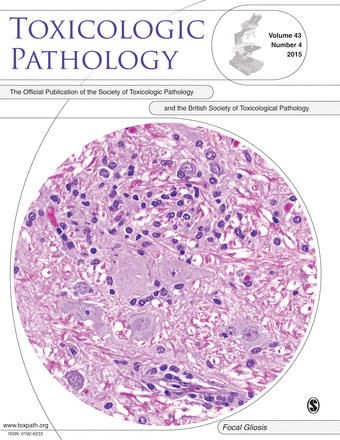
Toxicologic Pathology – a Sage title – has issued expressions of concern for six papers that were among the subjects of an investigation by Azabu University that concluded in November 2022.

The expression of concern, dated March 7, 2024, includes a list of the six articles and reads:

Continue reading Publisher flags papers found by university to involve misconduct more than a year ago

Weekend reads: ‘Objectionable conditions’ at psychiatry institute; impact factor obsession; Nobel winner acknowledges more errors

Would you consider a donation to support Weekend Reads, and our daily work?

The week at Retraction Watch featured:

Our list of retracted or withdrawn COVID-19 papers is up past 400. There are more than 48,000 retractions in The Retraction Watch Database — which is now part of Crossref. The Retraction Watch Hijacked Journal Checker now contains more than 250 titles. And have you seen our leaderboard of authors with the most retractions lately — or our list of top 10 most highly cited retracted papers? What about The Retraction Watch Mass Resignations List — or our list of papers with evidence they were written by ChatGPT?

Here’s what was happening elsewhere (some of these items may be paywalled, metered access, or require free registration to read):

Continue reading Weekend reads: ‘Objectionable conditions’ at psychiatry institute; impact factor obsession; Nobel winner acknowledges more errors

Cureus reviewing paper alleged to plagiarize Lancet article

A 2022 paper in Cureus on causes of cancer around the world is under investigation by the journal following inquiries by Retraction Watch prompted by a reader’s email.

The paper, “Causes of Cancer in the World: Comparative Risk Assessment of Nine Behavioral and Environmental Risk Factors,” shares a title and figures with a 2005 paper in The Lancet. It also “follows the Lancet one on a sentence-by-sentence level while using tortured phrases,” an anonymous tipster told us.

As we’ve noted elsewhere in a report on the team that developed the phrase, “Tortured phrases are what happens to words that get translated from English into a foreign language, then back to English — perhaps by a computer trying to generate a scholarly publication for a group of unscrupulous authors.”

Continue reading Cureus reviewing paper alleged to plagiarize Lancet article

Weekend reads: Clinical trial fraud leads to prison; journal editors resigning en masse; who should police scientific fraud?

Would you consider a donation to support Weekend Reads, and our daily work?

The week at Retraction Watch featured:

Our list of retracted or withdrawn COVID-19 papers is up past 400. There are more than 48,000 retractions in The Retraction Watch Database — which is now part of Crossref. The Retraction Watch Hijacked Journal Checker now contains more than 250 titles. And have you seen our leaderboard of authors with the most retractions lately — or our list of top 10 most highly cited retracted papers? What about The Retraction Watch Mass Resignations List — or our new list of papers with evidence they were written by ChatGPT?

Here’s what was happening elsewhere (some of these items may be paywalled, metered access, or require free registration to read):

Continue reading Weekend reads: Clinical trial fraud leads to prison; journal editors resigning en masse; who should police scientific fraud?

Following mass resignation, obstetrics journals place editor’s notes on studies

Two BMC journals – part of the Springer Nature stable – have flagged studies a month after 10 editors at one of the journals resigned to protest the publications’ failure to respond quickly to allegations of data fabrication.

As we reported earlier this month, obstetrician-gynecologist and sleuth Ben Mol sent allegations about papers published in BMC Pregnancy and Childbirth and BMC Women’s Health on Jan. 29, 2024. When BMC had not responded to Mol by February 28, 10 editors quit.

Mohamed Abdelmonem Kamel of Fayoum University in Egypt, the corresponding author of both articles, did not initially respond to a request for comment from Retraction Watch. However, he left a comment defending the work on our post and said his team could not share the data behind one of the papers “before publishing it first as a paper to prevent stealing the data in another paper by different authors.” The study said that the data “are available from the corresponding author on reasonable request.”

Continue reading Following mass resignation, obstetrics journals place editor’s notes on studies

Weekend reads: More retractions at Columbia; ‘an epidemic of scientific fraud’; when articles cite retracted papers

Would you consider a donation to support Weekend Reads, and our daily work?

The week at Retraction Watch featured:

Our list of retracted or withdrawn COVID-19 papers is up past 400. There are more than 47,000 retractions in The Retraction Watch Database — which is now part of Crossref. The Retraction Watch Hijacked Journal Checker now contains more than 250 titles. And have you seen our leaderboard of authors with the most retractions lately — or our list of top 10 most highly cited retracted papers? What about The Retraction Watch Mass Resignations List — or our new list of papers with evidence they were written by ChatGPT?

Here’s what was happening elsewhere (some of these items may be paywalled, metered access, or require free registration to read):

Continue reading Weekend reads: More retractions at Columbia; ‘an epidemic of scientific fraud’; when articles cite retracted papers

Exclusive: PLOS ONE to correct 1,000 papers, add author proof step

The megajournal PLOS ONE will be correcting about 1,000 papers over the next few months, Retraction Watch has learned, and will add an author proof step – a first for the journal.

The corrections are for “errors in author names, affiliations, titles and references; to make minor updates to the acknowledgements, funding statements, and data availability statements, among other minor issues,” PLOS ONE head of communications David Knutson told us. He continued:

This batch of corrections does not reflect a recent change in the journal’s quality control standards or processes. Rather, we are clearing a backlog that accumulated during a 2-year period when minor corrections were deprioritized and resources were diverted to other areas. PLOS ONE is in the process of implementing an author proof step so that in the future such errors can be identified and addressed prior to publication.  

Continue reading Exclusive: PLOS ONE to correct 1,000 papers, add author proof step

Weekend reads: A paper written by ChatGPT goes viral; the Gino misconduct investigation report; superconductivity scandal

Would you consider a donation to support Weekend Reads, and our daily work?

The week at Retraction Watch featured:

Our list of retracted or withdrawn COVID-19 papers is up past 400. There are more than 47,000 retractions in The Retraction Watch Database — which is now part of Crossref. The Retraction Watch Hijacked Journal Checker now contains more than 250 titles. And have you seen our leaderboard of authors with the most retractions lately — or our list of top 10 most highly cited retracted papers? What about The Retraction Watch Mass Resignations List?

Here’s what was happening elsewhere (some of these items may be paywalled, metered access, or require free registration to read):

Continue reading Weekend reads: A paper written by ChatGPT goes viral; the Gino misconduct investigation report; superconductivity scandal