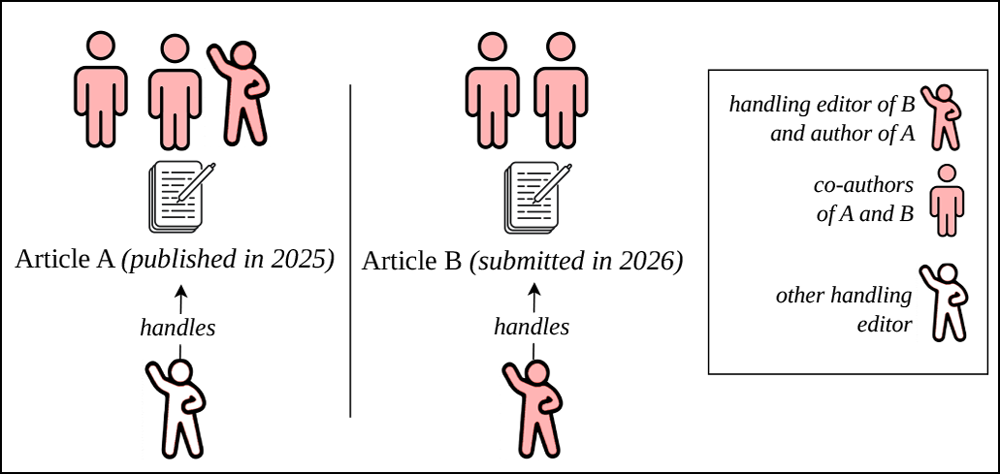
Over 10,000 peer-reviewed papers from two publishers breach journal policies about past collaborations between handling editors and authors, a new analysis has found.
The work — presented October 15 at the 26th ACM/IEEE Joint Conference on Digital Libraries in Frisco, Texas — examined how often research studies published by journals run by the Public Library of Science and MPDI violate the publishers’ policies covering conflicts of interest.
PLOS requires that a handling editor of a manuscript and its authors haven’t coauthored papers together in the previous five years, while MDPI’s limit is three years.
To mine those relationships, Jules Di Scala, a computer scientist at the University of Toulouse in France, and his colleagues developed a tool called EditorCheck. It scans metadata files of published papers to collect the names of handling editors of each manuscript. It then searches the database Dimensions for any papers on which the handling editor and author were coauthors.
They used the tool to examine more than 340,000 papers published in PLOS journals and more than 172,000 published by MDPI journals. More than 8,000 papers published by PLOS journals violate the publisher’s policy on author-editor relationships, as well as around 2,500 papers published by MDPI titles, the researchers found.
EditorCheck identifies articles for which the policy has been breached, but journals should look further into cases that are the most problematic, Di Scala told Retraction Watch. “In the end, we don’t know if the review process was honest or not or not,” he said.
For example, for large-scale collaborations with thousands of coauthors, Di Scala said, it’s not easy to decipher what the past working relationship between an author and handling editor might have been.
The ethics team at PLOS helped with benchmarking for EditorCheck by annotating some of the collaborations flagged in the results, the study authors wrote. Di Scala said when he and his colleagues reached out to PLOS, they had already taken action by reassigning some of the articles they flagged to different handling editors, or adding another editor to supervise the editing process. As a result of the study’s findings, PLOS’ publication ethics team took a closer look at around 100 papers that the analysis flagged, Di Scala said.
PLOS did not reply to our request for comment on the study by press time.
Jamie Barclay, head of executive affairs at MPDI in Basel, Switzerland, told Retraction Watch: “We would be very interested in reviewing the database behind the study. If we then identify any cases in which MDPI’s policies have been breached, we will investigate, as is our standard policy.”
Di Scala said he and his colleagues plan to further refine EditorCheck to flag papers with handling editors and authors who are based at the same institution.
EditorCheck is “very simple” yet “super useful,” said Florian Naudet, a psychiatrist and metascience researcher at the University of Rennes in France, who was not involved with the new study. He suggested publishers should implement the tool in their pre-publication checks and workflows. Conflicts of interest have traditionally been considered when money is involved, he said, but tracking past collaborations is important because publications are “the currency for academics and editors are in charge of allocating this currency.”
Naudet is involved with the Open Editors Plus, a database that documents the positions of nearly 750,000 editors in positions at scholarly journals. That dataset is used largely to track editors publishing excessive numbers of papers in their own journals, Naudet said.
He said journals should at least label studies with disclaimers documenting past collaborations and let readers decide if those amount to conflicts of interest. In some cases that are more serious, publishers may choose to retract studies instead, he said. Last month, for instance, an Elsevier journal pulled 165 papers, dozens of which were handled by associate editors with significant past records of collaborations with authors.
Vitali Mindel, a business scholar at Virginia Tech University in Blacksburg, who has reported on conflicts of interest in academic publishing, told us the study authors do a good job of exposing potential conflicts of interests between handling editors and authors.
But the study should have also explored reciprocal handling, where two editors handle one another’s papers, either at the same time or in turns, submitted to the same or different journals, Mindel said. “Their data does allow for that sort of examination,” he said.
The researchers plan to study datasets from other publishers who release the names of handling editors in their metadata files, Di Scala said. While many publishers do not release such data, they should do so for transparency, he said.
Mindel agreed, arguing that sharing handling editors’ identities should be mandated across all publishers. “When we do audits for those journals where they do disclose editors, we realize the shenanigans happen behind the scenes,” he said. “We can only imagine what happens in journals which do not disclose editors, which are protected by this anonymity.”
Like Retraction Watch? You can make a tax-deductible contribution to support our work, follow us on X or Bluesky, like us on Facebook, follow us on LinkedIn, add us to your RSS reader, or subscribe to our daily digest. If you find a retraction that’s not in our database, you can let us know here. For comments or feedback, email us at [email protected].