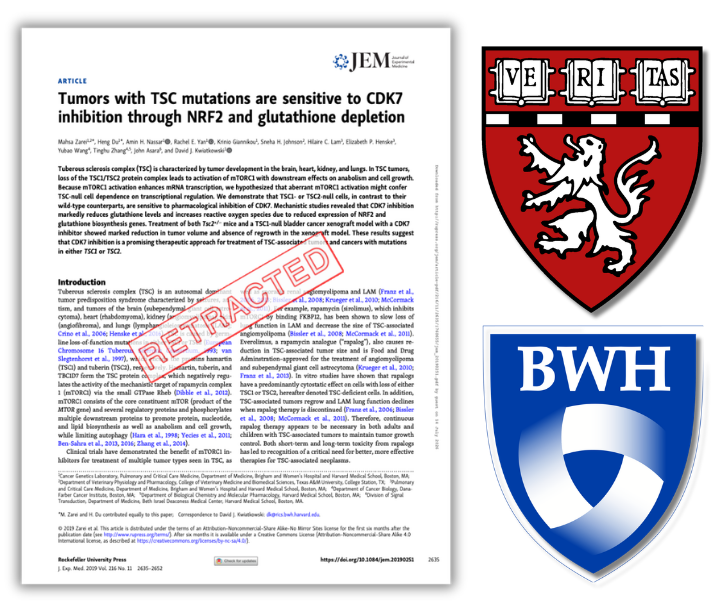
A group of researchers at Brigham and Women’s Hospital and Harvard Medical School in Boston have lost a paper for image duplication following an investigation by the two institutions.
The paper, published in September 2019 in the Journal of Experimental Medicine, described a treatment for tumors caused by a disorder called tuberous sclerosis complex. Several of the article’s 12 authors are affiliated with Brigham and Women’s Pulmonary and Critical Care Medicine division. Corresponding author David Kwiatkowski is an oncologist at Brigham and Women’s Hospital and Dana-Farber Cancer Institute, and a professor at Harvard Medical School.
The research was partially funded by two grants from the U.S. Department of Defense and a National Institutes of Health grant, the latter of which was awarded to Kwiatkowski.
According to the June 12 retraction notice, the authors requested the retraction following a joint investigation by Brigham and Women’s Hospital and Harvard Medical School. Four images in the paper “have been found unreliable due to image duplication,” the notice reads, and the data in one of the figures “do not accurately represent the source data.”
“The authors have lost confidence in the data and believe the most responsible course of action is to retract the article,” according to the notice.
Kristin Bittinger, dean for faculty and research integrity at Harvard Medical School, declined our request for information regarding the investigation.
“Any concerns brought to our attention are reviewed thoroughly in accordance with our institutional policies and applicable regulations,” she said.
The authors alerted the Journal of Experimental Medicine to the institutional investigation, Rory Williams, the director of communications at Rockefeller University Press, which publishes the journal, told us. He said he could not disclose information regarding the investigation, per the publisher’s policies.
The paper has been cited 21 times, according to Clarivate’s Web of Science.
This is the first retraction for any of the authors, according to our database. Seven of Kwiatkowski’s other papers have been flagged on PubPeer. The most recent comment, made in February, flags images in a 2014 PLOS One paper as “much more similar than expected.”
In 2020, commenters pointed out image similarities in three figures of a 2002 paper on which Kwiatkowski was a coauthor. The authors issued a correction in 2021, noting they repeated experiments related to two of the images as they didn’t have access to the 18-year-old data. Shortly after, a commenter replied on PubPeer that the correction “does not address the very similar images” in the third figure.
Kwiatkowski declined our request for comment on the image duplication in the now-retracted paper and whether any of his other papers were being investigated.
Other coauthors include Elizabeth Henske, the director of the Center for LAM Research and Clinical Care and codirector of the Pulmonary Genetics Center, both at Brigham and Women’s Hospital, and John Asara, the director of Mass Spectrometry at Beth Israel Deaconess Medical Center in Boston. Both are also professors at Harvard Medical School. Neither responded to our request for comment.
A 2014 article in the Journal of Experimental Medicine coauthored by Kwiatkowski and Henske has comments on PubPeer noting similarities between several images in the paper. Williams did not respond to our question regarding whether the journal was also looking into that article.
Like Retraction Watch? You can make a tax-deductible contribution to support our work, follow us on X or Bluesky, like us on Facebook, follow us on LinkedIn, add us to your RSS reader, or subscribe to our daily digest. If you find a retraction that’s not in our database, you can let us know here. For comments or feedback, email us at [email protected].