This past year, Zhihao Lei has signed his name to at least 35 letters to the editor of medical journals, weighing in on topics from ICU care to breast cancer. In eight of them, he identified himself as a Ph.D. at Cornell University, although he held only a bachelor’s degree at the time.
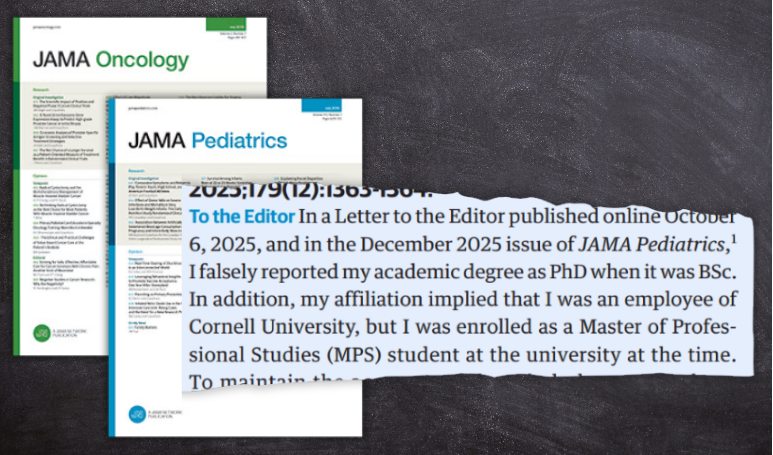
Two of those letters, one in JAMA Oncology and another in JAMA Pediatrics, were retracted last month after Lei himself acknowledged in the notices he had “falsely reported” his degree as a Ph.D. and implying he was an employee at the university when he was not. When he published the letters, he held a bachelor’s degree and was enrolled at Cornell as a master’s student in the School of Professional Studies. The retractions relate to Lei’s false credentials and not the content of the letters. In at least six others Lei published in the past year, he also signs off as a Ph.D., although none of these has been corrected or retracted.
Lei, who has served as a peer reviewer at Cancer Gene Therapy and the British Medical Journal, said he didn’t understand why Retraction Watch was interested in this case. “I am not entirely clear about the purpose of your inquiry,” he wrote in an email, adding that the retractions involved only author metadata and credentials, not fabrications, falsification or plagiarism.
Many of the letter titles follow a formula typical of LLMs (i.e., ‘“Measurement or Judgment?” Reconsidering Data Quality and Inference in EudraVigilance’ and ‘“Efficacy or illusion?” Interpreting null results in the rifaximin trial’). Lei did not respond to our questions about whether he used AI to generate the letters.
“There are countless other retractions involving far more serious issues,” he told us. “I therefore find it difficult to understand why this relatively minor issue has attracted you [sic] such sustained attention, and I am concerned about the basis and intent of the inquiry.”
He said he had proactively notified the journals, including the others where his credentials are still listed as a Ph.D., once he became aware of the error, and that JAMA had applied “a stricter policy” than other publications by opting for a retraction over a correction.
Lei also declined to share his correspondence with the editors and publishers informing them of the issue, calling it confidential. “I do not believe that declining to disclose private correspondence should be treated as evidence of wrongdoing or used as a basis for speculation,” he wrote.
“I am a student, and this situation is already personally difficult and embarrassing,” he added. “I respectfully ask that you not pursue this matter further.”
Lei did not explain how he became aware of the issue, but maintained that the credentials were “reported incorrectly by mistake.” The retraction notices in both JAMA journals are nearly identical, and attribute the push for retraction to Lei, told from his point of view rather than the editors. “To maintain the accuracy of the scholarly record, I have requested retraction of this Letter to the Editor,” they both read.
The other letters that include his false Ph.D. credentials remain uncorrected. They include a letter in the Journal of Surgical Research addressing a study about rib fractures, a comment on ICU-decision making in Chest, a letter to the Journal of the National Cancer Institute on Medicare Advantage plans, a comment in Integrative Cancer Therapies on a drug trial for breast cancer, a letter to Annals of Emergency Medicine on low back pain, and another letter addressing a study on critical illnesses in Critical Care Medicine.
In total, Lei published at least 35 letters to the editor in the past year, taking issue with the methodology in a broad spectrum of health-related research. We’ve previously reported on an author who published more than 500 letters in one year.
Elsevier, which publishes the Journal of Surgical Research and Chest, said they could not comment while an investigation is ongoing. A spokesperson for Sage, which publishes Integrative Cancer Therapies, said the publisher was “reviewing the case to assess whether further action is required.” The Journal of the National Cancer Institute has an ongoing ethics and integrity investigation related to Lei’s letter.
The other journals, JAMA and Cornell University have not responded to requests for comment.
Like Retraction Watch? You can make a tax-deductible contribution to support our work, follow us on X or Bluesky, like us on Facebook, follow us on LinkedIn, add us to your RSS reader, or subscribe to our daily digest. If you find a retraction that’s not in our database, you can let us know here. For comments or feedback, email us at [email protected].
Kudos for digging into “this relatively minor issue.” Can’t quite get the psychology of a student in “professional studies” claiming to be a medical expert. Who’s he trying to impress? Unfortunately journals, especially medical journals, will have to start looking at every letter to the editor from unvetted authors as presumptively fake.
Wow. I guess that I am really amazed that he cannot understand why Retraction Watch is interested in his case, which involves falsifying his credentials and also scattershot publishing in many scientific areas in which he cannot possibly have the expertise given his current training. Did his Professional Studies course not teach any ethics and proper scientific practice material???
It’s equally amazing that he served as a reviewer for Cancer Gene Therapy and the British Medical Journal. That someone with no advanced technical education & falsified credentials can serve as a reviewer of medically important articles is surprising.
Not excusing the journals, just offering context: as a journal editor myself, I can say it’s a huge challenge to find willing reviewers, let alone qualified ones, and it gets harder every year. The problem is compounded by an absolute deluge of new submissions. In the journal I edit we had around 150 submissions in 2024, 250 in 2025, and already 250+ in the first half of 2026.
Authors need to step up and agree to review. My rule is to complete two to three reviews for every paper I publish, to repay the “cost” of having my own work reviewed.
I have no clue how to stem the tide of exploding submission numbers, but I fear this kind of unethical behavior will only increase.
“Authors need to step up and agree to review. My rule is to complete two to three reviews for every paper I publish, to repay the ‘cost’ of having my own work reviewed.”
I commit to that myself. However, editors need to step in also and start actually editing. During the past year, I have had the “honor” to review 100% AI slop and other things that should have never ended on my desk. Several times. Tens of times. And, then, when I am in the role of an author, poor-quality and LLM-generated reviews will often also “kill” a paper without editors doing anything but blindly trusting some random people (who may not even have a Ph.D., as this case demonstrates). But, finally, to the topic at hand: I also reviewed last week, twice, two manuscripts written by so-called “independent researchers” without any reliable traces in the Internet. And given the quality of the manuscripts, I again wonder why I was honored to devote my free time?
Agreed. I have been more than willing to review papers, but sometimes I feel like journals have offloaded even the most cursory of overview labor to reviewers instead of desk rejecting obviously poor quality science.
He’s still at it as of this year according to PubMed. See PMID: 42229747 & PMID: 41547002. Also I couldn’t find a Cornell School of Professional studies that offered a masters degree. I did find a School of Continuing education that offers a BSc in Professional Studies though. Odd all around.
His plea at the end to be given grace falls on deaf ears considering what he’s been up to.
The illustration has Lei saying “I was enrolled as a Master of Professional Studies (MPS) student at the university at the time.” Cornell does offer the Master of Professional Studies (MPS) degree in some fields; it looks like over 500 people received that degree this year. But it could be awarded in several different courses of study.
I did not realise that it is easy to get your letters published in JAMA!
Reviewer issue – I notice this as I handle manuscripts for a journal: system-suggested names are all fake IDs, I presume. You can game the system now, you create a profile and insert keywords – the system shows you the names of reviewers with a keyword match. As mentioned above, it is not easy to find reviewers, most may chose the submission system-generated names – most of which are not accurate. Welcome to the future!!
Whether in academia or as a professional, his career will be an arduous one if he doesn’t have the humility now to admit now that claiming false credentials is a fraud (with potentially legal consequences in some countries)…
Thanks for your reporting.