Martin Tramèr was editor-in-chief of the European Journal of Anaesthesiology during what he once called in print “The Boldt debacle.”
The misconduct scandal involving hundreds of papers by Joachim Boldt broke to the surface in 2010, but journals continue to retract papers by the disgraced German anesthesiologist – and researchers have continued to cite the work.
Tramèr, who described the story as “sad,” said he was “surprised that, so long after the Boldt debacle, articles still are being retracted again, including eight from his former journal – articles he and his colleagues specifically exempted from retraction 15 years ago: “What has happened since then? Why were these additional articles retracted after all, albeit very late? It’s a mystery.”
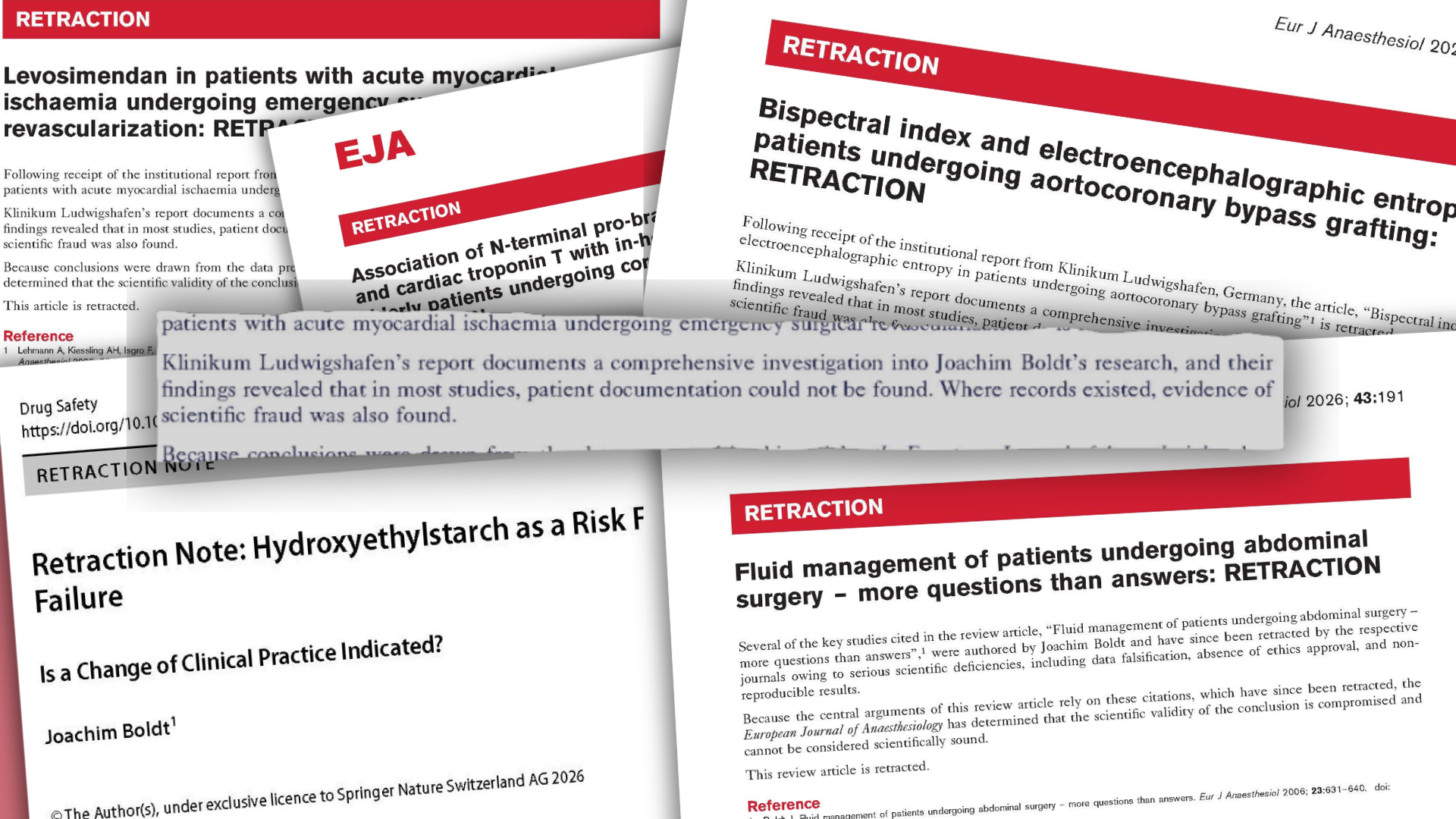
The retraction count for Boldt now stands at 240, according to our leaderboard – which he sits atop, ahead of fellow anesthesiologist Yoshitaka Fujii, at 172 – thanks to the removal this week of a 2002 review article in Drug Safety by Boldt. The retraction notice reports that three of the paper’s references have been retracted and “state, among other things, concerns with ethical approval and data concerns.”
The article has been cited 10 times, according to Clarivate’s Web of Science, including once since 2011, when the Boldt scandal was in high gear.
We asked Springer Nature, which publishes the journal, about the timing of the retraction and got a statement from Tim Kersjes, head of Research Integrity, Resolutions: “This paper was recently flagged to us by a reader. The Editor and our research integrity team confirmed concerns that undermined the validity of the review and retracted the paper.”
The Drug Safety move followed the retraction in May of a 2007 review in Expert Opinion on Pharmacotherapy, which Boldt wrote with his occasional coauthor Stephan Suttner. That retraction notices says that “the publisher was made aware that the below four original articles referenced in this review article have since been retracted by the respective journals due to serious ethical concerns, including data falsification, absence of ethics approval, and unreliable results.”
The article has been cited eight times, according to Clarivate, six after 2011, once in 2018, once in 2020, once in 2025 and once more this year.
That followed the bulk removal in February of the eight papers from the European Journal of Anaesthesiology, a Wolters Kluwer title.
Three of the articles were solo-authored reviews. One, a 2006 paper, was retracted because “several of the key studies” it cited “have since been retracted by the respective journals owing to serious scientific deficiencies, including data falsification, absence of ethics approval, and non-reproducible results.”
The rest are reports of clinical trials on which Boldt was a coauthor – for example, a 2009 article retracted because “Klinikum Ludwigshafen’s report documents a comprehensive investigation into Joachim Boldt’s research, and their findings revealed that in most studies, patient documentation could not be found. Where records existed, evidence of scientific fraud was also found.”
The article has been cited 72 times, 62 since 2011 – when the bulk of the Boldt retractions occurred – and 17 from 2020 on.
One of the eight papers was a 1987 study published while Boldt was still at Justus-Liebig-University of Giessen, which took the position that anything with his name on it was unreliable: “The institutional investigation identified many inconsistencies in the data and publications conducted by Joachim Boldt. In view of this, the university’s recommendation is that all articles where Joachim Boldt is the responsible author are retracted, even in the absence of explicit falsification.”
The date of that recommendation? 2018.
Marc Van de Velde, the top editor of the journal, did not respond to requests for comment.
André Rebelo, a spokesperson for Wolters Kluwer, provided the following statement from the company: “[T]he scientific validity of the conclusions in those articles were compromised and they cannot be considered scientifically sound. Any Wolters Kluwer journal that receives inquiries around fraud, misconduct or other ethical issues pertaining to scientific integrity, thoroughly investigates the concern in accordance with COPE guidelines. Each complaint is reviewed at the time that the appropriate information is shared, ensuring the proper procedures are adhered to.”
Rebelo said he could not provide any information about the timing of the retractions – a lack of transparency that does not sit well with Tramèr.
“It is, of course, a pity that the EJA Editors did not carry out these recent retractions “lege artis””, the former editor told us. “In particular, there is no explanation anywhere as to why these articles were retracted. We had, after all, described this retraction procedure in detail years ago. I have no clue what has happened.”
And he seemed skeptical about the notion any article by Boldt should be retracted.
“Do we need to clean the literature of any single sentence that Boldt has written during his career? Why retracting a letter to the editor, for instance? And if a narrative review article (that does not need any ethics approval) of Boldt should be retracted because there are some references that cite Boldt himself, why doing it only now, two EICs later? I simply would like to understand the reasoning behind this.”
Like Retraction Watch? You can make a tax-deductible contribution to support our work, follow us on X or Bluesky, like us on Facebook, follow us on LinkedIn, add us to your RSS reader, or subscribe to our daily digest. If you find a retraction that’s not in our database, you can let us know here. For comments or feedback, email us at [email protected].
The questions and comments of Professor Tramer can be explained, when looking at the availability of relevant information regarding the fraud of Dr. Boldt. Already in 2010 the initial retraction comment by S Shafer stated the lack of source data ,a stated randomization list and an questionnaire on top of the missing ethics vote and informed consent(1). The following 88 retractions by the Editors in Chief simply checked the availability of an ethics vote looking back ten years, but only at studies performed in Ludwigshafen. In 2014 the first two publications from Boldt’s time at Giessen University were retracted due to data manipulation and double publication of the same study.(2,3) Only in 2020 an editorial by Shafer in the BJA cited the recommendation of the president of Giessen University in detail to retract all studies from J. Boldt from his time in Giessen , when Boldt, was the responsible author.(4) The earliest retracted study from Gielen is from 1985. In 2019 a review of the status of the 88 to be retracted studies posted hidden among the attachments the Ludwigshafen report in full detailing the extent of GCP violations, missing data or outright invention of data. Not a single study analyzed by Klinikum Ludwigshafen was done according to legal requirements and scientific standards.(5)
In the same year Hartog and Perner recommended to retract HES reviews by an author knowingly citing his own fraudulent studies. This was due to the fact ,that Boldt had authored about 30 HES reviews favorably arguing for the safety and efficacy of HES based on his fraudulent studies.(5)This short review of Events demonstrates ,when new information became available for editors to act upon. Usually, it takes interested readers to alert journals to new information. The retraction notes of EJA , detailed by the retraction watch staff in the article , explain why each individual pub in EJA was retracted. The editors should be applauded for providing this detail. It should also be noted, that not all of Boldt’s papers in EJA have been retracted, e.g. a clinical study of HES sponsored by B. Braun Company is active as well as another review on clinical nutrition.
Quite a number of journals have still not taken action and retracted known fraudulent articles by Boldt .(7)To not act, despite the available evidence and having been alerted by readers, casts doubt on the journal and editor statements „ We are following COPE Guidelines!“
References:
1) Shafer SL. Notice of retraction. Anesth. Analg. 2010 Dec;111(6):1567. doi:
10.1213/ANE.0b013e3182040b99.
2)Notice of formal retraction of an article by Dr Joachim Boldt. Br J Anaesth.2014 Feb;112(2):397. doi: 10.1093/bja/aet488.
3)Shafer SL. Editor’s note: notice of retraction. Anesth. Analg. 2014Nov;119(5):1225. doi: 10.1213/ANE.0000000000000417.
4) Hemmings HC Jr, Shafer SL. Further retractions of articles by Joachim Boldt.Br J Anaesth. 2020 Sep;125(3):409-411. doi: 10.1016/j.bja.2020.02.024.
5) McHugh UM, Yentis SM. An analysis of retractions of papers authored by Scott Reuben, Joachim Boldt and Yoshitaka Fujii. Anaesthesia. 2019 Jan;74(1):17-21. doi: 10.1111/anae.14414. Epub 2018 Aug 24. Erratum in: Anaesthesia. 2019Jan;74(1):113. doi: 10.1111/anae.14515. .
6)Hartog CS, Perner A. Narrative reviews from a fraudulent author: reasons to retract. Intensive Care Med. 2019 May;45(5):719-721. doi:0.1007/s00134-019-05558-5. Epub 2019 Feb 14.
7) . Wiedermann CJ. Assessing institutional responsibility in scientific misconduct: A case study of enoximone research by Joachim Boldt. Clin Trials.2025 Apr;22(2):239-247. doi: 10.1177/17407745241297162. Epub 2024 Dec 18.