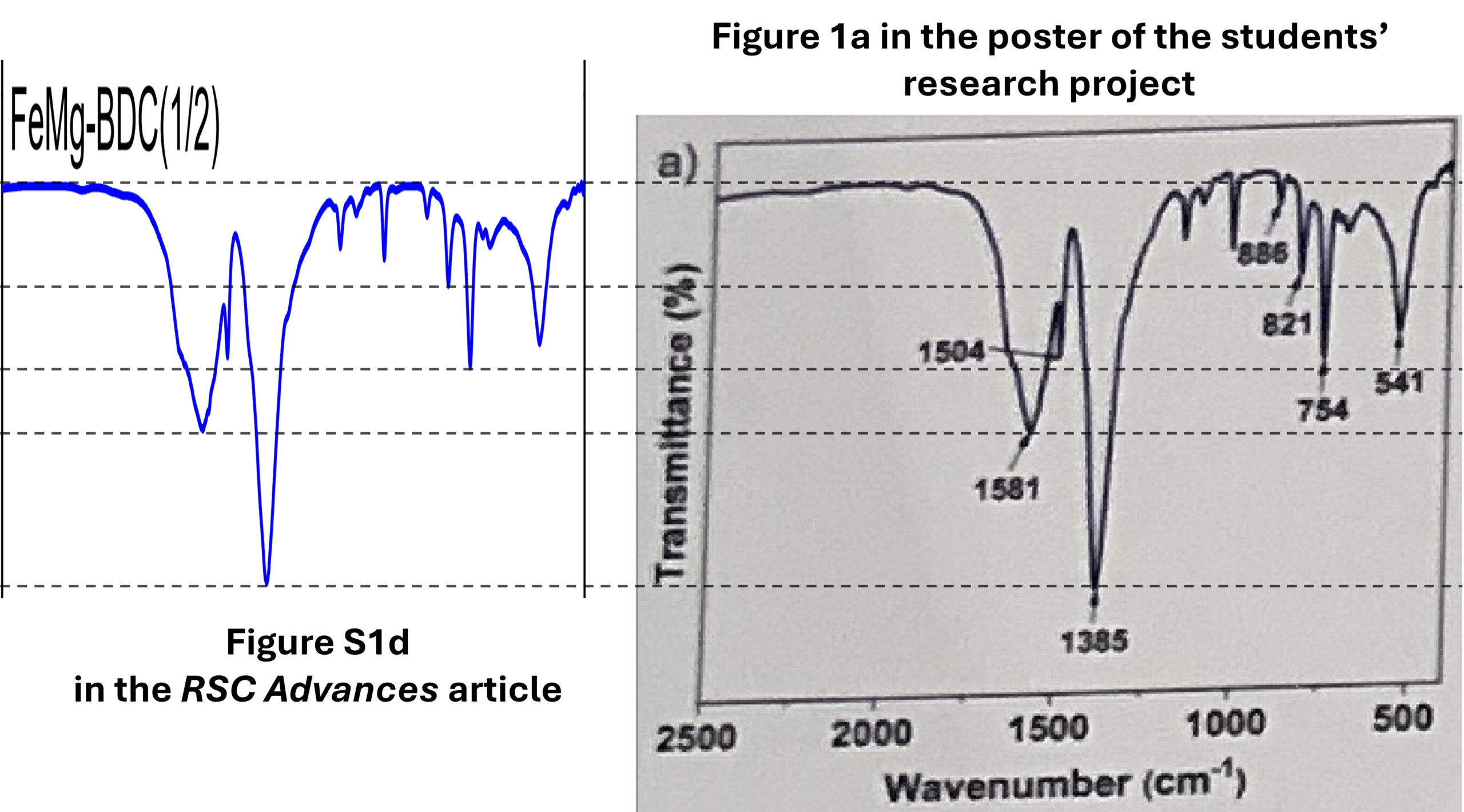
A science competition for middle and high school students in Vietnam is embroiled in controversy as its winners head to next week’s Regeneron International Science and Engineering Fair – widely considered the most prestigious event of its kind. Allegations include cheating and plagiarizing.
Observers in Vietnam noticed the suspect work appears to be especially advanced to have been conducted by two high school students, one of whom is studying mathematics and the other geography. Under the rules of the Vietnam Science and Engineering Fair (ViSEF), the project – titled “Development of multifunctional fire-resistant, heat-insulating, and antimicrobial polyurethane composite materials for application in construction and daily life” – had to have been completed in 12 months while the two student-authors also continued their school work.
Sleuths in a Vietnamese scientific integrity group have found multiple overlaps between the students’ poster and research published in RSC Advances in February 2025. A graph in the students’ poster is almost identical to one in the published paper, according to sleuth Van Tu Duong, although it is plotted in a different color and thickness (see the comparison above). This observation has led to allegations that the students had access to the researchers’ raw data.
Mai Ha Hoang, corresponding author for the RSC Advances article and vice director of the Institute of Chemistry at the Vietnam Academy of Science and Technology, has repeatedly denied any connection with the students’ work. Hoang told Retraction Watch he became aware of the work only after seeing posts about the potential misconduct on social media. “I did not provide them with any data, materials, figures, or guidance,” he said.
“Only the students and their supervisors can clarify whether and how they may have drawn upon my published results,” he added.
Hoang also responded to a PubPeer comment, saying his paper has no connection to the students’ work.
On April 10, ViSEF’s organizer, the Vietnamese Ministry of Education and Training, issued a statement saying an advisory board of experts ran the submission through the text-plagiarism detection software Turnitin and concluded the students did not plagiarize. The board also ruled the students could have conducted the work themselves.
Some of the experiment videos from the project have disappeared from the internet since public scrutiny has intensified. One of these videos, archived by sleuths, stated the experiments were performed at the Institute of Chemistry, where Hoang works.
Hoang said the equipment used by the students is strictly managed and can only be operated by authorized staff. External users can submit samples for testing, or they can observe experiments.
“In the case of the students’ project, I believe their measurements were likely arranged by submitting samples to the technical staff for testing, rather than the students or their teachers directly operating the equipment,” Hoang said. “The term ‘access’ in this context generally refers to using the analytical service (submitting samples and receiving data), which is available to external users upon request. It does not imply unrestricted or direct access to the instruments.”
A supervisor for the students and the school did not respond to our request for comment. The Vietnam Ministry of Education also did not respond.
The Institute of Chemistry has posted a statement affirming it had no connection with the students’ project. The group said it reviewed the list of students registered for internships and research at the unit in 2024-2025 and found no overlap.
“As the students are minors, I have been careful to avoid any statements or actions that could harm them,” Hoang said. “The Institute of Chemistry and I have requested the Ministry of Education and Training of Vietnam to conduct a thorough investigation and clarification of this case.”
ViSEF is no stranger to controversy. Last year, a winning project saw its award revoked because of similarities with an existing product. The incentive for students to win at the competition runs high: Until recently, ViSEF winners could automatically enroll at any university in Vietnam.
The Society for Science owns and runs the Regeneron International Science and Engineering Fair (ISEF), an event previously sponsored by Westinghouse and Intel. The Regeneron Talent Search, a separate competition, is also organized by the Society for Science.
In 2024, the ISEF was hit with scandal when the winner of a $50,000 Young Scientist Award was accused of fraud. The student subsequently withdrew his project and declined the award. Last year, three students who were found to have violated the society’s policies had their finalist status revoked. One of those students was found to have engaged in cyberbullying. Competitors were recently warned to avoid the use of A.I.
The controversial Vietnamese project is expected to be presented in Arizona next week. A representative for the Society for Science, told us it is aware of the allegations and is conducting an investigation.
Like Retraction Watch? You can make a tax-deductible contribution to support our work, follow us on X or Bluesky, like us on Facebook, follow us on LinkedIn, add us to your RSS reader, or subscribe to our daily digest. If you find a retraction that’s not in our database, you can let us know here. For comments or feedback, email us at [email protected].