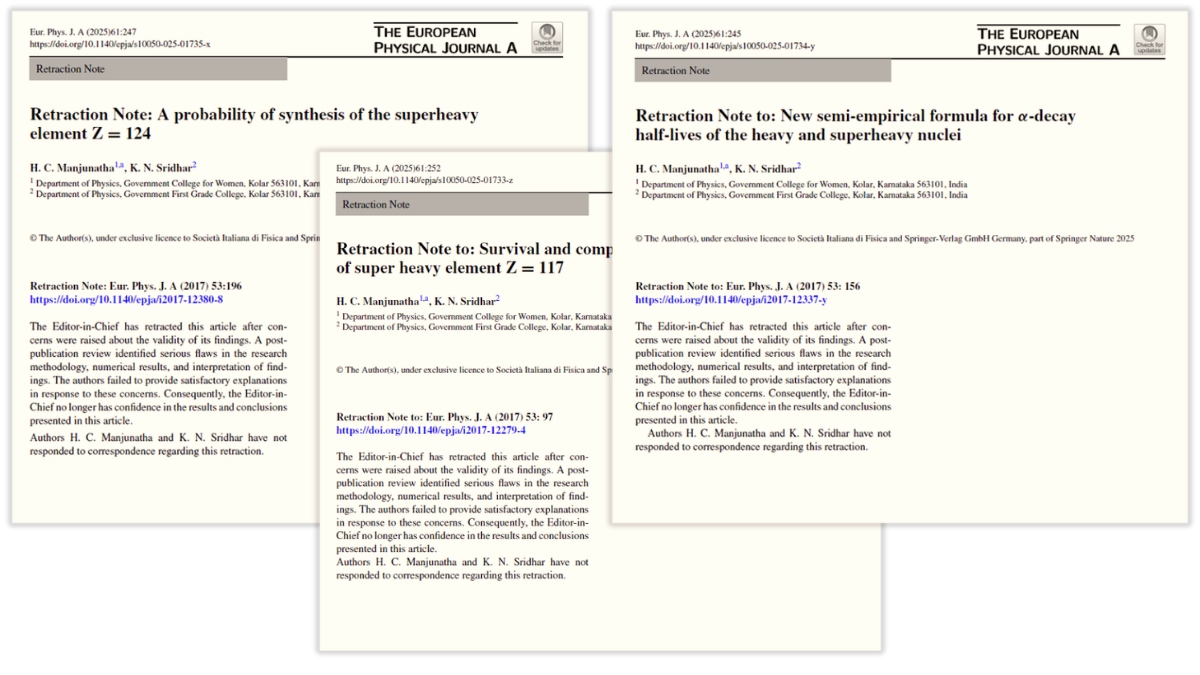
A physicist in India has accumulated three retractions and 13 expressions of concern for papers on superheavy elements after three researchers in the field began to flag issues with his work.
H.C. Manjunatha, the common author on the articles, is with the physics department at the Government First Grade College in Devanahall, according to his most recent papers, including eight published this year.
The three retracted papers originally appeared in Springer Nature’s The European Physical Journal A in 2017. According to the retraction notices, a post-publication review found “serious flaws in the research methodology, numerical results, and interpretation of findings.” All pertain to the discovery and synthesis of superheavy elements, which are unstable elements with large numbers of protons.
David Boilley, a physicist at the University of Caen Normandy and researcher at GANIL, first noticed issues with papers by Manjunatha and colleagues in 2019. After identifying issues with the papers, Boilley told us he contacted publishers, including Springer Nature, in 2024 with concerns.
The Brazilian Journal of Physics, also published by Springer Nature, issued expressions of concern for 13 of the papers at the end of 2025 and the beginning of 2026 after Boilley and his team reached out with their findings. According to the notices, further editorial action “will be taken as appropriate once the investigation into the concerns is complete.”
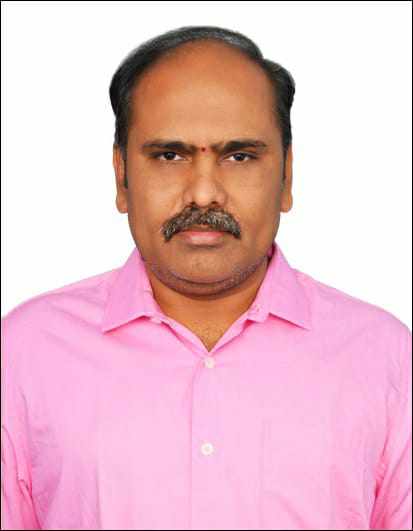
Manjunatha told us he disagreed with the retractions, and said: “sorry to say that it was not manipulated data.” He said the editor told him equations missing from the theory portion of the papers were “too lengthy to include in the erratum,” leading to the retraction of the three papers.
As reviewers for journals, Boilley, Krystyna Siwek-Wilczynska of the University of Warsaw, and Dieter Ackermann of GANIL were “alarmed” by how often Manjunatha was submitting “very poor quality” papers, they wrote in a preprint published March 23 that details their efforts to take a closer look at the work. The preprint calls out over 50 papers they consider problematic.
For example, the authors flagged a 2018 paper published in Physical Review C. Of the paper’s 95 citations, 86 are to other works by Manjunatha. “This serves to illustrate the extent of the issue that we are seeking to highlight, namely a considerable number of papers that cannot be produced by any reasonable researcher and which have a negligible impact, if not a negative one, on the scientific production related to superheavy elements,” the authors wrote.
Except in a few recent papers, Manjunatha and his coauthors have “not developed any model that describes one of the steps in the reaction leading to the synthesis of superheavy nuclei,” a process the papers claim to accomplish, Boilley told us.

Boilley pointed out several issues with graphs in Manjunatha’s papers on PubPeer, including some without units. Another pseudonymous commenter noted figures without a vertical scale. So far, 61 of the physicist’s papers have comments on the forum.
Boilley and his coauthors say the approach to some of the studies doesn’t make sense. While most of the field is centered on creating a theoretical framework for synthesis of superheavy elements, Manjunatha and his team use equations for lighter nuclei, according to the preprint.
“Speaking personally, I have serious reservations about the reliability of a significant part of this body of work,” physicist Michal Kowal of Poland’s National Centre for Nuclear Research told us. “Within the community, these papers have not generally been regarded as particularly influential or widely trusted,” noting the technical details of the publications should be assessed individually.
Tim Kersjes, Head of Research Integrity, Resolutions at Springer Nature, told us the publisher was looking into more of Manjunatha’s papers and “will take further editorial action as appropriate.”
Boilley said he was particularly concerned that Manjunatha published nine papers in Physical Review C, a journal published by the American Physical Society that calls itself the “Home of Nuclear Physics.” Jessica Thomas, executive editor of the journal, told us she had been contacted regarding the concerns, but wouldn’t comment on the “details or status of editorial reviews, and any potential editorial action remains confidential unless and until a public notice is issued.”
When we asked for a comment on the growing number of flagged articles, Manjunatha said: “it is not misuse of equations [sic]…some equations are missing.”
“If such ‘predictions’ were to be taken seriously, it could result in the undertaking of impossible experiments, which would ultimately lead to the squandering of valuable human resources and investments,” the preprint authors wrote.
Like Retraction Watch? You can make a tax-deductible contribution to support our work, follow us on X or Bluesky, like us on Facebook, follow us on LinkedIn, add us to your RSS reader, or subscribe to our daily digest. If you find a retraction that’s not in our database, you can let us know here. For comments or feedback, email us at [email protected].