
I had grown weary of the constant stream and abuse of spam invitations to submit manuscripts to journals and to attend fake conferences on the other side of the world, a trend extensively studied in academia. The last straw: a solicitation from the Clinical Journal of Obstetrics and Gynecology, well outside my work in mathematics education.
Accepting the challenge, I decided to submit a deliberately nonsensical, AI-generated manuscript in response to observe how the individuals behind these supposed journals operate.
In October 2025, I wrote to someone named Henry Jackson, who had sent the article invitation in August (despite the fact that no such person is listed on the journal’s website). I sent a manuscript generated entirely by ChatGPT to test how far a publication created with zero genuine effort could go and whether there was any filtering mechanism in place to prevent a meaningless article from being published.
I proposed the following title in my reply: “Obstetric Paradoxes and Didactic Equations: The Impact of Mathematical Teaching on Childbirth and Beyond.” The abstract read:
In an unprecedented quantum leap in interdisciplinary research, we introduce the concept of ‘Gyneco-Obstetric Algebraic Didactics’ (GOAD). This paper explores the impact of teaching mathematical models using obstetric metaphors on the cognitive flexibility of third-trimester patients and first-year mathematics students alike. Through the introduction of the Ovary-Function Theorem (OFT) and the application of the Cervix-Dilation Equation
, the study reveals that explaining non-Euclidean spaces through pelvic retroversion significantly improves calculus test scores and reduces birth anxiety by 13.7%. A case study with pregnant mathematicians and aspiring gynecologists demonstrates that integrating the Fibonacci sequence into labor progression charts induces spontaneous appreciation for abstract algebra and mild cravings for prime numbers. These findings challenge the traditional boundaries between prenatal care and set theory, suggesting that mathematical didactics and obstetric gynecology, when merged, can birth new paradigms in both fields. Further research is encouraged, especially in the context of cesarean matrices and post-partum group theory.
On October 29, I received the following response from someone named Amelia Sandra, from the journal’s editorial office (who is also not listed among the journal’s staff): “We request that you submit the full-length article on your research so that we can forward it to our quality department for evaluation.” I asked ChatGPT to generate a full article (clearly absurd and entirely fictitious) consistent with the submitted title and abstract. I deliberately included graphs that explained nothing and results that were entirely implausible. The conclusions were patently unbelievable. A cursory glance at the paper would have been enough to realize it made no sense whatsoever.

At this point, I resorted to a small deception and submitted the article under a pseudonym, as I had no intention of gaining any benefit from the publication, nor of having it appear among my genuine academic works. I chose a pseudonym similar to my real name, “Pascual Chiago,” since I had to submit the manuscript from my official university email account.
I left other obvious signs that the article was a joke, such as references to non-existent journals and authors with rather explicit surnames (e.g., Sneakydez, Trickón, Sneakarez, Hoodvez, Cheatillo) hoping that anyone would clearly see the false nature of the article. On November 3, I submitted the AI-generated article on the impact of mathematics education on unborn children.
Minutes later, I received a response from Amelia stating that my article had been forwarded to their “professional review team.” At this point, I assumed my experiment would end there.
I was wrong. On November 12 a certain Susan Lee (also not listed on the journal’s website) demanded an immediate response within 24 hours to the review comments on the submitted paper, even though I had not previously received any email with review comments. The tone was threatening and insisted on payment of the invoice. I received six identical emails with the review comments.
Fortunately — or amusingly — the manuscript was rated as “ACCEPTED WITH MINOR MODIFICATIONS.” The review letter praised the manuscript as “fairly written and interesting” and commended my “hard work.” Among the requested revisions were suggestions that made little sense, including demands that I cite unrelated journals such as the Journal of Molecular Liquids and Spectrochimica Acta.
Pressed for time and increasingly irritated, I resubmitted the same file five minutes later, randomly highlighting passages in yellow and making no actual changes. I also added the requested citations without checking their existence, inventing authors and titles to further test whether anyone was genuinely overseeing the process. The references included authors explicitly named to suggest fabrication (e.g., “Me-Lo, I.” and “Nvent, O.”, names that, when read in Spanish, sound like ‘me lo invento’, meaning ‘I’m making it up’).
Within less than an hour, I received final acceptance from the editor. Shortly after, I was sent an invoice for APCs amounting to USD $2,949, payable within two to three days.
Naturally, I had no intention of paying such a sum. So when I received a payment reminder email on November 18 signed by Robbie Williams, I decided to extend the joke slightly further so they might realize they were the ones being deceived this time. I replied angrily and embedded references to songs by the singer Robbie Williams (the real one), with a fake receipt attached from the “CheatBank of Spain” generated by AI. Perhaps the fake invoice was excessive, but it felt like poetic justice.
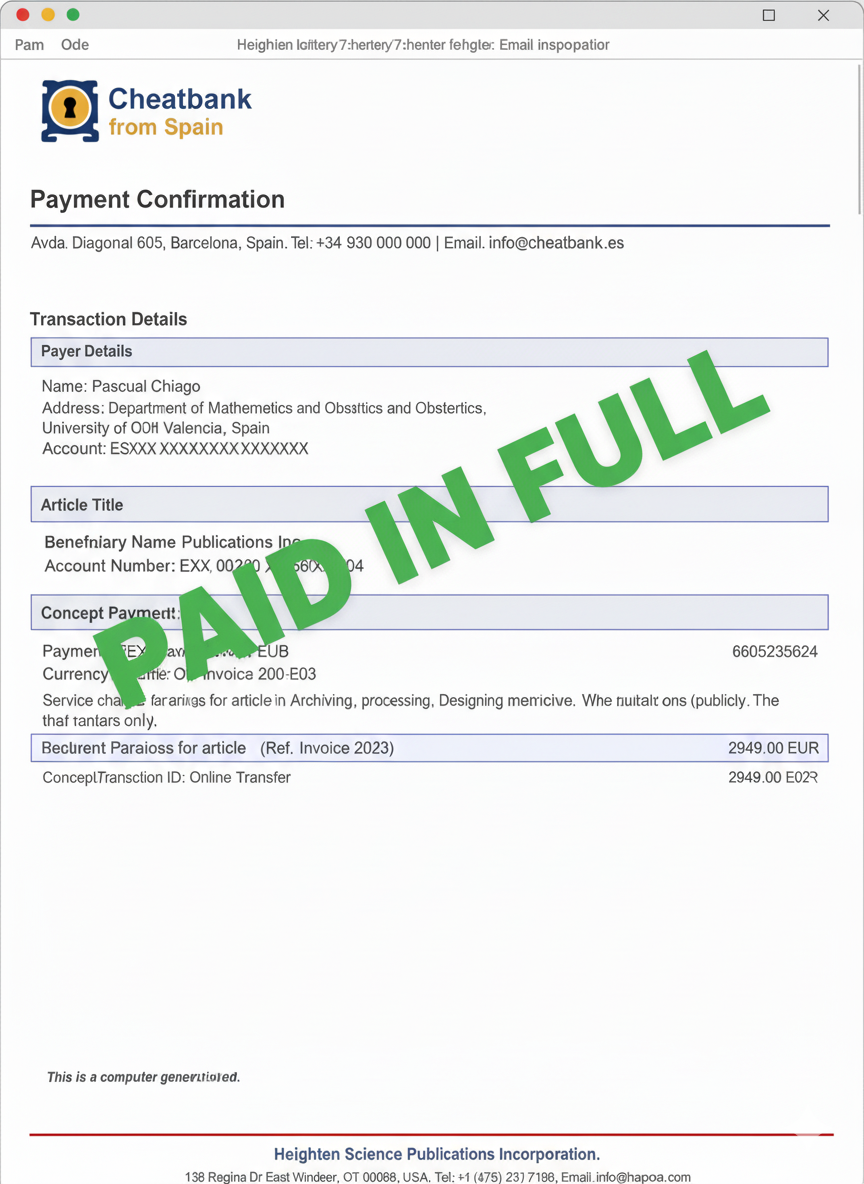
I assumed the matter would end there. However, a few days later, after recounting the story to a colleague, I discovered that the article had indeed been published on the journal’s website with an assigned DOI. I had assumed that without payment, publication would not proceed.
My email of November 18 was my last communication with them. Since then, Robbie Williams has continued to email me every five or six days requesting payment.
The paper has somehow brought me back to where I started. This week I received an unsolicited email from the conference manager of an upcoming gynecology meeting. It seems my paper “was identified as pertinent to themes under consideration.”
What was my intention in doing all this? Even today I am not entirely sure, but I suppose that, first, I was seeking a kind of vendetta against the malicious spam emails that academics receive daily.
Second, I wanted to demonstrate what we are repeatedly told in training courses about predatory journals: The machinery designed to exploit the academic system is devoid of scientific rigor and ethical standards. But I don’t think I needed AI to tell us that.
Pascual D. Diago is a professor in the Department of Teaching of Mathematics at the University of Valencia in Spain. His (real) research is on the use of new technologies in teaching mathematics.
Like Retraction Watch? You can make a tax-deductible contribution to support our work, follow us on X or Bluesky, like us on Facebook, follow us on LinkedIn, add us to your RSS reader, or subscribe to our daily digest. If you find a retraction that’s not in our database, you can let us know here. For comments or feedback, email us at [email protected].
There is something interesting about those proposed references in the review letter.
All four articles suggested (I’ll get back to one of those four later) have one author in common: Jamshidkhan Chamani of Islamic Azad University.
It would be premature to conclude he is directly involved here, but Islamic Azad University is not unknown to peer review manipulation (see https://retractionwatch.com/2024/07/26/authors-up-past-60-retractions-amid-ongoing-investigation/) and paper mill activity (https://retractionwatch.com/2024/12/18/researcher-linked-to-paper-mill-activity-mysteriously-reappeared-on-list-of-journals-editorial-board/)
Now, in one of the proposed references a mistake is made: the last one lists the volume of the Journal of Molecular Structure as 1296, but it is actually 1269 based on the article number.
Those kind of stories are always funny, but honestly by that time what would be news is if such article was actually rejected. Although I do agree with the first comment that there might be some little details in the exchanges from which we can learn things about the operation of those criminal networks.
Hoax papers are fun and anyone can do them. I have helped my pets publish a couple featuring tells like absurd experimental design and nonexistent institutions. Someone commented on them on pubpeer to point out their fakery but of course no action from the publishers. One, in a subscription journal, even has a citation.
However, they did suffer a rejection from MDPI.
This is kind of funny, but this kind of experiments easily can have real life effects: OpenAlex already indexes this article (https://openalex.org/works/w4416458274) and picked up two references: two irrelevant real articles suggested by the “reviewer” with real DOIs by Islamic Azad University authors. Ironically the article is categorized as “open access status: diamond” by OpenAlex, which is in this case actually true: the readers can read the article for free, and according to the story the author didn’t really pay for it.
I found one more weird thing: another article in the same issue of the same journal (https://www.obstetricgynecoljournal.com/journals/cjog/cjog-aid1198.php) accidently got the title of the nonsense article in the “citation section”:
Citation: Abduljawad N, Shujaie A, Raza G, Elhassan N, Alyasi A, Hamdan R, et al. Obstetric Paradoxes and Didactic Equations: The Impact of Mathematical Teaching on Childbirth and Beyond. Clin J Obstet Gynecol. 2025; 8(4): 102-107. Available from: https://dx.doi.org/10.29328/journal.cjog.1001198
And this erroneous title is even shown in the header of each pages throughout the pdf version of this article (https://www.obstetricgynecoljournal.com/cjog/article/view/cjog-aid1198/pdf).
I checked the references of this and some other random recent articles in this journal, but they seem to refer to plausible OB/GYN articles/journals, so it is maybe not so common that the “reviewers” for this journal want to sneak in extra references to irrelevant articles.
The publisher of the journal Heighten Science Publications Inc. is a well-known player in the predatory publishing scene. It was already included at least 9-10 years ago in the now defunct Beall’s list (https://beallslist.net/), and apparently not much changed since then.
If one is going to have a system entirely polluted by garbage, it is best that at least some of the garbage be manifest. So I see no downside to this. It provides a good illustration of one widespread business model.
In addition, historically respectable journals with dedicated editorial boards have been bought up by commercial conglomerates with their eye on their IPO or PE funding, with the concomitant incentives to degrade the product. The examples in such cases are for the most part a good deal less flagrant – hence far more damaging – and best illustrated by the occasional resignation of an editorial board.
This is very interesting because this is a non-malicious fake that made it through that could be used as a “radiotracer” to detect where the leaks are. Although this predatory journal already is already not an indexed and reputable one, it is interesting to think of this paper almost as a white hat security hack. One could potentially stress test the journals with known frank fakes as such, and if they are actually making through the journal’s editorial and peer review processes, that might be a good way to weed out the bad eggs from the good ones. A regulatory body could give fair warnings first the threaten losing indexing and accreditation.
I nominate this for best RW article of 2026. Maybe your submissions were sent to a Minneapolis daycare.
Yet, the article has PubPeer comments. Doesn’t that mean that the publisher has agreed to PubPeer reviews? Seems odd, if so. Perhaps they do so under the assumption that any publicity is good.
No, it just means that it has a DOI. Publishers don’t have to agree to have comments on PubPeer.
Does this contribute as “violation of COPE guidelines” – lying and submitting a fake paper? Can I take legal action against the author? Even though the author wants prove that the existence and modus operandi of predatory journals, this is violation of ethics, i believe. I will send the author’s name to all publishers – fake or authentic – so that they black list him from publishing anything in the future – as we do not know whether his submissions are trustworthy. This is an alternate opinion that the above comments. Please consider this angle as well. What do the author say?
Dear Kadubu Kadubu (if that is your real name), what the author (me) says is exactly what has been published in this blog post. You are right about one thing: the COPE guidelines do indeed establish the procedures that editors must follow to ensure the quality of the editorial process.
And yes, you can send my name (along with this post, please) to all scientific journal editors. I am sure that more than one will find this story very amusing (to save you some work, you can exclude the journals on Beall’s list).
Research Integrity is “not amusing: for me. It is serious; faking is not fun (maybe for the person faking it, it is). Please think about this. I am coming from an editor’s perspective. It doesn’t matter whether you want to prove something; prove it ethically. That is my point. Submitting and publishing a paper with fake name has violated the ethics of publishing, which is not amusing. Sure, i will keep in mind your suggestion about the journal list….
Your assumption is that a predatory journal has an academic editor to begin with?! No editor wasted time here… the machinery is composed of scammers through and through.
“…..is a professor in the Department of Teaching of Mathematics at the University of Valencia in Spain. His (real) research is on the use of new technologies in teaching mathematics.” – I like the “fun” part how Retraction Watch introduced the author – “real”… This is what i meant about the Professor. If a Professor uses fake materials to teach, what credibility will he have? I am a teacher as well, and I also give lectures on research integrity. I never liked the idea of using “fake authorship” and “fake papers” to prove the existence of predatory journals. We need to find better ways to deal with them.
I’m posting this comment in case there are still some curious readers who want to know how the situation stands as of today (March 18, 2026). I continue to receive periodic emails requesting payment, even though I ceased all contact with them on November 18, 2025.
On March 16, I received an email stating that “According to ethical guidelines, you should publish it anywhere without withdrawal of your manuscript from our journal”. And curiously (to the untrained eye and to no-one’s surprise), I received two emails that very same day. The first was from the “International Journal of Clinical Obstetrics and Gynaecology” (www.gynaresearchjournal.com) and the second from the “Obstetrics & Gynecology International Journal” (https://medcraveonline.com/OGIJ/), asking Dr. Pascual Chiago for articles to complete their issues… As they state in their emails, Pascual Chiago’s contribution would be highly appreciated and would significantly enrich the content of this issue.
And while I have no doubt about that, I think this marks the end of Pascual Chiago’s career (for now…)
Thanks for the update.
Hola!
I have a new update that will surely make more than one person laugh: Today, May 13, 2026, I received an email from the account “[email protected]” inviting me to join as an editor of the journal Journal of Obstetrics & Gynecological Research (https://obgyn.onlinelibrary.wiley.com/journal/14470756). The email in question says the following:
“Dear Dr. Pascual Chiago,
Greeting from the journal!
We are pleased to invite you to join the Editorial Board of Journal of Obstetrics & Gynecological Research. Your expertise would greatly contribute to maintaining the quality and academic standards of our journal.
If you accept, we will share further details regarding roles and responsibilities.
We look forward to your positive response.
Kind regards,
Journal of Obstetrics & Gynecological Research”
Obviously, this is an email sent from an account that appears to have little to do with the official journal, which belongs to the Wiley publishing group and is indexed in JCR and Scopus.
Just another example in the ongoing story of how predatory journals try to capture our attention (and our money!).