Six editors and nearly 60 advisory editors of Games and Economic Behavior resigned after the journal’s publisher decided not to renew the editor-in-chief’s contract.
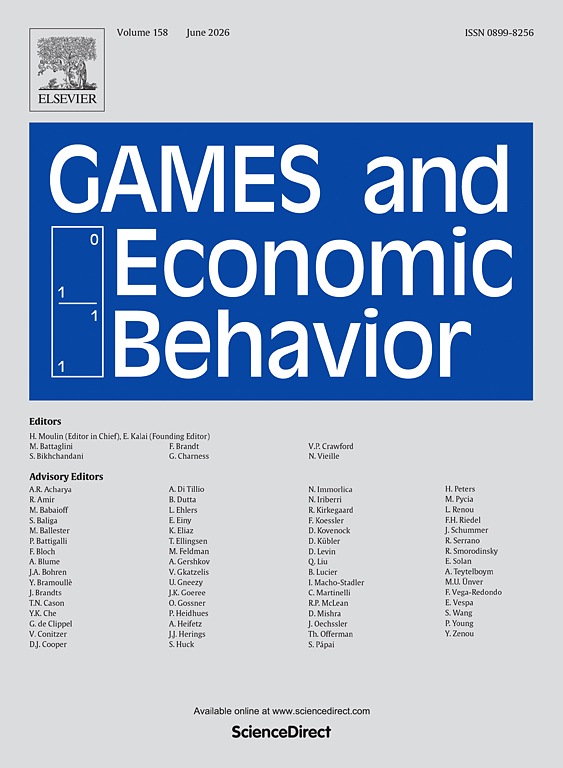
In late July, Elsevier told Hervé Moulin, a business professor of the University of Glasgow, his six-year tenure as editor-in-chief of the journal would end in December. Moulin told Retraction Watch he was disappointed by the news, as he had expressed a desire to continue in his role.
The journal’s six editors resigned in the weeks following, according to an August 16 email, the text of which is also posted on the website for the Game Theory Society. Games and Economic Behavior is one of the group’s two official journals. As of August 19, 58 of the 62 advisory editors had resigned as well.
“Requests for explanations, first by me, then in a collective letter by the other six Editors, were dismissed by Elsevier which simply reaffirmed its legal power to make such decisions,” Moulin wrote in the email, which was cosigned by the six resigning editors. In the email, he also said Elsevier cited “closer alignment with Elsevier strategic priorities and publishing policies” as a reason for the move.
The journal joins our Mass Resignations List at number 57, marking the seventh mass exodus we have covered this year. In April, we reported on the resignation of editors from another Elsevier journal after the publisher similarly informed the editor-in-chief the company would not be renewing his contract.
Because the editors are required to give three months notice, the resigning board members wrote they plan to continue their duties at the journal until November 14. Moulin chose to resign at the same time rather than complete his contract.
Roberto Serrano, another editor resigning in November, told us Elsevier “has behaved in this incident arrogantly and inappropriately, by refusing to answer key questions about the future direction of the journal, which we had asked, and by suggesting names of new editors with no input from the academic community.”
Serrano, a professor of economics at Brown University in Providence, Rhode Island, added: “As the other editors of the journal, we wanted to own what those new initiatives and directions for the journal were, and their answer was complete silence.”
Moulin told us the publisher “crossed a fundamental red line in the good faith agreement between the Editorial Board and the publisher” by not consulting with the editorial board regarding future editorial appointments.
The publisher told the editorial board in an August 20 email: “We respect Hervé’s leadership experience, hence the outreach about potential successors was made with a view to including him in shaping GEB’s future — but he chose not to respond further and withdrew from those discussions.”
“Leadership transitions are a normal part of a journal’s evolution, and Elsevier’s priority is ensuring GEB continues to serve its editors, authors, and the research community well,” the publisher wrote.
An Elsevier spokesperson told us Moulin “reached the end of its three-year timespan, and the team at Elsevier deeply appreciates the Editor’s years of contribution to GEB.”
“No respectable academic journal can work under these rules, and so it is understandable that the resignations of our entire board of Advisory Editors —about 60 distinguished scholars— have followed the resignation of us, the seven editors,” Serrano said. “[W]hen a publisher goes as far as to suggest who the new editors should be, without any input from the academic community, I can’t work for a journal like that.”
Like Retraction Watch? You can make a tax-deductible contribution to support our work, follow us on X or Bluesky, like us on Facebook, follow us on LinkedIn, add us to your RSS reader, or subscribe to our daily digest. If you find a retraction that’s not in our database, you can let us know here. For comments or feedback, email us at [email protected].
Of course the editors of a journal on game theory and economics would manage to solve a collective action problem.
Sure. This would be a direct empirical test of their theories.
All journal publishers must have the right and must exercise their rights to change the leadership after a few years to make sure new things are allowed to come in and challenge old things. “[W]hen a publisher goes as far as to suggest who the new editors should be, without any input from the academic community, I can’t work for a journal like that.” Start a new journal if you feel you are too important. Or, Just shut up and leave. That’s what Elsevier is implying without saying it loud.
Publisher sure do have the right to change editors without the consent of anyone.
But serving editors and the community, who work for free for the journal, sure have also the right to leave ship and let the publisher sort out how they ended up with a fistful of flies as the community built another journal somewhere else.
Changes of management just for the sake of changes in management are almost always bad ideas.
Well this time it is more likely that the old editorial board can actually start a new journal, making the old GEB an empty house.
I beg to differ from the tenor of the opinions offered so far by commenters. These are mass resignations. Not just individual departures. We are talking about six editors and 60 advisory editors. And this is number 7 this year and 57 on the Mass Resignations List. In my view this reflects a shift in the journal publishing market with the growing emphasis on volume over quality. With the arrival of Open Access publishers of questionable ethics and commitments the publishing ecosystem has become infected by an almost unqualified commitment to volume production over traditional quality criteria. It now seems that the legacy publishers are getting into the game. A signal was the purchase of Hindawi by Wiley. Anybody could see this was a dodgy move spurred by commercial motives, and so it has proved with multiple retractions and the resignation of the culpable Wiley CEO. Does this matter? Yes. This is why we have a Retraction Watch newsletter. Because the entire scholarly and scientific academic publishing system is becoming infected by issues of integrity and downright fraud. What’s the answer? Scholarly and scientific communities need to take back control of the editorial process.
Protesting by mass resignation is allowed in any journals. This rarely occurs in traditional academic journals because they pass the batons to the same system such that these journals are run by the same academic system to promote and support their own agenda. Elsevier and others are right to shuffle or to change the editorial boards to see the editors off as often as necessary. This has got nothing to do with Wiley’s decision to buy Hindawi. However, Wiley, Elsevier and Springer (WES) do not and cannot promote the same agenda as the traditional journals do, if they do, then there is no money to be made, no alternative thinking, no new results that can overthrow traditional ideas protected by the traditional academic journals. So, WES need to be independent of traditional academic journals by publishing scientifically correct and validated science that are new and original regardless of who are the authors and authors affiliations. Desperate scientists will take advantage of these publishers willingness to consider alternative ideas, and these publishers may take advantage of these desperate scientists by offering them OA journals. This situation is also happening in traditional journals, but without permitting outsiders and the works that do not promote or support established academics works. So, there is an important role played by these commercial publishers-They permit alternative new or original or outstanding works to be published that challenge the established works with proper science (with proper physical, mathematical and experimental proofs). So there you go. As for the published fraudulent and scientifically false works published in ALL journals, we always have Retraction Watch to thank for, for exposing them. Finally, just because a work is published (anywhere), it does not imply it should be permanently protected. All published work must be allowed to be challenged, and academics in traditional academic-society journals must learn to defend their work with proper science.
This is so far off that I feel the need to write a comment. First of all, this whole argument hinges on the assumption that “traditionalists” are unwilling to publish new ideas. At least in my field (which happens to be GEB), I have never experienced this. Sure, it can be more difficult to publish a paper if one breaks with traditional assumptions or frameworks. However, if there is a sound motivation for why one does so, I have always felt that reviewers/ editors can be convinced. Also, the whole story of “overthrowing old ideas” does not really apply in “hard” sciences or theory, where results are usually proven by some hard evidence. If this evidence is correct, the result is essentially just a true fact which one can expand on, interpret differently, and so on, but one cannot overthrow it.
As a second point, most journals (such as GEB) serve a community (for GEB, that is the game theory society). Of course, it is within the rights of the publisher to change the editor-in-chief, and it is fair if they want to have a say in the follow-up. However, choosing the editor-in-chief without any input from the community it serves amounts to pushing away the community. That is effectively also what we see with the mass exodus of editors at GEB, in an extreme form. As a matter of fact, I see a significant chance that GEB either closes within the next few years or degrades to a low-quality journal, as most (good) researchers in the field will likely avoid it for the next few years.
Lastly, on the point that the journal can still publish papers by desperate authors: I’d argue that, if authors do not manage to convince other people working in the field that their idea is good, there is no point in publishing the work at all. That is, who is going to read it if not other people working on the subject, who apparently don’t think it is worth publishing? Also, in most cases (at least in my field), the reason why authors struggle to publish a paper is not that it is “too ground-breaking or novel”, but that it simply does not live up to the standards of the field.
The point that stands is that the objectives of the publishers do not align with that of researchers. That is certainly true, and in my opinion, all the more reason to just avoid them altogether…
Very well-put, Anonymous, and a concise explanation of the issue. Journals were developed to serve the scientific community, and parasitic monetization by publishers is ultimately against the scientific community.
You are contradicting yourself and you are not even aware of it.
(1) “if authors do not manage to convince other people working in the field that their idea is good, there is no point in publishing the work at all. That is, who is going to read it if not other people working on the subject, who apparently don’t think it is worth publishing? Also, in most cases (at least in my field), the reason why authors struggle to publish a paper is not that it is “too ground-breaking or novel”, but that it simply does not live up to the standards of the field.”
Response (1): This point is false for cases where if those same “people” refused to and/or unable to counter the ideas put forth scientifically, but instead decided to reject them anyway based on one’s authority and past beliefs. Therefore the claim, “However, if there is a sound motivation for why one does so, I have always felt that reviewers/ editors can be convinced. I have always felt that reviewers/editors can be convinced.” cannot be maintained.
(2) “If this evidence is correct, the result is essentially just a true fact which one can expand on, interpret differently, and so on, but one cannot overthrow it.”
Response (2): This should not be imposed outright, but by evaluating the submitted work, even if overthrowing is an extremely rare event. Scientific community (SciCom) must be open to new scientific ideas that have been properly derived and presented using scientific method (consistent logic and math and/or observations (if any)).
(3) “However, choosing the editor-in-chief without any input from the community it serves amounts to pushing away the community.”
Response (3): This is not valid. Who are the SciCom is not decided by EiC and their boards or anyone. Anyone can and should be allowed to counter whatever the new EiC and his new board happen to decide what work to publish in the future, for as long as the arguments and comments are scientifically valid. We are always welcome to thrash non-original, false and fraudulent work, and at the same time we must also allow them to counter us.
(4) “I’d argue that, if authors do not manage to convince other people working in the field that their idea is good, there is no point in publishing the work at all.”
Response (4): Convincing humans is not and does not require hard science. This is a fact. Convincing a robot (or AI) on the other hand, needs hard science, but then the submitted work must always be based on what is already programmed within that robot (AI), which implies nothing new can be presented to overthrow what has been programmed into AI. AI just repeats the same “shit”.
(5) “Also, in most cases (at least in my field), the reason why authors struggle to publish a paper is not that it is “too ground-breaking or novel”, but that it simply does not live up to the standards of the field.”
Response (5): Again, it is a fact that standards is not based on hard science. If standards is the issue, then use science or scientific method to justify why no-standards. SciCom should not fear to point out openly and explicitly why and how a work is below or no standards and be willing to allow the authors to respond. Unless these very people are incompetent and they do not allow authors to respond out of fear, and prefer to hide behind the words, no-standards and not-convincing and apply these words conveniently based on some internal democratic process.
In conclusion, in fact all journals (traditional or commercial) must reshuffle or change their editors and boards drastically and as often as necessary without the need to pass the batons to the same system for the progress of science. If I want to become a real champion in any game, I have to play with everyone who wants to compete with me, and defeat them all. I should not win any game by disqualifying my competitors with dubious conditions such as not-convincing and no-standards. Such privileges can never be allowed in science. We all must learn to earn our victories.
You think that without the predatory behemoth that is Elsevier, “no alternative thinking, no new results that can overthrow traditional ideas protected by the traditional academic journals”? This is the funniest thing I’ve read in ages, thanks!
I tried mentioning this in a comment at the time of the Journal of Approximation Theory similar non-renewing of the Editor-in-chief contract, but for some reason the comment did not get published – not implying anything here, as this was probably, a browser issue on my side.
In the case of the Journal of Approximation Theory, the EIC had been in that position for 35 years. In the case of the GEB, this editor had only been there for 6 years, but the previous EIC, Ehud Kalai had been an editor (if we are to believe the AI search), for 31 years and the new editor was a continuity solution:
Ehud Kalai
Tenure: 31 years (1989–2020)
Status: Founded the premier game theory journal in 1989 and served continuously as its head until passing the torch to Hervé Moulin on January 1, 2021.
While some journals/publishers do put a limit to the number of years an editor may be in charge of a journal, doing a search for other EIC that lasted (or are still there) for more than 20 years, for instance, does reveal that the two cases above are not isolated cases. People may then have different opinions as to whether this is a good thing or not.
Just saying. You can take the credit for my comments above if you think you have said something similar to my comments above. I do not write comments here to get any credit.
Wow, who would have thought that the comments section of Retraction Watch, off all places, would be so toxic!