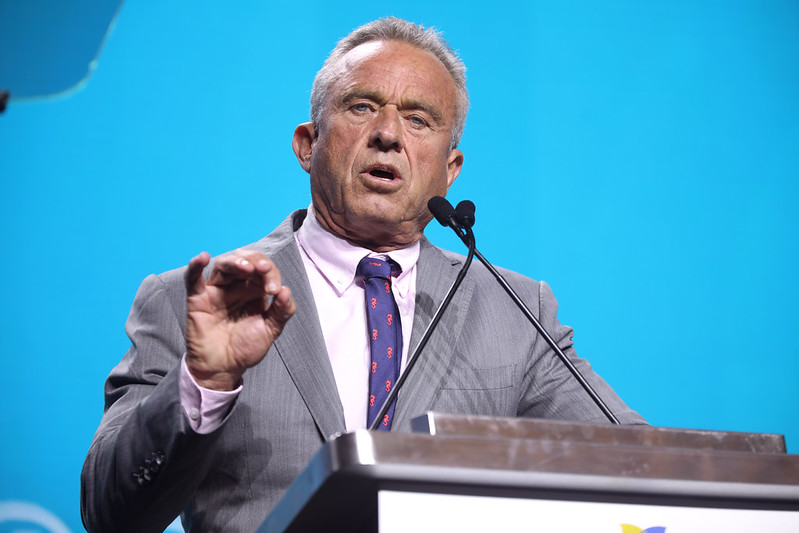
Credit: Gage Skidmore/Flickr
Robert F. Kennedy Jr.’s letter demanding answers from a journal that recently retracted an article about vaccines has drawn significant attention. But the inquiry isn’t the first time Kennedy has used his platform to try to influence retraction decisions, with one critic calling out a pattern by Kennedy of “politicizing” the process.
Scholars say Kennedy, the secretary of the U.S. Department of Health and Human Services, has shown an inconsistent ideological approach to retractions. Last year, he called for the retraction of a study that failed to find vaccines cause harm. His recent letter to Toxicology Reports — which includes reference blunders with an 80-year-old paper and outdated COPE guidelines — criticizes the retraction of a paper tying infant deaths to vaccines. While critics call his motives political, one researcher says a key component of Kennedy’s letter – a call for more publisher transparency – aligns with improving the retraction process.
In the June 11 letter to Lawrence H. Lash, editor-in-chief of Toxicology Reports, Kennedy demanded “a full explanation” from editors for removing a 2021 study linking sudden infant death syndrome to vaccines. We reported the retraction on May 26.
The single-author study, by vaccine critic Neil Z. Miller, found 75 percent of reported SIDS cases occurred within seven days of vaccination, suggesting the fatalities are tied to immunizations. But the retraction notice, dated April 9, states concerns about methodological flaws in the paper and the “potential implications for medical practice,” drove the retraction.
Kennedy wrote the journal’s retraction notice is “woefully insufficient,” and told the journal to provide more information about its decision by June 25.
Last year, Kennedy had a different take on retractions, calling for the retraction of a Danish study that determined aluminum in vaccines do not pose increased health risks for children. He called the research “a deceitful propaganda stunt by the pharmaceutical industry,” that was “meticulously designed not to find harm,” according to his opinion piece in TrialSite News. And in April, he told members of Congress that a different study – which failed to link Tylenol and autism, contradicting his earlier claims at the White House – should be retracted.
Kennedy himself has had an article retracted. In 2011, Salon withdrew an article he wrote that made claims tying autism to vaccines. Kennedy stood by the work and framed the retraction as censorship.
Kennedy has a pattern of “politicizing retractions,” said Kathleen Hall Jamieson, a communication professor at the University of Pennsylvania who researches science communication and ways to curb misinformation. She co-founded FactCheck.org which aims to correct political and scientific falsehoods.
“He calls for retractions of things he does not find ideologically convenient,” she told Retraction Watch. “And he objects to retractions he finds ideologically inconvenient.”
In this case, Jamieson said Kennedy is overstepping his authority and using legal language that suggests he has the “power to compel journals to give him answers.”
Rod Abhari agrees Kennedy has shown “bias” in how he approaches retractions based on what is most opportune. His objections to individual articles and retractions suggest he’s “looking to have greater control of what publishers can publish,” said Abhari, a scholar at the University of Wisconsin, Madison who researches information integrity and the politicization of science.
“The downstream effects of litigating retractions when it comes from a political figure like RFK is the suppression of academic freedom,” he told us.
However, Abhari said Kennedy’s questions about why the journal retracted the Miller paper are fair and that more explanation about how editors determined the paper had potential implications for medical practice would be helpful. Retraction notices often lack clarity and would benefit from more transparency, he said.
Specifically, Abhari said the notice lacks clarity for a public audience. He referenced the journal’s explanation that “given the inherent limitations of passive reporting systems, including the expected temporal clustering of events independent of causality, the conclusions presented in the article are not supported by the methodology employed.”
“The audience for a retraction notice is broader than ever thanks to the ubiquity of open science and online journals. Is a public audience readily able to understand what exactly the ‘expected temporal clustering of events independent of causality’ means?” Abhari said. “If the language of a retraction notice is too abstruse, it may fail to persuade public audiences.”
Abhari said it would be helpful for the notice to explain what the standards are in vaccine research and provide a more readable discussion of these standards. He would also like to see more explanation about the study’s ”implications” for medical practice and the criteria used to measure this.
Publishers have long been criticized for the lack of information and reasoning in retraction notices, although the landscape is slowly improving with some journals promising greater transparency and more sleuths receiving credit for fueling retractions.
A spokesperson for HHS declined to answer specific questions about the matter. In a statement, the spokesperson told us Americans “deserve transparency.”
“They have a right to know why scientific papers are removed, who made those decisions, what criteria were used, and whether those standards are applied consistently,” the spokesperson said in an email. “Under Secretary Kennedy’s leadership, HHS will continue working to restore trust in public health through increased accountability and open scientific inquiry, not by telling the public to accept decisions made behind closed doors.”
Lash did not return a message seeking comment.
Kennedy’s letter refers to 2009 Committee on Publication Ethics (COPE) retraction guidelines for support. COPE guidelines have been revised and updated several times since 2009 with the latest comprehensive update in 2025.
Magdalen R. Wind-Mozley, a former forensic scientist and vaccine advocate based in Newbury, England, said beyond Kennedy’s demand for explanation, his letter includes errors. Wind-Mozley previously condemned the Toxicology Reports paper on X and contacted the journal in 2022 to call for its retraction, she told us.
In his letter to the journal, Kennedy wrote the Miller paper “cites an extensive literature on an association between sudden infant death syndrome (SIDS) and recent vaccinations, from 1933ii to 2014iii. Did the experts involved in investigating the Miller article also investigate those cited papers?”
But Wind-Mozley discovered the reference cited in the letter is from 1946, not 1933, and the paper discusses twins who died of anaphylactic shock following vaccinations. The term SIDS was coined in 1969.
Wind-Mozley also pointed out the paper, published in JAMA, states the author hopes the report of the two fatalities “will not deter the profession from continuing to practice immunization.”
“So the paper itself is not about SIDS, is not a case from 1933, and is supportive of the importance of vaccination,” Wind-Mozley told us.
Debate over the retracted 2021 vaccine paper may not have escalated had the withdrawal come sooner, Jamieson said. Criticizing retractions is often easier when they happen years after flawed papers come to light, she said.
“If the retraction process were working well, we would retract when there’s problematic content early,” she told us. “When there are problems in something, the sooner the problem is addressed and it’s determined whether the paper should be retracted, the better.”
Like Retraction Watch? You can make a tax-deductible contribution to support our work, follow us on X or Bluesky, like us on Facebook, follow us on LinkedIn, add us to your RSS reader, or subscribe to our daily digest. If you find a retraction that’s not in our database, you can let us know here. For comments or feedback, email us at [email protected].
The journal more than adequately explained the reason for removal which is you cannot use VAERS for the purpose Miller used it for in his paper: “In particular, serious methodological flaws were identified in the use of VAERS data to infer a correlation between vaccination and sudden infant death syndrome (SIDS).” And the disclaimed on the US VAERS website explicitly states: ” While very important in monitoring vaccine safety, VAERS reports alone cannot be used to determine if a vaccine caused or contributed to an adverse event or illness. ”
What more does Abhari want? Kennedy isn’t a scientist and that’s his fault.
Read the paper before commenting. It does not claim to determine anything. Falling for the propaganda, it’s not a good look.
When you read the paper, did you notice where Miller simply lied about the contexts of the references he cites from 1946 and 1933?
Whoops, that should be “the *contents* of the references from 1946 and 1933.