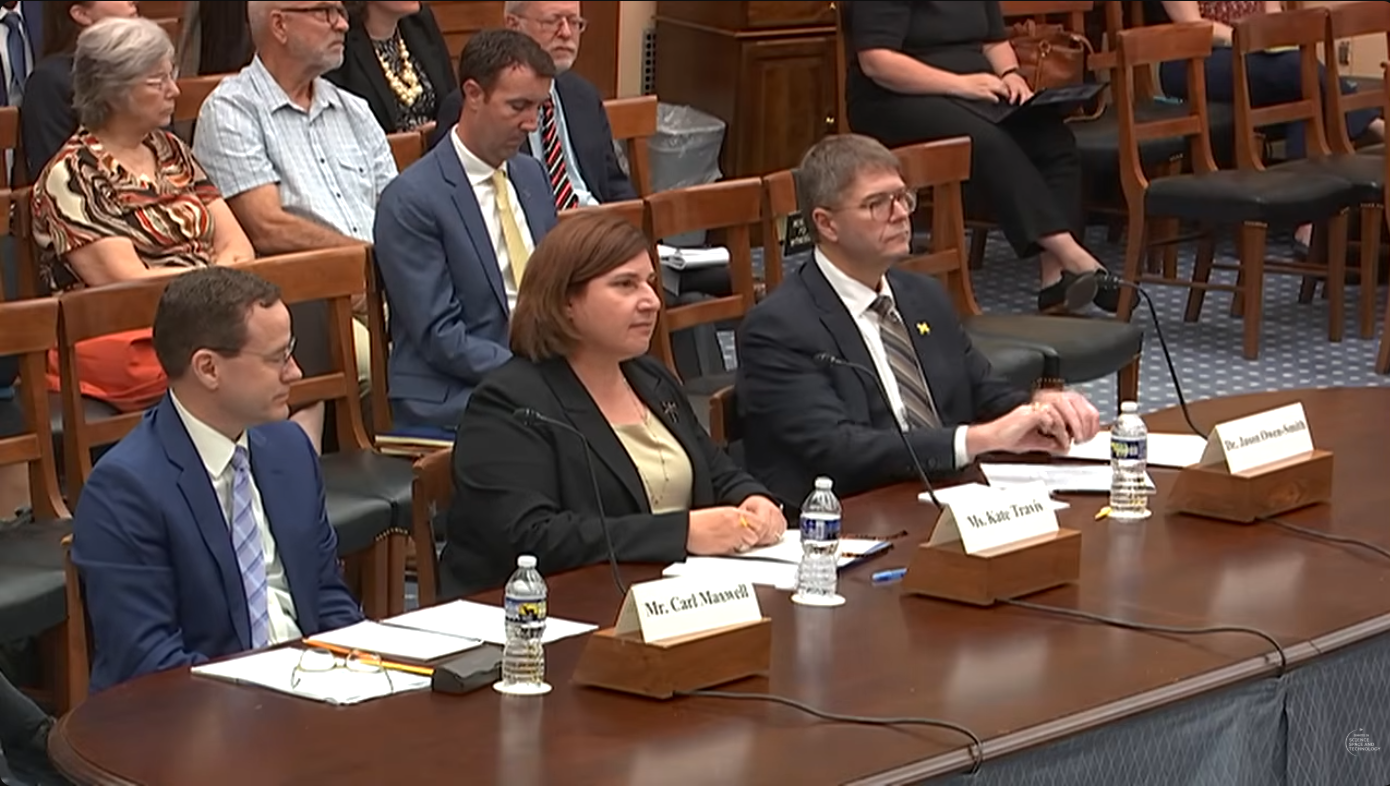
A hearing on Capitol Hill today explored issues in scientific publishing — and Retraction Watch had a seat at the table.
The Investigations and Oversight Subcommittee of the U.S. House Committee on Science, Space and Technology called the hearing to talk about open access, reproducibility, predatory journals, paper mills and the incentive structure in science. The wide remit meant the committee and witnesses touched on quite a few topics in 90 minutes.
Our testimony, delivered by managing editor Kate Travis, focused on the pitfalls of “publish or perish” and how an overreliance on metrics has incentivized shortcuts in research and publishing. “‘Publish or perish’ is what has allowed businesses like paper mills and predatory journals to flourish, and more recently is leading to an explosion of AI-generated papers flooding journals,” Travis told the subcommittee.
Those incentives have a global impact. “A number of news outlets have recently reported on data showing that China has overtaken the U.S. on many measures of scientific prestige and accomplishment,” we said in our written testimony submitted in advance of the hearing. “Some of this rise is due to investment by the Chinese government and real productivity gains. But some of it is also due to gaming the metrics by which science output is judged.”
Several subcommittee members focused on the issues in the context of the president’s 2027 proposed budget, which includes some deep cuts to scientific research. While we didn’t specifically weigh in on the proposed budget, we took the opportunity to talk in our written testimony about what retractions tell us about the research ecosystem:
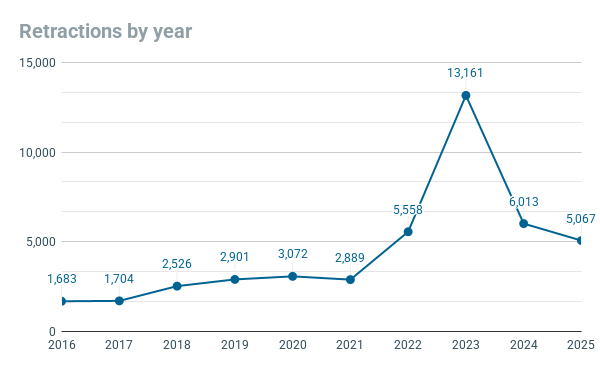
“The growing retraction rate should be interpreted as a sign of progress,” our testimony states. “It is, in fact, an argument for more investment in scientific research that is performed carefully and rigorously, and corrected when necessary. But retractions still take too long, and do not happen as often as they should.”
Find our written testimony and other information about the hearing here, as well as a recording of the hearing.
Like Retraction Watch? You can make a tax-deductible contribution to support our work, follow us on X or Bluesky, like us on Facebook, follow us on LinkedIn, add us to your RSS reader, or subscribe to our daily digest. If you find a retraction that’s not in our database, you can let us know here. For comments or feedback, email us at [email protected].
Kinda sad to see you’re going to play along with this administration. Seriously, you folks have blown off all the stuff I’ve sent you as though you don’t want to piss off Kennedy and Trump. I’m very disgusted with RW.
Not sure what you mean, just look up “RFK” and they’ve written multiple pieces on his lies and failures. Whatever independent things you’ve sent is a different issue that I don’t know about.
As far as “play along with the administration” goes, talking about specific critiques in publishing is, in my opinion, “benign” if you’re being uncharitable and “taking part in our democracy” if you’re being realistic.
Congressional hearings are hosted by members of Congress from both parties, including the opposition. Taking part in one doesn’t imply endorsement of either side.
Scientific integrity is ideally not the purview of any administration in particular, whatever the prevailing wind. As for being “blown off” by RW, perhaps you can prepare an article and publish it on Substack? I have brought my concerns about scientific integrity to many people in the past and discovered that the person who needs to take ownership of the story is you (me). In my case I realized that there is no investigative journalist out there just waiting to cover my story. Write a good article. Support your assertions with references. Self-publish and perhaps feature your articles on websites like this and others that host works from guest authors.