Retraction Watch testifies in Congressional hearing on scientific publishing

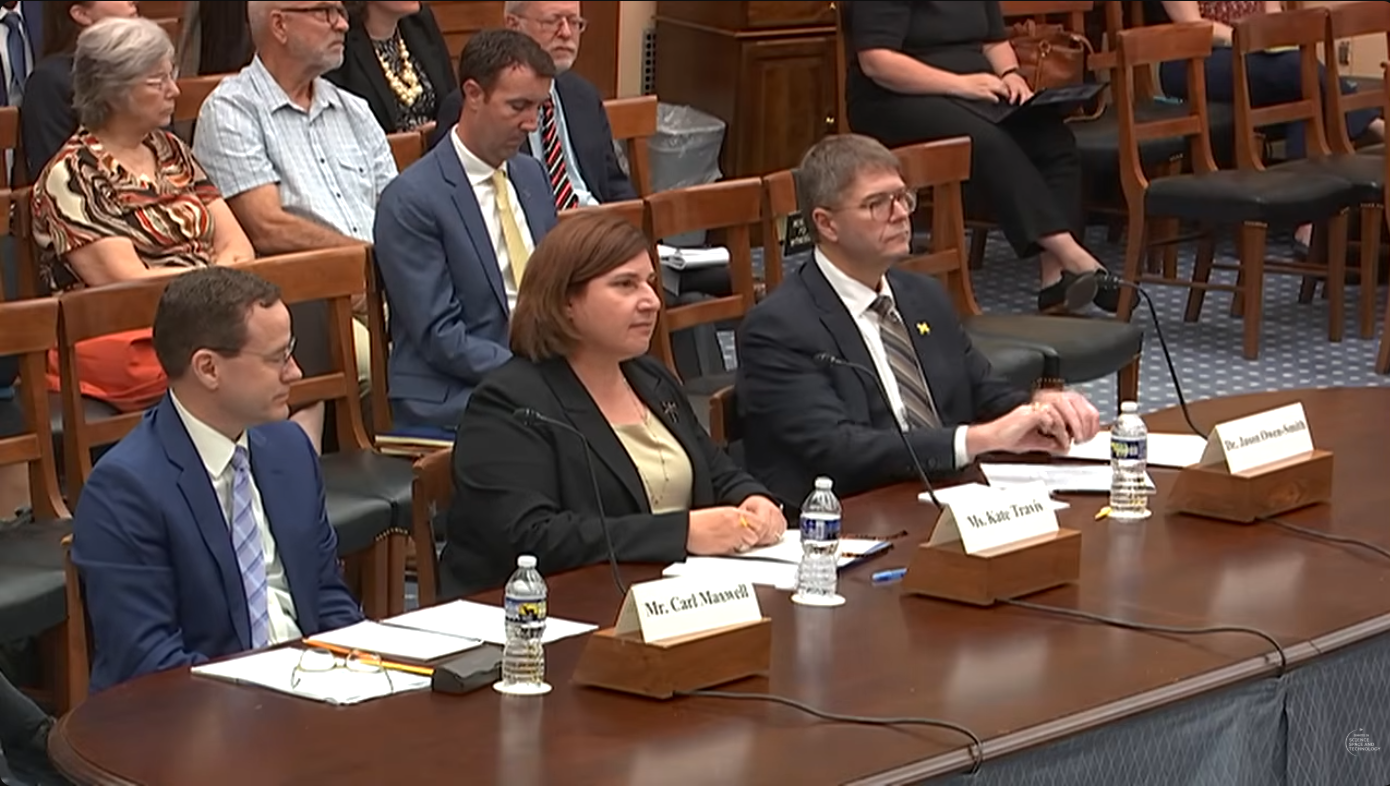
Retraction Watch managing editor Kate Travis (center) testified April 15 in a hearing before the Investigations and Oversight Subcommittee of the House Science, Space and Technology Committee. Other witnesses were Carl Maxwell (left) of the Association of American Publishers and Jason Owen-Smith (right) of the University of Michigan.

A hearing on Capitol Hill today explored issues in scientific publishing — and Retraction Watch had a seat at the table. 

The Investigations and Oversight Subcommittee of the U.S. House Committee on Science, Space and Technology called the hearing to talk about open access, reproducibility, predatory journals, paper mills and the incentive structure in science. The wide remit meant the committee and witnesses touched on quite a few topics in 90 minutes.

Our testimony, delivered by managing editor Kate Travis, focused on the pitfalls of “publish or perish” and how an overreliance on metrics has incentivized shortcuts in research and publishing. “‘Publish or perish’ is what has allowed businesses like paper mills and predatory journals to flourish, and more recently is leading to an explosion of AI-generated papers flooding journals,” Travis told the subcommittee.

Continue reading Retraction Watch testifies in Congressional hearing on scientific publishing

Cheers to 2025: In which Retraction Watch turned 15, and The Center For Scientific Integrity really became a center

We always enjoy our annual review of the year at Retraction Watch, and 2025 is no exception. But we’re more excited about what lies ahead than what we already accomplished. 

We’re on track for our second-highest year for pageviews — 6.6 million. This year we brought you more than 300 posts. Among our most-read stories this year include ones on metrics: The most-read of the year was on universities whose publication metrics show signs of “questionable authorship practices.” Also among the most-read stories was one on the 20 journals that lost their impact factors this year for citation issues. 

Fakery was also a theme in 2025. A story on a Springer Nature book full of fake references and one on dozens of papers with fake company affiliations were among the most popular of the year. 

Continue reading Cheers to 2025: In which Retraction Watch turned 15, and The Center For Scientific Integrity really became a center

The Retraction Watch Hijacked Journal Checker now has 400 entries

Sham journals that mimic real ones can fool unsuspecting authors who are submitting a manuscript, researchers looking for references for papers — and even indexing services aiming to be comprehensive in their coverage. For three years, researcher and sleuth Anna Abalkina has been tracking these clones in the Retraction Watch Hijacked Journal Checker.

Earlier this month, Anna’s list of hijacked journals surpassed 400 entries. We took the opportunity to ask her about the list’s history, what happens to journals on the list, how to spot a potentially hijacked journal, and more. 

Continue reading The Retraction Watch Hijacked Journal Checker now has 400 entries

Happy 15th anniversary, Retraction Watch

Once upon a time, a long time ago, two science journalists had an idea for a blog about retractions. And on Aug. 3, 2010, Retraction Watch launched, detailing in the first post why retractions matter. 

And now, 15 years and 6,700 posts later, that work seems more important than ever. 

We are gratified every day to see Retraction Watch driving the conversation on integrity in scientific research. Our work has provided the foundation for stories on mass resignations at journals, how fake phrases end up in the literature, the retraction of a paper claiming evidence for an ancient comet with Biblical ties. We’ve gotten shoutouts in Science, which included links to our stories as examples for scientists of how to respond constructively to critiques of their work, and in Nature, which urged universities to examine their own retraction data.

Continue reading Happy 15th anniversary, Retraction Watch

$900,000 grant to Retraction Watch’s parent organization will fund forensic analysis of articles that affect human health

The Center for Scientific Integrity, the parent nonprofit of Retraction Watch, has launched a new initiative to investigate and rapidly disseminate problems in the medical literature that directly affect human health.

Thanks to a $900,000 grant from Open Philanthropy, the Medical Evidence Project will leverage the tools of forensic metascience — using visual and computational methods to determine a paper’s trustworthiness — to rapidly identify problems in scientific articles, combined with the experience and platform of Retraction Watch to disseminate those findings.

“We originally set up The Center for Scientific Integrity as a home for Retraction Watch, but we always hoped we would be able to do more in the research accountability space,” said Ivan Oransky, executive director of the Center and cofounder of Retraction Watch. “The Medical Evidence Project allows us to support critical analysis and disseminate the findings.”

Continue reading $900,000 grant to Retraction Watch’s parent organization will fund forensic analysis of articles that affect human health

Meet the first two Retraction Watch Sleuths in Residence

We are thrilled to announce that David Robert Grimes and Mariana Ribeiro will join the Retraction Watch team as Sleuths in Residence starting June 1.

Earlier this year we announced the Sleuth in Residence Program, an opportunity for active sleuths to have a secure and paid position while working closely with our research team on specific projects, and with our journalism team to publish their findings. Our goal is to build capacity in this space to emphasize the value of compensating and protecting the critical work of sleuths.

We’re pleased to be able to bring on two Sleuths in Residence as part of this effort.

Continue reading Meet the first two Retraction Watch Sleuths in Residence

‘Now is not the time to fade’: Retraction Watch awarded Council of Science Editors’ highest honor

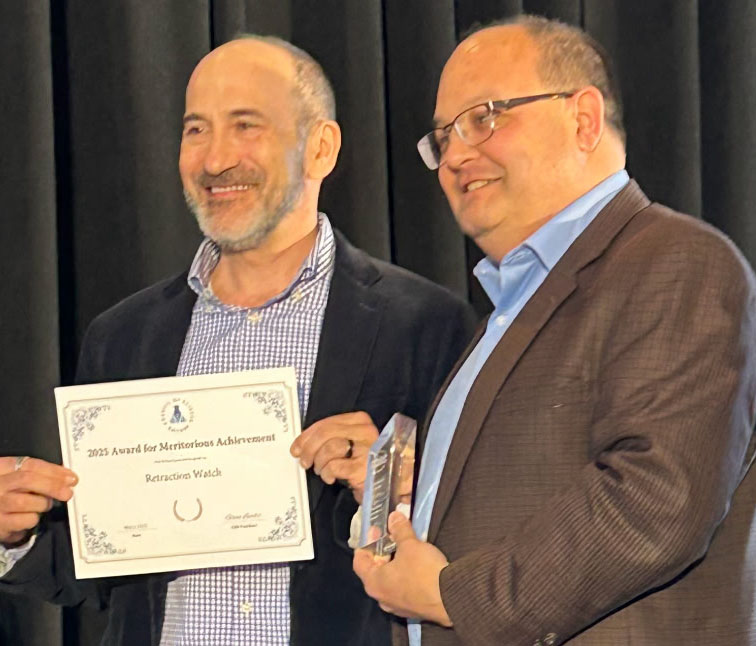
Retraction Watch cofounders Adam Marcus and Ivan Oransky accept the award.

Retraction Watch has been honored with the Council of Science Editors’ highest honor: The 2025 Award for Meritorious Achievement.

CSE gives the award each year to an organization or individual who has made “significant contributions” toward the goal of CSE, “namely, the improvement of scientific communication through the pursuit of high standards in all activities connected with editing.” 

We were honored to be at the CSE Annual Meeting in Minneapolis today to accept the award. Below is a lightly edited version of our acceptance speech.

Continue reading ‘Now is not the time to fade’: Retraction Watch awarded Council of Science Editors’ highest honor

Announcing the Elisabeth Bik Science Integrity Fund

Elisabeth Bik

We’re thrilled to be partnering with foremost scientific sleuth Elisabeth Bik on a new way to support scientific integrity: The Elisabeth Bik Science Integrity Fund.

Bik is a renowned science integrity advocate and microbiologist who investigates and exposes research misconduct, including image duplication and data manipulation, to uphold transparency and ethical standards in scientific publishing.

The Fund, launched with the proceeds of Bik’s Einstein Award, will provide financial resources to Bik and other sleuths and collaborators, as well as provide funding for training programs, grants, or awards for science integrity advocates. Plans also include funding educational or outreach initiatives promoting transparency and accountability in scientific research. Based on a fiscal sponsorship model, and leveraging our experience in nonprofit development and administration, Bik will have full direction over the Fund’s resources.

Continue reading Announcing the Elisabeth Bik Science Integrity Fund

Meet Retraction Watch’s two new journalists

Kate Travis (left) and Avery Orrall (right)

Please join us in welcoming two new Retraction Watch staff members: Managing editor Kate Travis, and reporter Avery Orrall.

Kate comes to us with a long and impressive resume. She has served as digital director at Science News, an editor for Science’s careers website, Science Careers, and news editor of the Journal of the National Cancer Institute. She contributed a chapter to A Tactical Guide to Science Journalism, is the coordinator of the National Association of Science Writers’ Science in Society Journalism Awards, and serves as the part-time managing editor of Connector, an online library of resources on science writing produced by the Council for the Advancement of Science Writing. Reach her at [email protected]

Avery’s name will be familiar to readers, as she was one of our two summer interns last year and has since been our newsletter editor. She is a recent graduate of New York University’s Science, Health and Environmental Reporting Program, and has also interned at JAMA Medical News. Reach her at [email protected]

Continue reading Meet Retraction Watch’s two new journalists

Introducing the Retraction Watch Sleuth in Residence Program

We’re thrilled to announce the creation of the Retraction Watch Sleuth in Residence Program, an opportunity for a sleuth to spend a year working with us.

Too often, sleuths work for free, often at great legal and personal risk. We want to build capacity in this space so others see the value of compensating and protecting the critical work of sleuths.

The goal of this program – funded by a generous donation from George Tidmarsh – is to offer a secure and paid position for an active sleuth with a proven track record. The Sleuth in Residence would work closely with our research team on specific projects, and with our journalism team to publish their findings. All of that work would go through rigorous review and be covered by our defamation insurance policy. 

Continue reading Introducing the Retraction Watch Sleuth in Residence Program