On Monday, we published a story about a physicist in India who had three papers on superheavy elements retracted after others in his field began flagging his work. Hours later, a publisher decided to retract an entire volume of conference proceedings after one of the critics pointed out the researcher, H.C. Manjunatha, was responsible for the majority of its contents.
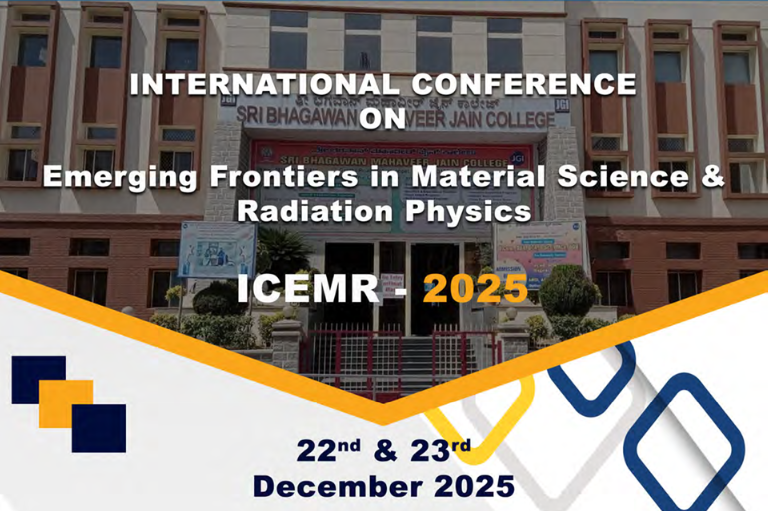
Manjunatha is listed as coordinator of the International Conference on Emerging Frontiers in Material Science and Radiation Physics, which took place in December. Manjunatha was one of four editors for the conference’s proceedings published in EPJ Web of Conferences on March 18. Of the 55 articles in the volume, Manjunatha is an author on 32.
David Boilley, a physicist at the University of Caen Normandy and researcher at GANIL, emailed EDP Sciences, which publishes EPJ Web of Conferences, on March 22 noting Manjunatha’s position as editor and the large number of papers he authored in the volume. Boilley, whom we interviewed for our story, mentioned the forthcoming article to the journal and also included a copy of his recent preprint calling out Manjunatha’s papers.
The next day, Solange Guehot, editor of the journal, responded that the publisher would withdraw the entire volume. “Naturally, HC Manjunatha and his entire team will no longer be able to publish in Web of Conferences,” she wrote in an email to Boilley.
Guehot also told Boilley the articles did not initially raise suspicion “because they did not contain ‘classic’ editorial anomalies such as, for example, manipulated quotations or blatant inconsistencies.”
Manjunatha, who is with the physics department of the Government First Grade College in Devanahalli, told us the conference organizers and EPJ Web of Conferences invited him to edit the issue. He said other authors had more than two papers published in the proceedings. Of the other three conference editors, only one was listed on a proceeding that wasn’t the preface.
Guehot told us that when the publisher informed the conference organizers they were retracting the issue, the organizers suggested the journal take “‘corrective measures’ to avoid having the volume retracted, which we naturally will refuse to do,” she said. EPJ Web of Conferences is indexed in Scopus and Clarivate’s Web of Science.
Manjunatha is named in the draft retraction notice Guehot shared. “A specific type of malpractice is involved, in particular serial publications of the same author, H.C. Manjunatha, with 32 articles in the same volume,” the draft notice reads. “We are extremely concerned by such malpractice which considerably impacts the image of our title and our Publisher’s reputation.”
“I have worked tirelessly, day and night, on a voluntary basis to contribute to the advancement of science. However, there may be typographical and representation errors,” Manjunatha told us. “I have been responding to all journal communications in a timely manner, and I am confident that these issues will be resolved—promptness and diligence always prevail.”
Like Retraction Watch? You can make a tax-deductible contribution to support our work, follow us on X or Bluesky, like us on Facebook, follow us on LinkedIn, add us to your RSS reader, or subscribe to our daily digest. If you find a retraction that’s not in our database, you can let us know here. For comments or feedback, email us at [email protected].
With these retractions en masse, plus the three he already had, that should be enough (at least 35 total) to singlehandedly win Manjunatha a spot on the RW leaderboard, right? It may even be a record for fastest “climb.”
The article left a bit of confusion : what was technically wrong with the articles by Dr. Manjunatha? Some how that point does not jump out. So he was editor and was somehow responsible for the contents of the proceedings. But did the contents of the proceedings suffer from moral and / or technical deficiencies.
One cannot edit one’s own articles, not in such massive numbers. That is an ethical breach of so great proportions that it is not even necessary to reach the point of evaluating the content.
It’s like if there’s a board that manages a property and 60% of the contact jobs that board approves are being done by companies owned by one of the board members. It isn’t a good look.
This guy was editor for what amounts to an anthology and it just so happens he’s the author of 60% of the papers in the collection? There’s a conflict of interests there
It’s more than a little disturbing that the answer wasn’t immediately apparent to you.
I’ve gotten authorship credit for editing papers. My name was actually on the entire annual output of a research lab because it was full of non-english speakers and I was editing for comprehensibility as the sole native English speaker. Because do this, I am technically an extremely prolific author despite never having actually written one myself.
I can see how it could look bad in certain circumstances, but whether or not it actually is bad requires a bit more information.
Anyone else noticed the dates of the conference? So unlikely to have any participants from western countries on those dates… maybe by design. It would not surprise me one bit if the conference never actually took place.
I am curious whether it is common practice in this area to refer to material included in a conference proceedings volume as “papers”. In my area, biomedicine, that isn’t the case. It would typically be called an abstract or something along those lines. anything of value presented a meeting would be published as a genuine peer-reviewed manuscript. I would give zero weight to anything in a proceedings volume even if it written by a pre-eminent scientist with a spotless record. It’s not a matter of mistrust, it just that proceedings contain zero added value to what already exists, but perhaps that isn’t true in all fields. I’ve always had the sense that a paper retraction meant something, but this seems to be a retraction of nothing. I have no problem with them doing it, but it seems like an empty gesture, isn’t it like adding a jay-walking charge to someone already in the dock on a grand theft?
In computer science and adjacent fields conferences are what matter, and the most prestigious venues are all conferences. Sure, there are also a lot of garbage conferences just as there are garbage journals, but please do not exclude or avoid citing stuff because of your own ignorance.
In the physical sciences, conference proceedings tend to be previews of work that the authors plan to write up later as a full article. Their value is not usually long-lasting because the full article will obsolete them as a reference, but they do get cited as a place-holder in the mean time.
I’m reminded a bit of https://igorpak.wordpress.com/2020/10/26/the-guest-publishing-scam/
which I believe I encountered on this site, though I do not see where that would have been.
He includes some remarks about the different types of contributions made.
It’s limited to one discipline, but in the end the incentives on the publishing side are rather more uniform than the incentives on the authors’ side, which vary a good deal by discipline and career stage.