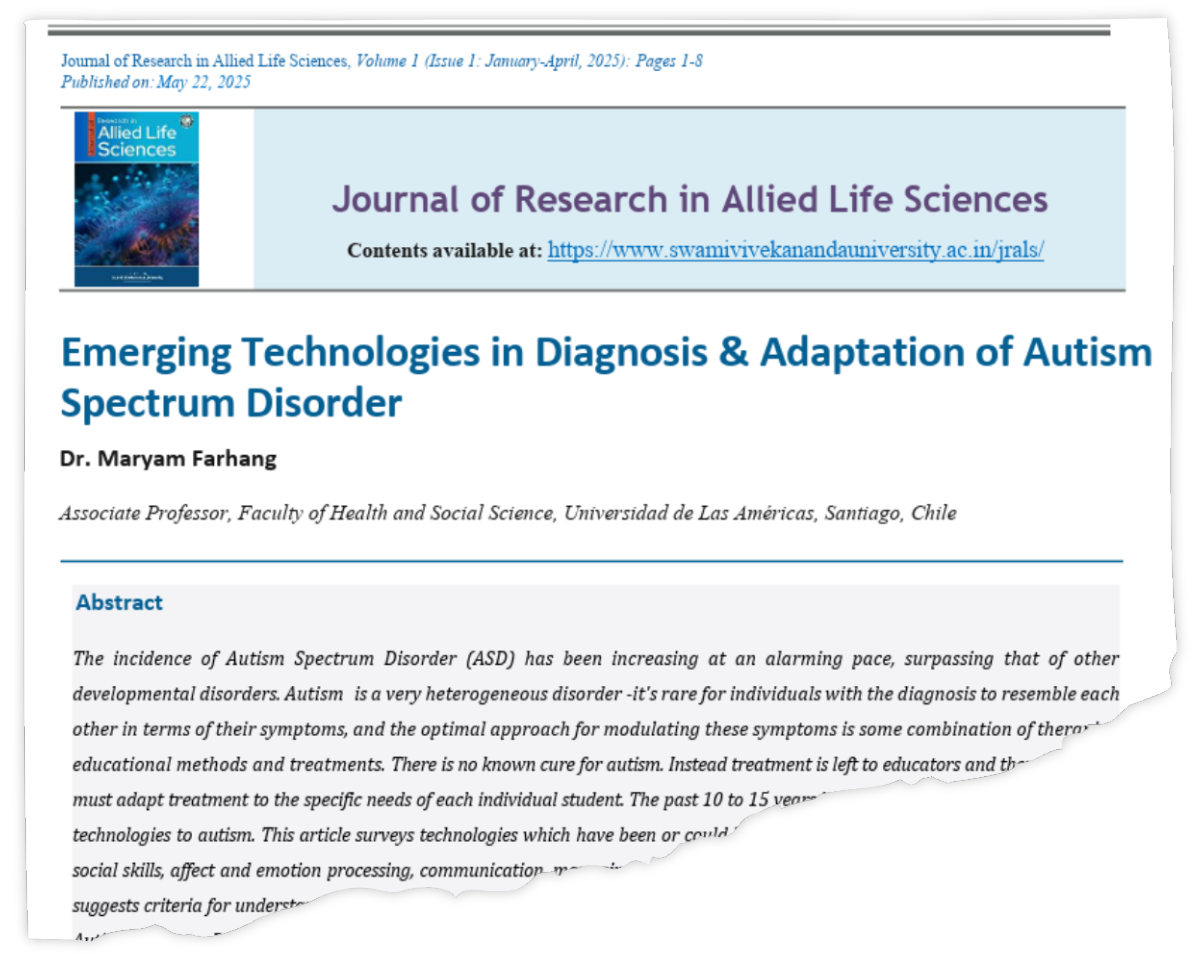
While reviewing her Google Scholar profile to prepare a list of her publications, psychologist Maryam Farhang came across a paper she didn’t recognize.
The article, in the Journal of Research in Allied Life Sciences, included her name and affiliation, but Farhang hadn’t written or contributed to the paper in any way, she told Retraction Watch.
“I was honestly shocked and very concerned to see my name and affiliation used without my permission,” said Farhang, an associate research professor at Universidad de Las Américas in Chile. “This is not only unethical, but a serious breach of research integrity. As a researcher, authorship comes with responsibility, seeing my name attached to work that I neither wrote nor approved was professionally alarming and personally upsetting.”
The case is among plenty of others we’ve seen on impersonation in scientific articles. We’ve reported extensively on the identity theft of researchers, people impersonating reviewers or former colleagues, and journals being hijacked. Farhang’s case appears similar to that of Canadian exercise physiologist Jamie Burr, who discovered an imposter’s article in the Journal of Blood Disorders & Transfusion in 2021. Some journals have considered conducting identity checks to expose fake authors and mitigate ongoing impersonation.
Farhang posted about the misappropriation on LinkedIn, informed her institution of the discovery, and contacted the journal for answers, she said.
The Journal of Research in Allied Life Sciences (JRALS), published by Swami Vivekananda University in India, describes itself as a “peer-reviewed, open-access e-journal” that encompasses life sciences, food sciences and behavioural sciences, according to its website. Started in 2025, the journal is not indexed in Scopus or Clarivate’s Web of Science.
After Farhang reached out, an associate editor at the journal contacted her and requested a meeting, Farhang told us. During the conversation, the associate editor apologized and explained her name and affiliation were added to the paper “by mistake,” Farhang said. She later received an email from the journal saying the article had been removed. The paper, while not formally retracted, no longer appears on the journal’s website.
An editor with JRALS apologized for the incident.
In an email dated Jan. 2 and shared with Retraction Watch, the journal’s Editor-in-chief wrote there was “a misunderstanding and the name was mistakenly used.” The editor offered “sincere apologies for the inconvenience caused.” The email is signed “Editor-in-chief, JRALS,” but does not specify a name.
Priyajit Banerjee of Swami Vivekananda University in India is listed as editor-in-chief on the journal’s website. He and associate editor Nilanjana Mitra did not return messages seeking comment.
“Publishers are committed to upholding the highest standards of publication ethics and as a publisher we take every possible measure against publication malpractice,” the journal’s ethics statement reads. “Authorship should be limited to those who have made a significant contribution to the conception, design, execution, or interpretation of the reported study.”
The JRALS paper, published in May 2025, analyzes technologies applied to the diagnosis, assessment, and treatment of autism. Farhang’s research has focused on adults with mild cognitive impairment, intellectual disabilities and depression. She has written several papers on self-determination in autistic adults, including a 2025 article that studied how everyday technologies shape choice, self-regulation and beliefs about the capacity to act in autistic adults.
At least two references listed in the JRALS paper appear to be placeholders left in the text with the words “insert pages” and “conference or journal name” in parenthesis.
Although the article was removed from the journal’s website and no longer appears on Farhang’s Google Scholar profile, it is still visible on ResearchGate and on the university website associated with the journal, Farhang said. She has submitted a formal removal request to ResearchGate and is waiting for a response, she said.
In addition to being “very distressing,” Farhang said the experience shows how easily a researcher’s identity can be misused.
“In today’s publishing environment, especially with the growing use of AI tools, stronger safeguards around authorship and editorial practices are clearly needed,” she told us. “Being listed as an author without consent is not just a simple mistake, it directly affects credibility and trust in academic work. I hope that speaking openly about this can help raise awareness and encourage better protections for researchers.”
Like Retraction Watch? You can make a tax-deductible contribution to support our work, follow us on X or Bluesky, like us on Facebook, follow us on LinkedIn, add us to your RSS reader, or subscribe to our daily digest. If you find a retraction that’s not in our database, you can let us know here. For comments or feedback, email us at [email protected].
this is a bit of an odd case. the journal itself is not well regarded, does not seem like there is much to gain by adding a fake author. assuming the objective was to add credibility to the study… the need was not there as the journal itself has no credibility.
Actually that isprecisely why they would add the researcher’s name because it adds cache and respect to the article and the journal.
The author has only published one autism paper, and that was in Spanish: https://scielo.isciii.es/scielo.php?pid=S0210-16962024000300005&script=sci_arttext
What I don’t understand is that it looks like Farhang was the sole credited author. Who actually wrote this article? If someone else wrote the article and added Farhang’s name to give the article more credibility, where is the original author’s name? I would think that adding uninvolved people as co-authors could only benefit the real author if the real author were also credited with them.
It might be a desperate attempt by the journal to create some content. Who wrote this? Well either AI or a clever student can fabricate a ‘paper’ easily.
In this case I think the paper discussed here is highly ‘inspired’ by:
Begoli, E., DeFalco, J., & Ogle, C. (2018). The Promise and Relevance of Emerging Technologies in the Education of Children With Autism Spectrum Disorder. In I. Management Association (Ed.), Virtual and Augmented Reality: Concepts, Methodologies, Tools, and Applications (pp. 582-602). IGI Global Scientific Publishing. https://doi.org/10.4018/978-1-5225-5469-1.ch028
See for full text https://www.researchgate.net/publication/325248286_The_Promise_and_Relevance_of_Emerging_Technologies_in_the_Education_of_Children_With_Autism_Spectrum_Disorder
Parts of the chapter are plagiarised, a quick look shows high similarities see for example in the following sections:
Augmented Reality wearable systems. Take for example “As an educational tool, Augmented Reality(AR) has been shown to have potential in teaching skills in a range of areas for students with an array of abilities (McMahon, 2014). Richard, Billaudeau, Richard and Gaudin (2007) showed evidence that the use of AR with ID…”
Conclusion. Take for example “VR and AR technologies are beneficial technologies for education of children with ASD, particularly suitable for the teaching of critical social skills”
Future directions. Take for example “Fueled by the popularization of the technology, availability and affordability of the VR and AR devices, and by advances in the realism and capabilities of the algorithms, it is …”
References. Most of the references of the fake paper are taken from this chapter.
Either this is a deliberate thing done by the journal or it is not spotted by the journal and might be a scam where the purpose might be a citation boosting attempt for one or more ‘clients’.