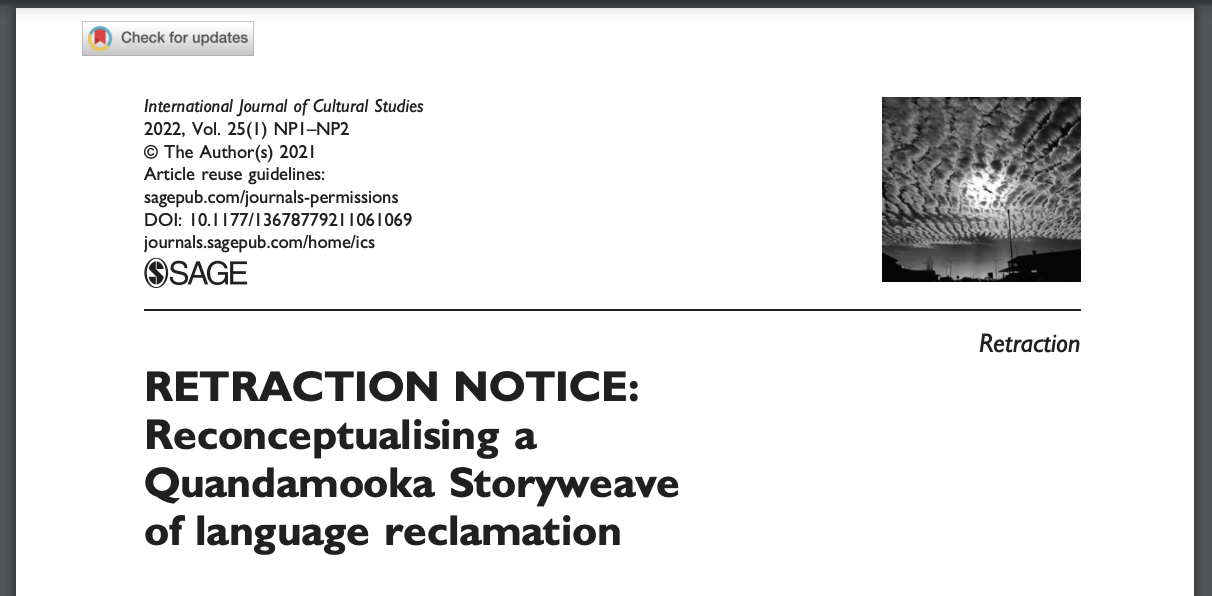
Paper on ‘language reclamation’ and decolonization plagiarized from eight papers, journal acknowledges

Talk about cultural misappropriation. 

A cultural studies journal has retracted a 2021 article on storytelling among the Quandamooka people in Australia for widespread plagiarism. 

The article, “Reconceptualising a Quandamooka Storyweave of language reclamation,” appeared in the International Journal of Cultural Studies in July and was written by a group led by Sandra Delaney, a scholar of indigenous languages in Australia. 

As the journal, a Sage title, makes clear, the article went through the typical course of peer review and, presumably, some editing – which somehow managed to miss plagiarised text from not one but at least eight sources. Three of those involved rip-offs from unpublished university theses, while the rest were from published articles. 

According to the retraction notice

Continue reading Paper on ‘language reclamation’ and decolonization plagiarized from eight papers, journal acknowledges

Authors unhappy as “battlefield acupuncture” paper earns an expression of concern

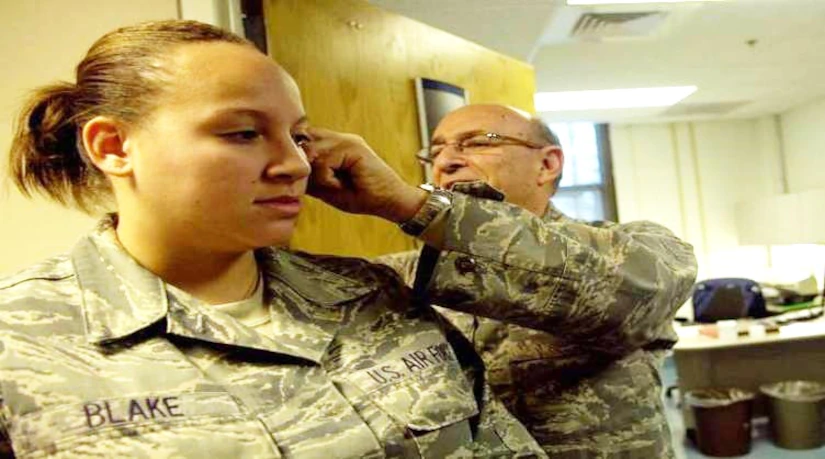
A journal has slapped an expression of concern on a 2021 paper reporting on the utility of self-administered “battlefield” acupuncture in soldiers, citing readers who said the FDA has not approved the devices for that use – a point the authors, who object to the move, dismissed as irrelevant and misleading. 

The study, which appeared in Medical Acupuncture, looked at the experiences of a dozen veterans at an Ohio VA hospital who’d purportedly self-administered acupuncture to treat chronic pain. According to this 2010 article from the U.S. military

Continue reading Authors unhappy as “battlefield acupuncture” paper earns an expression of concern

Cancer journal with hefty retraction record retracts another 15

A cancer journal with a history of batch retractions has pulled 15 articles dating back to 2014 after concluding that they contained manipulated or misused images. 

As we reported in 2017, Tumor Biology was forced to retract 107 papers that had been corrupted by fake peer review – a record at the time. That move had followed a similar, if smaller, sweep in 2016 by the journal, which was owned by Springer but purchased by SAGE in December 2016 after the more massive cleanse. 

Continue reading Cancer journal with hefty retraction record retracts another 15

University of Rochester cancer researchers included ‘incorrect images’ in 13 papers, committee finds

Yuhchyau Chen

A group of cancer researchers at the University of Rochester have now lost three papers over concerns about the data in the articles – issues that evidently did not rise to the level of misconduct, according to the institution.

The work came from the lab of Yuhchyau Chen, of the university’s Wilmot Cancer Institute. A common co-author was Soo Ok Lee, who is no longer affiliated with the University of Rochester. In addition to the three retractions, Lee has several corrections and an expression of concern.

The most recent retraction involves a 2019 article in the Journal of Molecular Medicine titled “Radiation-induced glucocorticoid receptor promotes CD44 + prostate cancer stem cell growth through activation of SGK1-Wnt/β-catenin signaling” for which Chen and Lee were corresponding authors. The paper has been cited nine times, according to Clarivate Analytics’ Web of Science.

According to the retraction notice, dated December 10:  

Continue reading University of Rochester cancer researchers included ‘incorrect images’ in 13 papers, committee finds

‘This is really ridiculous’: An author admitted plagiarism. His supervisor asked for a retraction. The publisher said, “nah.”

Behrouz Pourghebleh is perplexed. And also exasperated.

Pourghebleh, of the Young Researchers and Elite Club at the Urmia branch of Islamic Azad University in Iran, noticed a paper published on December 15, 2020 in an IEEE journal that overlapped 80 percent with an article he’d co-authored the year before.

Pourghebleh wrote to Zakirul Alam Bhuiyan, the associate editor who had handled the paper, on December 31, 2020, expressing concern. Bhuiyan responded the same day, saying the paper hadn’t been flagged in a similarity check, and that he would contact the authors for a response.

The first author, Karim Alinani, wrote to Pourghebleh less than two weeks later, admitting the plagiarism but citing personal circumstances:

Continue reading ‘This is really ridiculous’: An author admitted plagiarism. His supervisor asked for a retraction. The publisher said, “nah.”