allowed a group of researchers in Italy to correct a 2016 paper with questionable images after a faculty member in their institution — and a frequent co-author of the group’s — said his investigation found no reason to doubt their integrity.
At the time, the journal told us they were unaware that Fulvio Magni — to whom they were directed “as the person who oversees ethics issues for the institute” — was a frequent co-author with the researchers who had authored the corrected paper.
The same day we posted on the case — Oct. 29, 2019 — a PubPeer commenter pointed out new issues in Figure 4 of the paper. And now, the journal has retracted the paper:
You probably read a story or heard a news report over the past few days saying that if nearly all Americans wore masks to prevent COVID-19 spread, 130,000 lives could be saved by the end of February. That’s what a paper published on Friday says.
But it turns out that figure sounds twice as good as reality. Here’s the story:
On October 6, a group at the Institute for Health Metrics Evaluation (IHME) — a frequently cited source of COVID-19 data — submitted a manuscript to Nature Medicine. The paper was accepted on October 13, and published on October 23. It concluded:
In a July 23 post on Medium, Kurly Tlapoyawa and Ruben A. Arellano “ask that the The Urban Review journal retract the article by Wiggan et al and discontinue its promotion of ‘Black Olmecs:’”
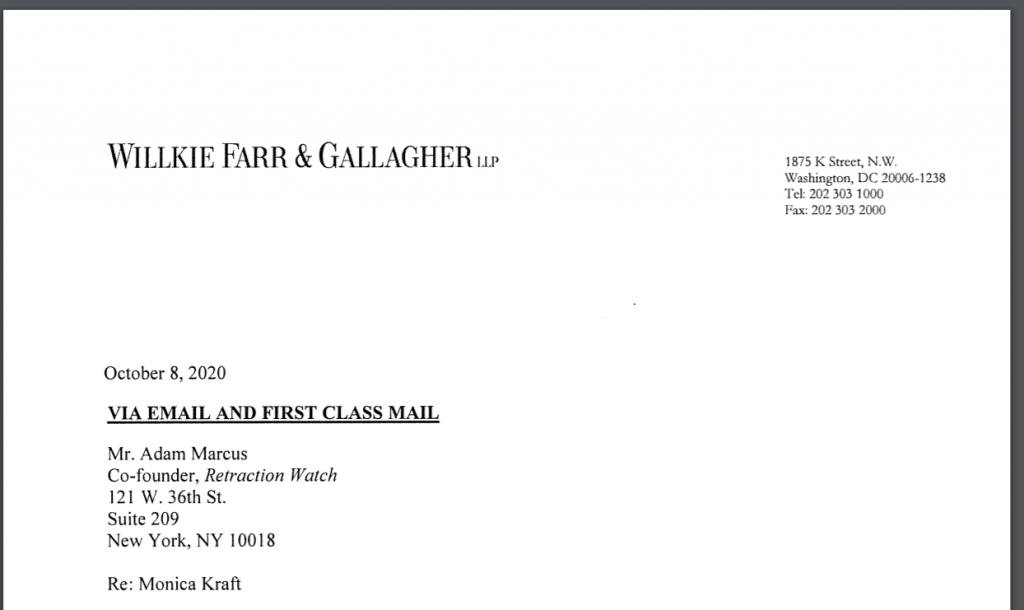
We receive occasional demand letters from attorneys here at Retraction Watch. Perhaps the most memorable was one in 2013 from an attorney claiming to represent Bharat Aggarwal. That prompted Popehat’s Ken White to enlarge our vocabulary by using the word “bumptious” in a post about the letter.
Duke, as Retraction Watch readers may recall, settled a False Claims Act case last year for $112.5 million following allegations about how various members of its Department of Medicine’s Pulmonary Division responded to alleged misconduct in the department beginning in 2013. As Duke acknowledged in a court filing, “Kraft was a Principal Investigator for some research projects conducted within the Pulmonary Division and was Division Chief from January 1, 2013 through September 30, 2014.”
The facts in the previous two paragraphs are, as best we can tell, all uncontested. That is also true of all of the facts in the Dec. 20, 2019 post that Weinstein requested we remove.
And now it is no more, along with four more articles from the Open Access Macedonian Journal of Medical Sciences in what was billed as a special issue on Global Dermatology.
You may fairly wonder what a terrestrial black hole and skin diseases have in common. The abstract, which we present for posterity, sheds no, ahem, light on the question: