Court injunction forces gastro journal to slap expressions of concern on 40 articles about probiotics

A gastroenterology journal has issued expressions of concern for forty articles about a probiotic formulation that has been at the center of a long-running legal saga in the United States and Europe.  

The articles appeared in the Journal of Crohn’s and Colitis, the official journal of the European Crohn’s and Colitis Organisation (ECCO) and date back to 2007. All mention a proprietary formulation of probiotics – and therein lies the tale.

Continue reading Court injunction forces gastro journal to slap expressions of concern on 40 articles about probiotics

Expressions of concern mount for heart researchers over data provenance

A group of heart researchers in China now have four expressions of concern, along with a retraction, for questions about the reliability of their data. 

The latest expressions of concern for the team, led by Bu Lang Gao, of Shijiazhuang First Hospital of Hebei Medical University, involves a 2019 paper in Springer Nature’s Scientific Reports titled “Asymmetrical middle cerebral artery bifurcations are more vulnerable to aneurysm formation.”

Here’s the notice for the article, which has been cited 4 times, according to Clarivate Analytics’ Web of Science: 

Continue reading Expressions of concern mount for heart researchers over data provenance

Wiley snafu costs an early-stage researcher his first paper

Through no fault of his own, Martin Bordewieck is oh-for-one in his publishing career. 

The psychology researcher at Ruhr-University Bochum, in Germany, published his very first paper in Applied Cognitive Psychology in August 2020 – only to lose the article to retraction because of a screw-up by the journal. 

Malte Elson, Bordewieck’s co-author – whose name might be familiar to readers of Retraction Watch for his work as a data sleuth – called the situation “a weird one”: 

Continue reading Wiley snafu costs an early-stage researcher his first paper

Two abstracts about unapproved heart technology retracted

A group of heart researchers have lost two meeting abstracts after, according to one of the authors, companies said the data were proprietary and couldn’t be published. But it’s not clear the companies did so.

The studies appeared in the journal Heart Rhythm, the official journal of the Heart Rhythm Society, and were presented at the group’s 2021 annual meeting. 

The first author on both abstracts was Andrea Natale, a cardiac electrophysiologist at the Texas Cardiac Arrhythmia Institute at St. David’s Medical Center in Austin. We wrote about Natale in 2016, after the researcher lost a paper in the Journal of the American College of Cardiology – again based on work he presented at the Heart Rhythm Society conference about which he raised concerns over industry meddling. (Natale disputes that he was the first author on the now-retracted posters, for reasons that aren’t clear to us.)

Continue reading Two abstracts about unapproved heart technology retracted

How an ivermectin study that didn’t mention COVID-19 fell under scrutiny

Kyle Sheldrick

A PLOS journal has issued an expression of concern for a 2018 paper which claimed that ivermectin could be useful as a way to control dengue fever. 

In fact, the reason the journal re-examined the article was because the hype about the use of ivermectin for Covid-19 led at least one skeptic to take a closer look at the study – and he didn’t like what he saw. 

The article, “Antivirus effectiveness of ivermectin on dengue virus type 2 in Aedes albopictus,” was written by a group in China led by Tie-Long Xu, of the National Institute of Parasitic Diseases at the  Chinese Center for Disease Control and Prevention. According to the study, which appeared on PLOS Neglected Tropical Diseases

Continue reading How an ivermectin study that didn’t mention COVID-19 fell under scrutiny

COVID-19 spike protein paper earns an expression of concern

A virology journal has issued an expression of concern about a paper claiming that the SARS-CoV-2 virus can damage DNA after one member of the research team raised reservations about the reported findings. 

The article, “SARS-CoV-2 Spike Impairs DNA Damage Repair and Inhibits V(D)J Recombination In Vitro,” was written by a pair of scientists at institutions in Sweden and published in MDPI’s Viruses (as Vincent Racaniello of TWiV would say, the kind that make you sick).

The paper has received a fair amount of attention – particularly among vaccine skeptics who, as critics noted, used the article to buttress their claims that Covid vaccines are unsafe – generating enough buzz on social media and in the news to make it into the top 5% of all articles tracked by Altmetric. TWiV even devoted part of an episode of the show to the findings. 

According to the journal

Continue reading COVID-19 spike protein paper earns an expression of concern

Paper on ‘language reclamation’ and decolonization plagiarized from eight papers, journal acknowledges

Talk about cultural misappropriation. 

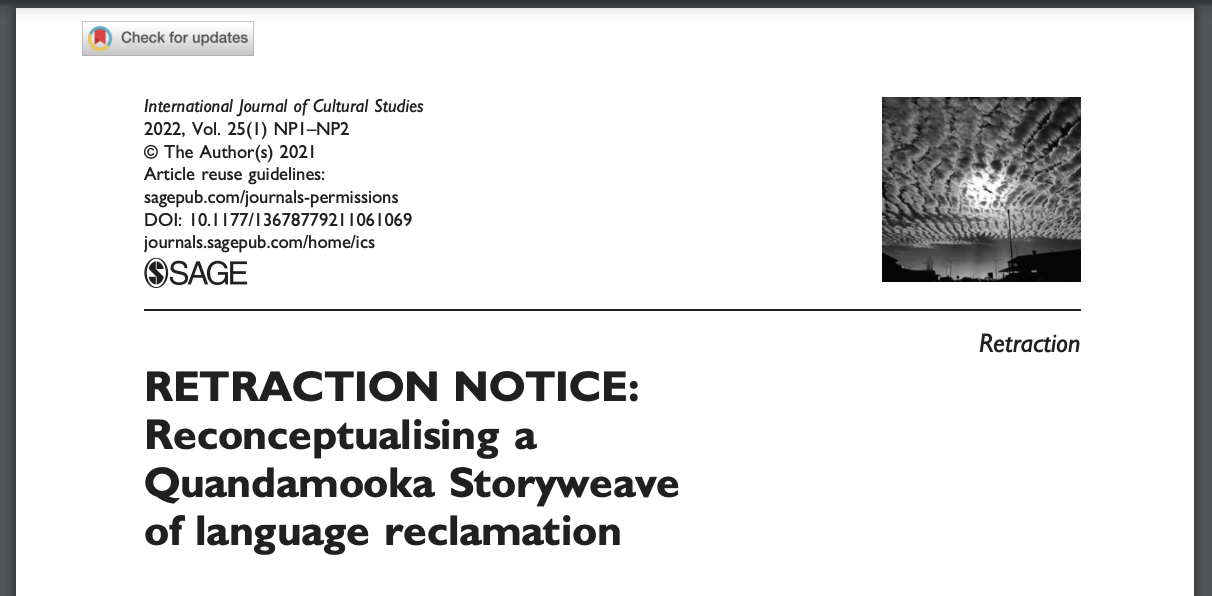
A cultural studies journal has retracted a 2021 article on storytelling among the Quandamooka people in Australia for widespread plagiarism. 

The article, “Reconceptualising a Quandamooka Storyweave of language reclamation,” appeared in the International Journal of Cultural Studies in July and was written by a group led by Sandra Delaney, a scholar of indigenous languages in Australia. 

As the journal, a Sage title, makes clear, the article went through the typical course of peer review and, presumably, some editing – which somehow managed to miss plagiarised text from not one but at least eight sources. Three of those involved rip-offs from unpublished university theses, while the rest were from published articles. 

According to the retraction notice

Continue reading Paper on ‘language reclamation’ and decolonization plagiarized from eight papers, journal acknowledges

Authors unhappy as “battlefield acupuncture” paper earns an expression of concern

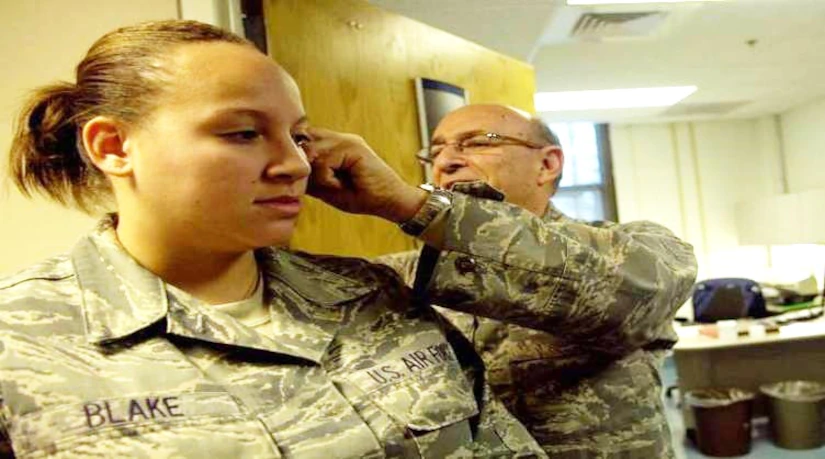
A journal has slapped an expression of concern on a 2021 paper reporting on the utility of self-administered “battlefield” acupuncture in soldiers, citing readers who said the FDA has not approved the devices for that use – a point the authors, who object to the move, dismissed as irrelevant and misleading. 

The study, which appeared in Medical Acupuncture, looked at the experiences of a dozen veterans at an Ohio VA hospital who’d purportedly self-administered acupuncture to treat chronic pain. According to this 2010 article from the U.S. military

Continue reading Authors unhappy as “battlefield acupuncture” paper earns an expression of concern

Cancer journal with hefty retraction record retracts another 15

A cancer journal with a history of batch retractions has pulled 15 articles dating back to 2014 after concluding that they contained manipulated or misused images. 

As we reported in 2017, Tumor Biology was forced to retract 107 papers that had been corrupted by fake peer review – a record at the time. That move had followed a similar, if smaller, sweep in 2016 by the journal, which was owned by Springer but purchased by SAGE in December 2016 after the more massive cleanse. 

Continue reading Cancer journal with hefty retraction record retracts another 15

University of Rochester cancer researchers included ‘incorrect images’ in 13 papers, committee finds

Yuhchyau Chen

A group of cancer researchers at the University of Rochester have now lost three papers over concerns about the data in the articles – issues that evidently did not rise to the level of misconduct, according to the institution.

The work came from the lab of Yuhchyau Chen, of the university’s Wilmot Cancer Institute. A common co-author was Soo Ok Lee, who is no longer affiliated with the University of Rochester. In addition to the three retractions, Lee has several corrections and an expression of concern.

The most recent retraction involves a 2019 article in the Journal of Molecular Medicine titled “Radiation-induced glucocorticoid receptor promotes CD44 + prostate cancer stem cell growth through activation of SGK1-Wnt/β-catenin signaling” for which Chen and Lee were corresponding authors. The paper has been cited nine times, according to Clarivate Analytics’ Web of Science.

According to the retraction notice, dated December 10:  

Continue reading University of Rochester cancer researchers included ‘incorrect images’ in 13 papers, committee finds