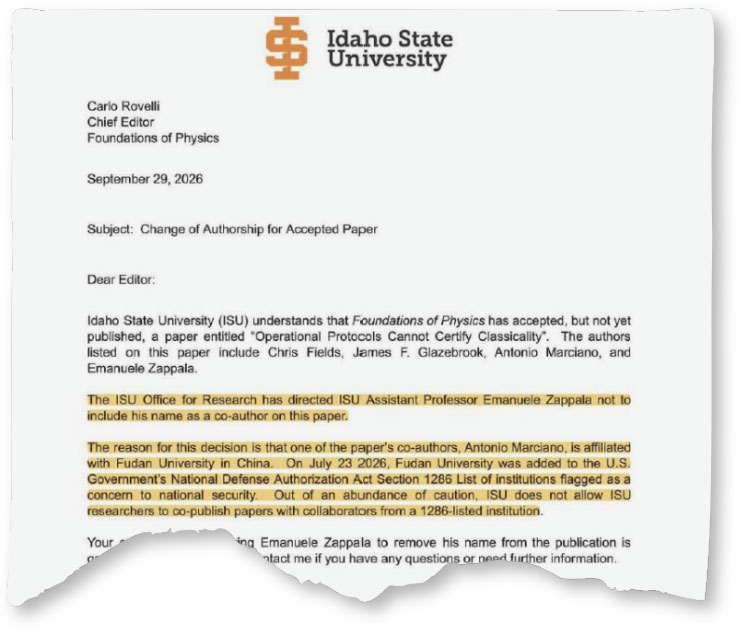
A physics journal has removed a professor’s name from an article at his university’s request, because a coauthor works at a university in China that has been flagged for national security concerns.
“The decision of the journal has been of course to consult the author,” Carlo Rovelli, the editor of Foundations of Physics, a Springer Nature title, told Retraction Watch. “As for the author, it was a problem to challenge his own university.“
The professor, Emanuele Zappala, an applied mathematician at Idaho State University, was the senior author on a paper, “Operational Protocols Cannot Certify Classicality,” that had been accepted for publication. His name is still listed on a preprint posted online last year.
The paper’s third author is Antonino Marciano, a tenured professor at Fudan University in China. In July, the U.S. Department of Defense added Fudan to its Section 1286 List, which identifies entities that the government says pose a threat to national security.
Collaborating “with an individual affiliated with an entity on the 1286 List constitutes a compliance risk and may negatively impact their eligibility for federal funding,” the government warns.
On September 29, Martin Blair, ISU’s vice president for research & economic development, formally requested that Rovelli remove Zappala’s name from the paper. “Out of an abundance of caution, ISU does not allow ISU researchers to co-publish papers with collaborators from a 1286-listed institution,” Blair wrote in the letter to Rovelli, which he posted on Facebook.
Blair told us he ordered Zappala to cease all collaborations with Fudan University due to the “potential national security implications” of his recent work, which includes problems related to artificial intelligence and quantum computing. “He understood the difficult consequences that both he and the institution could potentially face.”
Blair has heard anecdotally of other universities considering similar actions, though two other coauthors, both of whom are at U.S. institutions, will remain on the article. (Neither Marciano nor the other authors responded to a request for comment.)
Zappala, who did not respond to a request for comment, has published seven papers with Marciano and has one additional preprint with him, according to his curriculum vitae. Blair said he asked Zappala’s department chair and college dean to give Zappala “publication credit for this work in his next promotion and tenure review.”
Rovelli, the journal editor, who is based at the Centre Physique Theorique de Luminy in Marseille, France, said he felt that such decisions were one reason top scientists were leaving the United States. In his response to Blair, he expressed his disapproval:
“I understand the complexity of the political situation in the US,” he wrote. “But this level of lack of courage by a University does not make it shine. Such an attitude is contrary to the basic values of science, and contributes to US scientific and moral decay. I would hope that wiser decisions could be taken by ISU or other US universities.”
Like Retraction Watch? You can make a tax-deductible contribution to support our work, follow us on X or Bluesky, like us on Facebook, follow us on LinkedIn, add us to your RSS reader, or subscribe to our daily digest. If you find a retraction that’s not in our database, you can let us know here. For comments or feedback, email us at [email protected].
So the university administrators do not deny that Zappala did most of the work on the paper, in collaboration Marciano, but in retrospect they would rather he hadn’t announced the collaboration, so they asked the journal to falsify the record and leave the other authors falsely claiming all the credit for the paper.
The journal editor: “But this level of lack of courage by a University does not make it shine. Such an attitude is contrary to the basic values of science, and contributes to US scientific and moral decay.”
Accusations of cowardice from someone who went along with the request to falsify the scientific record.