Some people might happily take credit for an article in Nature they did not write. That’s not the case when the credited author is a cofounder of Retraction Watch and the attribution comes in a citation to an article that doesn’t exist.
The reference appeared in a November 2025 paper, published in DARU Journal of Pharmaceutical Sciences, which criticized post-publication peer review platforms, specifically PubPeer, as vulnerable to “misuse” and “hyper-skepticism.”
Shortly after it was published, the article began to draw attention from users on — where else — PubPeer, where commenters flagged repetitive language, “essentially identical” paragraph structure, and five references that do not appear to exist, three with incorrect DOIs or links, and one with common authors that was retracted last year.
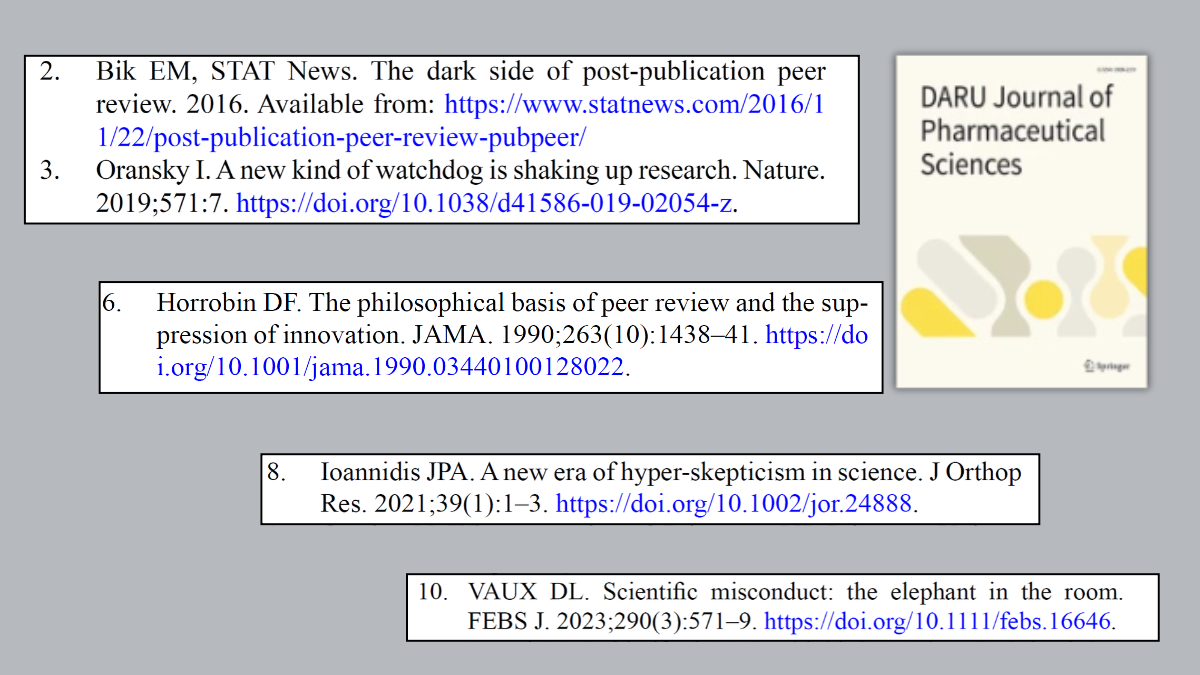
One fabricated reference attributes a nonexistent 2019 Nature article, “A new kind of watchdog is shaking up research,” to our cofounder Ivan Oransky, who is also a volunteer member of the PubPeer Foundation’s board of directors.
Springer Nature, which publishes the DARU Journal of Pharmaceutical Sciences on behalf of Tehran University of Medical Sciences in Iran, told us last November it was working on resolving the issues. One year later, no corrections have been made.
As we wrote last year, other references include nonexistent articles credited to Stanford’s John Ioannidis, molecular biologist and sleuth David Vaux – a member of the board of directors of The Center for Scientific Integrity, our parent nonprofit – and sleuth Elisabeth Bik. The DOI provided for Vaux’s supposed article on scientific misconduct is actually an interview with biochemist Peter Macheroux. The DOI attributed to Ioannidis leads to a study of steroid-induced bone death in rabbit hips.
The journal added a note to the paper six days after it was published, stating: “The Editor-in-Chief has become of aware [sic] of concerns with this article. Action will be taken as appropriate following further investigation and discussion with the relevant stakeholders.”
The last editor on the paper, Tehran University researcher Mohammad Abdollahi, was editor-in-chief of DARU Journal of Pharmaceutical Sciences at the time the article was published. Maria Hodges, the publishing director at Springer Nature, told us last year the matter was “a complex case and set of circumstances involving a journal that is owned by an external party.” The publisher was “working to clarify a number of issues relating both to the references and the editorial handling of the case,” Hodges added.
When we asked Springer Nature for an update last month regarding the case, a representative from the publisher told us they weren’t able to provide one. The paper has been cited twice, both times in articles published in recent months, according to Clarivate’s Web of Science. The authors of those papers don’t overlap with those on the DARU Journal of Pharmaceutical Sciences paper.
Abdollahi no longer appears on the journal’s list of editors, and Rassoul Dinarvand, also of Tehran University, is now editor-in-chief. Abdollahi has previously served as a council member for the Committee on Publication Ethics, according to COPE’s alumni website, and has 11 retractions, according to the Retraction Watch Database. Dinarvand has lost three articles for duplication.
When we asked Abdollahi how the references ended up in the paper he said he was “blind to the referencing process.”
“As far as I can tell, all the refs were right, but they had punctual [sic] problems,” he told us in an email last year.
Like Retraction Watch? You can make a tax-deductible contribution to support our work, follow us on X or Bluesky, like us on Facebook, follow us on LinkedIn, add us to your RSS reader, or subscribe to our daily digest. If you find a retraction that’s not in our database, you can let us know here. For comments or feedback, email us at [email protected].