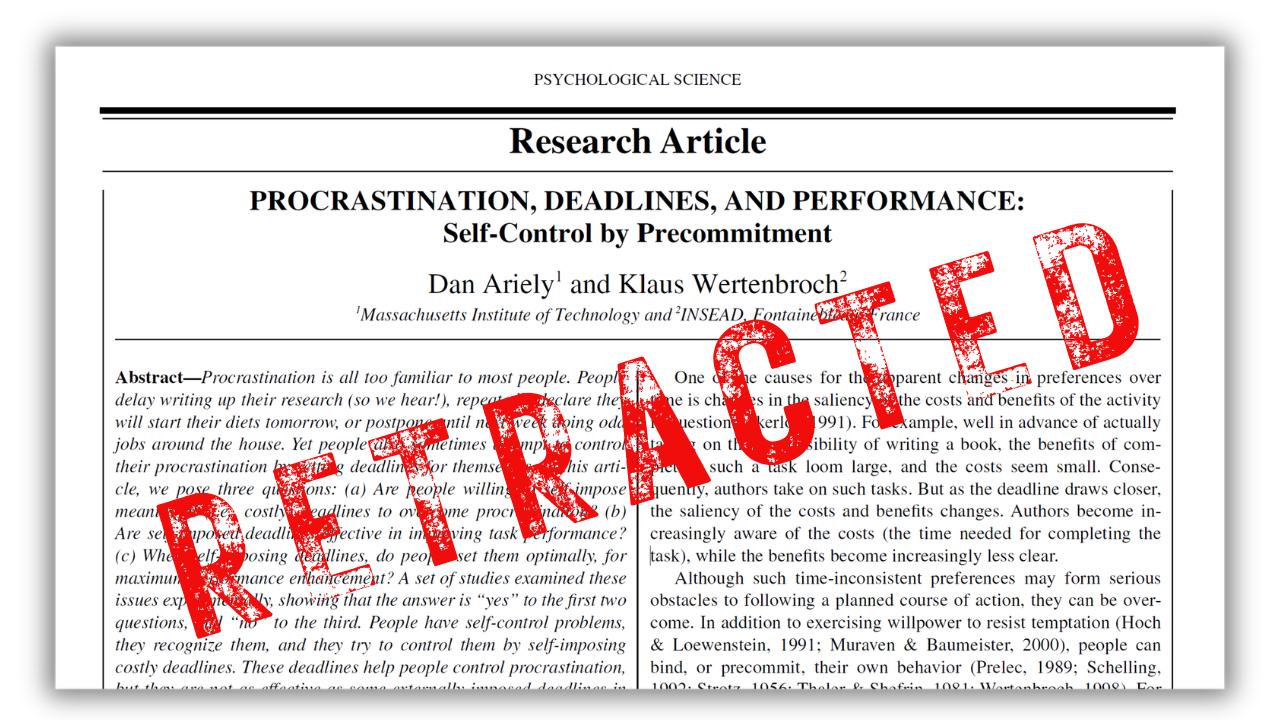
A psychology journal has retracted a seminal 2002 paper on deadlines and procrastination coauthored by behavioral scientist Dan Ariely of Duke University just days after a team of sleuths published analyses of the original study data, finding it had been tampered with.
The posts, which appeared Aug. 31 and Sept. 2 on the Data Colada blog, dug into the datasets behind the two main experiments in Ariely’s paper, published 24 years ago in Psychological Science. The reanalysis was prompted by a study published July 15 in the same journal attempting to replicate one of the paper’s original experiments.
The Sept. 2 retraction notice cited all three works, noting the replication study “raised questions about the underlying data in the original study,” and the Data Colada posts “called into question the veracity of the overall findings.” Ariely’s coauthor on the paper, Klaus Wertenbroch, of INSEAD in France, requested the retraction on July 23, Psychological Science editor-in-chief Simine Vazire told Retraction Watch.
Ariely and Wertenbroch’s paper was “the most well-known and important article” exploring the role of deadlines in overcoming procrastination, an oft-studied area in psychology and management science, economist Kyle Hyndman and Alberto Bisin wrote in their replication study. The 2002 article has been cited nearly 1,000 times, according to Clarivate’s Web of Science.

The retraction is the second for Ariely, a professor of business administration at Duke, founding member of the Center for Advanced Hindsight, and author of nine books. A 2012 paper on dishonesty — published in the Proceedings of the National Academy of Sciences and coauthored by Harvard researcher Francesca Gino — was also retracted over concerns data in the study were fabricated. The authors of Data Colada were cited in that retraction notice for providing evidence questioning the validity of the data.
That retraction brought attention to Ariely’s work. In 2024, another of Ariely’s papers on dishonesty, this one published in the Journal of Marketing Research in 2008, earned an expression of concern for concerns “about the replicability of the results.” A 2004 paper in Psychological Science on compensation in monetary versus social markets had received an expression of concern in July 2021, noting there was “uncertainty regarding the values of statistical tests reported in the article and the analytical approach taken.”
In response to a request for comment on the retraction of the 2002 study, Ariely referred us to a statement on his website. “Moving forward, my responsibility lies in ensuring accuracy – in updating the record on these experiments and, along with my co-author, cooperating with the journal that first published our paper to support their reviews and retraction processes,” the statement reads.
Hyndman, now professor of managerial economics at the Naveen Jindal School of Management, University of Texas at Dallas, took interest in Ariely and Wertenbroch’s paper more than 20 years ago when he was in graduate school. “During my Ph.D., I did some work with Alberto Bisin on time preferences … and this got us interested in thinking about the topic more broadly,” he told Retraction Watch.
The influential paper looked at how people perform on tasks depending on whether there are multiple, preset deadlines versus self-imposed deadlines or a single deadline. In the first experiment, 99 professionals were assigned to write three short papers, either meeting specific, evenly spaced deadlines or self-imposed deadlines. The second study included 60 students given three proofreading assignments to complete, either submitting one completed assignment every seven days, all three assignments at the end of 21 days, or at deadlines of their choosing.
Hyndman wrote to Ariely in March 2006 asking if he would share the experimental data, which Ariely sent the following month. “At the time, I just thought it might be useful to peek into the data of an influential paper that might help my own research,” Hyndman said.
Together with Bisin, an economist at New York University, he worked on a similar study they eventually published in 2020 in Games and Economic Behavior. “Over time, as we slowly got around to finishing our first paper, I did have increasing concerns about the data” Ariely had supplied, Hyndman said.
In August 2023, he and Bisin started working on a replication of the second experiment, the proofreading task, from Ariely and Wertenbroch’s paper. The pair carried out their experiments, and also did an analysis of Ariely’s original data, which they included in their manuscript. At the request of the Psychological Science editors, the authors reached out to Ariely for his permission to include the analysis, which Ariely declined. “Our main concern was to correct the scientific record about this important result and not to make any claims of research fraud,” Hyndman told us. “We believed that the replication stood on its own and achieved our goals.” Their paper did not corroborate the 2002 findings.
When they started working on the replication study, Hyndman and Bisin sent the original data files to Uri Simonsohn, Leif Nelson and Joe Simmons, the team behind Data Colada. The sleuths “performed quick analyses of the data, and then had a conversation” with Hyndman and Bisin, according to the Aug. 31 Data Colada post. They later revisited the data files when they learned of the forthcoming replication study.
In the first blog post, the Data Colada team looked at data underlying the proofreading experiment, or Study 2. The sleuths found several red flags, including an implausibly large effect given the sample size, duplicated values in number of proofreading corrections, a lack of correlation of variables expected to be highly correlated, and irregular self-reported estimates of time spent on the proofreading task.
“We are unable to generate a benign explanation for all of the anomalies presented here,” the team wrote in their blog post. “Based on this evidence, we believe the data for Study 2 of Ariely and Wertenbroch (2002) were severely tampered with or fabricated to produce the desired results.”
The team also dug into the data for the other experiment reported in the 2002 paper, the MIT executive course participants who either had regular deadlines to write papers or set their own deadlines. Among the findings Ariely and Wertenbroch reported was that those in the enforced deadlines group got better grades on their assignments than those in the group that set their own deadlines.
The Data Colada team could make sense of the grade calculations for the evenly spaced deadlines group. But they couldn’t reconcile calculations for the group that set their own deadlines. They found evidence the grades had been manipulated but couldn’t understand why. After finding an earlier version of the paper and then getting the original peer reviews from 2001 from Wertenbroch, the sleuths determined “this falsified analysis was conducted and included as a response to a request from reviewers,” the team wrote.
The Data Colada sleuths shared their findings with Ariely, Wertenbroch, Hyndman, Bisin, and Vazire, the editor-in-chief of the journal, on July 20.
“Their forensic analysis is far more sophisticated and thorough than what researchers without their experience could have done, and the evidence of data tampering they found is convincing,” Wertenbroch wrote in an undated statement sent to Data Colada. “It shows that much or all of the data — and therefore the results — are false.” He said he contacted Vazire to ask that the article be retracted; Vazire confirmed he contacted her on July 23.
Vazire told us that she was unaware of any prior integrity concerns raised about the paper, and that the replication study on its own “wasn’t a basis for considering retraction or investigation.”
“Hyndman and Bisin took the time to conduct a careful, rigorous replication and submit it for publication,” Vazire said. “Simonsohn, Simmons, and Nelson were extremely diligent in their post publication critique of the original article. Wertenbroch’s response to the Data Colada findings was admirable and swift. In many ways, this was everything you could wish for in scientific self-correction.”
Ariely did not reply to any of the emails the Data Colada team sent him about the analysis. In addition to the Aug. 7 statement on his website, he addressed the critiques in an Aug. 31 video. “If you have, like me, lived your life with the idea of precommitment to a deadline being important, whatever you believed in it, believe it less,” he said of the replication study. “The other piece of heartbreaking news, worse in fact, is that the deeper analysis of our data show that these data cannot be trusted. This was a long time ago and I’m not sure how all of this happened. It will take time to figure it out, and when I do, I’ll let you know.”
“I think retraction was the right outcome,” Hyndman told us. “This is an important result in the academic literature, with impact that goes beyond academia. Retraction corrects the scientific record.”
Like Retraction Watch? You can make a tax-deductible contribution to support our work, follow us on X or Bluesky, like us on Facebook, follow us on LinkedIn, add us to your RSS reader, or subscribe to our daily digest. If you find a retraction that’s not in our database, you can let us know here. For comments or feedback, email us at [email protected].
This guy is the worst.
״Retraction corrects the scientific record״
Not quite. Many papers were influenced by the retracted report, and ideally would need to reevaluate their conclusions.