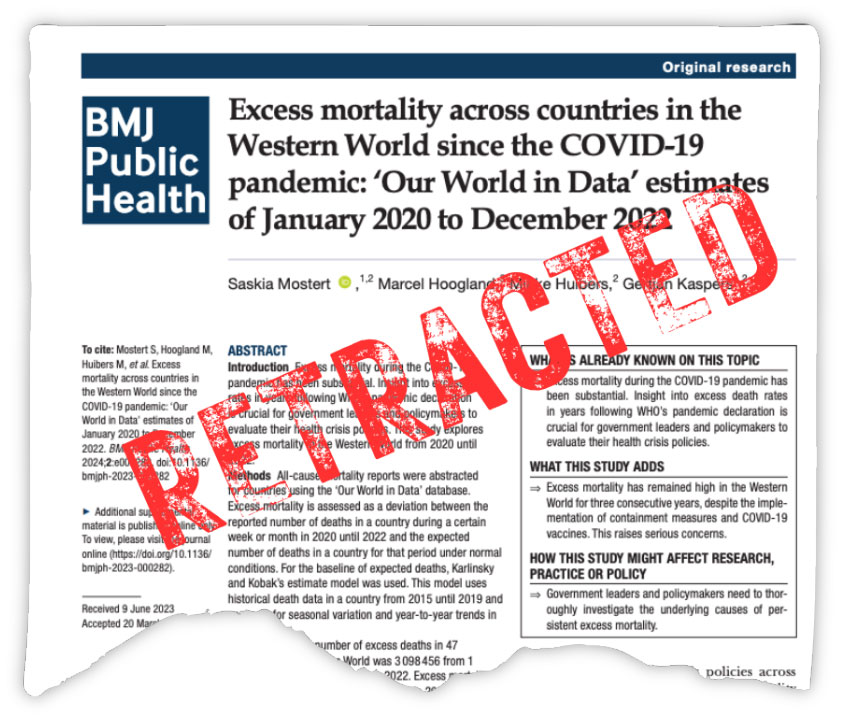
BMJ Public Health has retracted a paper some — including a witness at a recent U.S. Senate subcommittee hearing — have used to link COVID-19 vaccines to deaths. The action comes more than two years after a researcher cited in the work flagged issues with the study.
Published May 6, 2024, the paper used the “Our World in Data” database and the World Mortality Dataset to look at COVID-19 related deaths during the height of the pandemic. News outlets covered it, from The Telegraph — “vaccines may have helped fuel rise in excess deaths” — to the New York Post, which quoted the paper’s statements about reported “serious injuries and deaths following vaccination,” a move it later corrected.
An expression of concern, placed on the paper about a month after it was published, attempted to quell these claims, noting the study “does not establish any such link.” The notice also announced an institutional investigation by the Princess Máxima Center in the Netherlands, where three of the four authors worked, including corresponding author Saskia Mostert.
Critics of the paper said it contained misquotes and omissions on vaccines and was “full of inappropriate insinuation.” Ariel Karlinsky, an economist at Hebrew University in Jerusalem, Israel, and cocreator of the World Mortality Dataset, contacted the journal starting in June 2024, requesting a retraction multiple times. Karlinsky felt the analysis misused his data and “copied whole blocks of text and mathematical notation” from his article.
According to the August 11 retraction notice, BMJ Public Health retracted the paper for “misinformation in the discussion regarding the possible causes of excess mortality, and because the limited nature of the original work by the authors was not sufficiently described.”
In 2024, the Princess Máxima Center investigated the involvement of two authors, Minke Huibers and Gertjan Kaspers, but did not look at Mostert’s work on the study because she was “not able to cooperate with the investigation,” the report reads.
The anonymized version of the report summary dated January 2025 was published alongside the retraction and concluded that while the authors’ actions did not constitute misconduct, Kaspers and Huibers exhibited “carelessness, ignorance and negligence.”
The report also found the article “pays disproportionate attention to the possibility that introduction of corona measures and vaccination might have caused excess mortality, whilst largely ignoring alternative explanations” and “misleadingly and unilaterally cites literature that supports its own arguments.”
According to the detailed retraction notice, which is over 700 words long, Kaspers and Huibers requested the retraction alongside their institution “due to concerns about misinterpretation of the paper by others and subsequent public health risk,” but did not agree with the journal’s determination the paper contained misinformation. Emails to both researchers returned out-of-office notifications.
In a June 2024 announcement that has been removed but is archived here, the Princess Máxima Center said it was “emphatically” distancing itself from the publication and said they “strongly support vaccination.“
Jan Hoeijmakers, chair of the scientific integrity complaints committee at Princess Máxima Center, did not respond to our questions about specifics of the investigation or our request for a copy of the full report.
Lead author Mostert resigned in 2024 after the Princess Máxima Center announced it would be investigating the paper, she said at a hearing on June 3 before the U.S. Senate Homeland Security & Governmental Affairs Committee subcommittee on investigations on “Plausible Mechanisms of COVID-19 Injections Causing Cancer and Attacks on Scientific Publications and Research.” In her testimony, which was largely focused on the BMJ Public Health paper, she said the authors “did not claim certainty regarding the causes of excess mortality. Rather, we asked attention [sic] for three major events that were non-existent before the pandemic: COVID-infection, containment measures, and COVID-vaccines.”
The press office for U.S. Sen. Ron Johnson, chair of the subcommittee on investigations, did not respond to our request for comment regarding the retraction of the paper.
Mostert argued governments and media implemented fear and propaganda tactics to reduce “tolerance for reason and dissenting voices” during the pandemic and claimed the investigation into her paper violated academic freedom and constituted censorship.
She also said institutional responses like that from the Princess Máxima Center “are increasingly used as ‘official channel’-tactics to discredit, intimidate, isolate and silence those raising unwelcome scientific questions,” leading to her resignation.
Also in her testimony, Mostert said she proposed a revision to the published paper that “included a section on vaccine effectiveness in reducing mortality,” but the suggestion was “ignored by the journal.” She also claimed the original section on containment measures and vaccines was “much shorter in the original version of the paper,” but reviewers “asked us to either delete the text or provide more evidence. As there is evidence available, we included it.”
The BMJ Public Health retraction notice acknowledged the submission, but said the change would be “insufficient.”
Mostert wrote to the journal on behalf of herself and the study’s fourth author, Marcel Hoogland, that they disagreed with the decision to retract. Hoogland was listed as an independent researcher based in Amsterdam on the now-retracted paper. Mostert’s most recent article, published in February in JCO Global Oncology, lists her as an unaffiliated researcher. Requests for comment sent to two email addresses bounced back as undeliverable.
The article has been cited 21 times, according to Clarivate’s Web of Science. Altmetrics for the article put it in the top 5% of all research outputs scored by the site. It joins our list of nearly 700 retracted COVID-19 papers.
The retraction is hardly the first of a paper linking COVID-19 vaccines to excess deaths. For example, earlier this year, a lawsuit failed to block the retraction of a paper linking heart-related deaths to the COVID-19 vaccine. In 2024, Cureus retracted a paper on the “extensive” harms of the vaccine.
Karlinsky, whose estimate model was cited in the now-retracted paper, said he respected the Princess Máxima Center’s “swift action and internal investigation and request to retract on the matter, but disagreed with their finding that no plagiarism or malice occurred.”
He told us he suspected the retracted paper plagiarized his work, using a tortured phrase as an example: There was “no other way to explain how ‘compromise between flexibility and simplicity’” in his paper “was tortured to ‘a trade-off between suppleness and chasteness,’” he said. Tortured phrases can indicate plagiarism.
Karlinsky also called the BMJ Group’s response “quite bad.” The journal was “not touching on the fundamental issues and making themselves look good in this, where they really weren’t,” he told us.
He was particularly critical of how long the retraction took. Karlinsky submitted a commentary in June 2024 criticizing the work, which was rejected without review a month later, he told us.
The Princess Máxima Center shared the investigation report with the journal at the end of 2024, according to the retraction notice. “The time to investigate this paper was lengthy because the journal first awaited the formal official outcome of the institutional report,” which was shared in May 2025, the notice reads. After receiving the report, the journal attempted to contact Mostert again “for her perspective on key issues,” it states, before making its final decision.
“The fact that [the journal] prides itself on having waited until they hear back from Mostert is, in my opinion, ludicrous,” Karlinsky said, noting the move prolonged the investigation. “This is like letting a murder suspect get away with it because he’s refusing to come to the police station.”
Update, August 12, 2026, 12:30 p.m. ET: This story was updated with a new link to the June 2024 statement from Princess Máxima Center, which the institution tells us was moved, not removed.
Like Retraction Watch? You can make a tax-deductible contribution to support our work, follow us on X or Bluesky, like us on Facebook, follow us on LinkedIn, add us to your RSS reader, or subscribe to our daily digest. If you find a retraction that’s not in our database, you can let us know here. For comments or feedback, email us at [email protected].
Given how prominently the BMJ and the Lancet have platformed antivax quackery in the past, you’d think they would start being a bit more careful.
The larger issue is many of these retractions struggle to point to real issues that would change any of the real findings, and more point to “insinuations” or other vague issues because they don’t like the findings.
To be clear, conclusions can be wrong or erroneous and maybe shouldn’t be included. You can say the sun is likely to arise tomorrow without saying therefore we can conclude that it will be carried by a chariot, but now the inverse seems to be happening across multiple journals if things point in uncomfortable directions.
Sacred cows are real in science, and the Alzheimer’s research fiasco is only one example, and history isn’t going to be kind to some of what we’re seeing. It’s absolutely bizarre that journals and centers are having to go on about how “they strongly support vaccination” while yanking research, it’s just a strange conflation of two topics unless politics or ideology are involved.
eg, I’m absolutely pro-vaccine and think they’re one of humanity’s great triumphs. It doesn’t mean that a rushed rollout couldn’t cause issues, even from administration like mrna going into the bloodstream vs muscle, especially at scale (I am not proposing this, it is an example of potential mechanisms of harm), but some don’t even want us to talk about potential excess deaths because… It may harm people’s faith? You harm faith by circling wagons, as we’ve learned over and over and over…
Ah, vague accusations of “insinuations” by the journals and the old “rushed rollout” canard. Give up beating the talking points, you have zero evidence. We’d all be a lot better off if the top journals had done their job during the pandemic and refused to publish ivermectin quackery and poorly-sourced antivax “research”. For that matter, we’d all be better off if the entire editorial staff of the Lancet had been sacked for publishing Wakefield.
What “research” is being “yanked,” here? The authors did not do any research of their own. They misinterpreted and failed to correctly analyze other people’s data, ascribed cause where there was none, and omitted other data that contradicted their fundamentally wrong conclusions.
Pretending this is about plagiarism is silly. We can all read the OP and linked retraction for ourselves, so this comment seems like a lazy, foolish attempt at spinning this into more conspiracy about the suppression of controversial ideas when, whoops, this misinformation was, indeed, not suppressed. It just didn’t survive actual real-world scrutiny. The story here is about publications being afraid to equally apply rigorous standards to the anti-intellectual rightwing zeitgeist and then getting burned when experts and sources question the partyline.
Guess its easy to be a peer-reviewer in retrospect, when all the science is settled. Let us know what valuable scientific contributions you made in the heat of the pandemic since you are such a great researcher to smear the BMJ and Lancet.
I’ll let you know next time I create a public health crisis by promoting antivax quackery, that should put me on the same level as the BMJ and Lancet.
When a college states that they unequivocally support vaccines, that is a sign of problematic leadership. They’ve outed themselves as part of the mob who believes in “settled science”.
Quiet, James, the adults are talking.
Gosh, next thing you know they’ll be claiming that the Earth is not really flat!
Why read this blog if you don’t know the basics of science?
You’re assuming that commenters like James are able to read the articles?
What does James have to do with your anti-science viewpoints? Defend your assertion that we “trust the science” instead of following the science. Or would you like to plead the 5th?
What does, “a trade-off between suppleness and chasteness,’” even mean when read in context? That could make sense describing an OnlyFans model’s pornographic posing. It’s insane to describe a vaccine. That’s not just bizarre nonsense, it’s proof it was written by an ‘AI’ like ChatGPT!
But this very late piddling response that eviscerates the real criticism, combined with their desk-rejection of the original critical article accomplishes a staple of the anti-vax garbage narrative. It supports them by its “misinformation” language. I think this is quite intentional. It makes their final response into a victory for the lying grifters, and the flatly evil litigators of RFK Jr’s stable who continue to try to get the Vaccine Special Master’s Court shut down. If those liars get the shutdown they seek, for even 5 minutes, RFK Jr’s litigators like Mr. Siri will file the lawsuits requesting jury trials. They will litigate using the lies RFK Jr and his third world minions have spat at CDC, FDA, and NIH since RFK Jr lied to the idiot Cassidy. They will seek billions in their lawsuits, and again destroy the vaccine industry in this country.
So who, exactly, engineered this at BMJ? What editor(s) what exactly are the email exchanges? What is the complete report? This is something Congress could demand. It’s something a lawsuit or a whistleblower could expose.
I was curious about “suppleness and chasteness” too. I skimmed the cited paper and I expect it’s from this description of the methods for computing baseline mortality:
“We believe that our method achieves the compromise between flexibility and simplicity: it is the simplest approach that captures both the seasonal variation and the yearly trend”
And I agree, the language should have been flagged immediately.
“trade-off between suppleness and chasteness” may become “compromise between flexibility and simplicity” and/or vice-versa going back&forth in machine-translator.
“Karlinsky and Kobak argue that their method is a trade-off between
suppleness and chasteness.7 It is the simplest method
to captivate seasonal fluctuation and annual trends and
more transparent than extensive approaches.7”
looks like kinda summary (either handcrafted or by some AI) of your quote in K&K’s work
The trouble with this retraction notice is that it doesn’t explain how the authors of the paper could have come to their conclusions. I suspect that what the paper failed to do is account for the fact that many more people lived to an older age through the pandemic via the prevention of a range of infections diseases, and that meant there was an older age profile post-pandemic. That in turn meant more people died post-pandemic. To get over that simple fact you would need to adjust for the older age profile. If you fail to do that then of course it looks as though more people died post-pandemic.
How about the obvious reason, because they were antivax pseudoscientists?
What are the names of the peer reviewers? Maybe that should be included with every published article.
It is good to see that such misleading articles are now being retracted. But what are we to make of the article by Seneff et al. (doi: 10.1016/j.fct.2022.113008) concerning Covid-19 vaccination, which predicted that “the impact on billions of people worldwide could be enormous and could contribute to both the short-term and long-term disease burden our health care system faces”? It has still not been retracted by Elsevier despite our repeated requests (e.g., doi: 10.1007/s12015-022-10465-2 and doi: 10.1016/j.fct.2023.113897), which is unacceptable.
… addressed.
–
Row breaks out after BMJ retracts paper on vaccine deaths
https://www.telegraph.co.uk/news/2026/08/15/row-breaks-out-after-bmj-retracts-paper-on-vaccine-deaths/
https://archive.is/vCl3X ( Archive )
“Editors accused of damaging scientific integrity and setting ‘terrible’ precedent”
Sarah Knapton – Science Editor – Published 15 August 2026
„The British Medical Journal (BMJ) has been accused of damaging scientific integrity after retracting a paper which suggested that Covid vaccines may have been to blame for some excess deaths during the pandemic…“
–
British Medical Journal Retracts Paper Linking COVID Shots To Millions Of Excess Deaths
https://www.zerohedge.com/covid-19/british-medical-journal-retracts-paper-linking-covid-shots-millions-excess-deaths
by Tyler Durden – Monday, Aug 17, 2026
Authored by Steve Watson via Modernity News
„A peer-reviewed study documenting millions of excess deaths across the West after the rollout of COVID measures and shots has been yanked by the British Medical Journal – not for bad data, but for the crime of asking inconvenient questions.“
… and
The BMJ unethically retracts the Mostert paper that showed excess deaths kept increasing at the same rate after the COVID shots rolled out
https://kirschsubstack.com/p/the-bmj-unethically-retracts-the
They said the paper wasn’t balanced so they retracted it. You can’t declare a paper unfixable if you never told the author what needed fixing. This is not how science is supposed to work.
Steve Kirsch – Aug 18, 2026
–
“Retractions” seem to be a phenomena recently driven by Big Pharma and their greed for profit and power.
And there is another paper retracted after “peer review”
–
Homoeopathy vs. conventional primary care in children during the first 24 months of life—a pragmatic randomised controlled trial
https://link.springer.com/article/10.1007/s00431-024-05791-1
Menachem Oberbaum, Anupriya Chaudhary, Hima Bindu Ponnam, Reetha Krishnan, Dinesh V. Kumar, Mohammed Irfan, Debadatta Nayak, Swati Pandey, Akula Archana, Sai Bhargavi, Divya Taneja, Mohua Datta, Navin Pawaskar, Ravindra Mohan Pandey, Anil Khurana, Shepherd Roee Singer & Raj Kumar Manchanda
European Journal of Pediatrics – Volume 183, pages 5455–5465, (2024)
https://doi.org/10.1007/s00431-024-05791-1
Published: 19 October 2024 – open access
–
“This article was retracted on 13 December 2025”
Retraction Note: European Journal of Pediatrics (2024) 183:5455-5465
https://doi.org/10.1007/s00431-024-05791-1
“The Editor has retracted this article. Concerns were raised regarding the methodology as described in this article. Postpublication review confirmed concerns regarding the absence of blinding and placebo controls, which in the view of the Editor may introduce significant bias in the interpretation of the data, results and conclusions, which cannot be rectified by an erratum. The Editor therefore no longer has confidence in the reliability of this article. The authors have been invited to submit a revised manuscript that addresses these concerns.”
–
It looks like program running to eliminate studies and papers Big Phrama cannot profit from. For sure “AI” is used – and so this number of “cases” will increase – years later.
Revolving doors and Corruption seems to be the “New Normal”.
Manfred: Did Big Pharma use their time machine to remove the “blinding and placebo controls” from the study? That’s pretty clever.