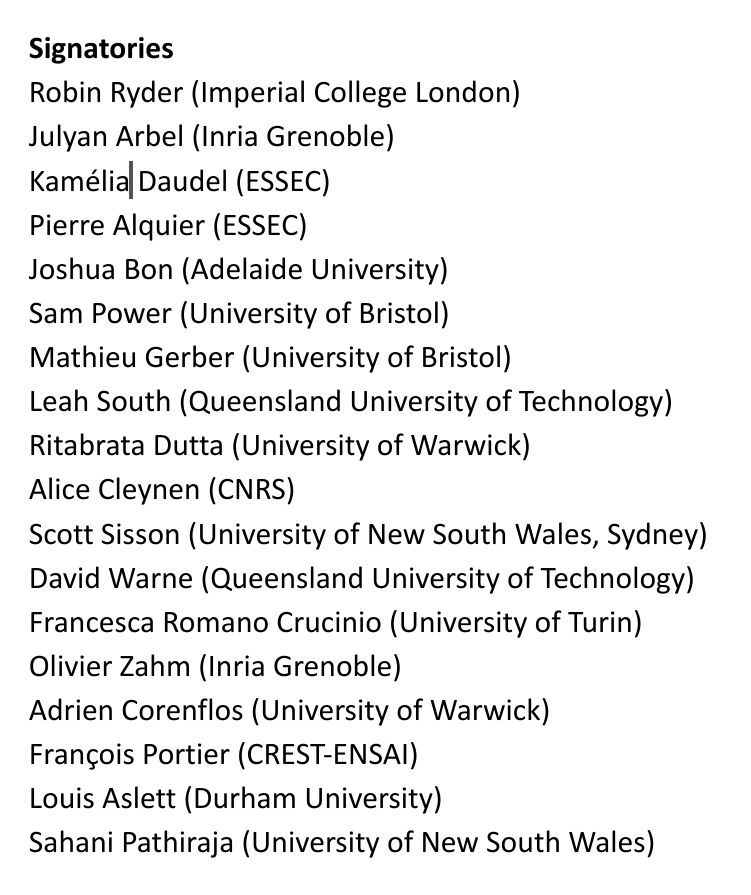
Eighteen associate editors of the journal Statistics and Computing have announced they will resign after Springer Nature announced the journal would require a fee to publish.
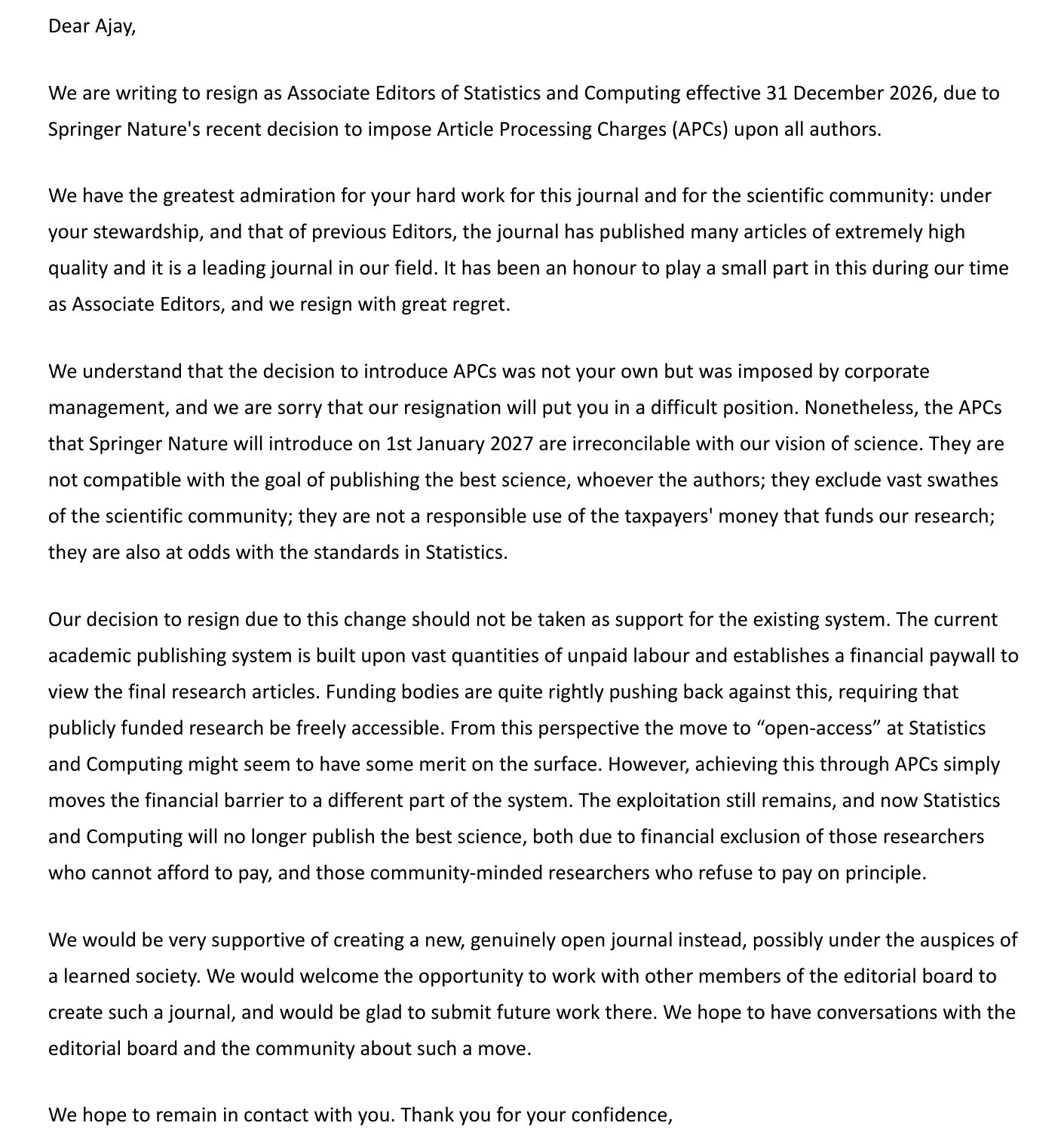
In a July 8 statement to editor-in-chief Ajay Jasra, the resigning editors cite the publisher’s decision to become fully open access starting in 2027, a move they call “irreconcilable with our vision of science.” According to the journal’s homepage, all submissions from July 1 that end up in the journal will be subject to a $2,990 article processing charge (APC).
The journal formerly operated as a hybrid model, with optional open access. While the fee to publish OA will remain the same, authors will not have the option to publish for free with their research behind a paywall, unless they qualify for a waiver. Springer Nature offers APC waivers to papers with corresponding authors in low-income areas, according to their website.
Statistics and Computing will join two other OA statistics journals at Springer Nature, one of which charges an APC of $1,590, according to the publisher’s list of OA fees. The other does not charge a fee.
The move “will impose massive financial barriers for colleagues who do not have access to funding, will create a further gap between institutions, and the journal will eventually lose its appeal as authors publish elsewhere,” Robin Ryder, one of the associate editors who resigned, wrote on LinkedIn.
Statistics and Computing will join our mass resignations list as the fifth journal this year to experience such an exodus.
Ryder, a mathematician at Imperial College London, told Retraction Watch Springer Nature first informed the editors of the change in May. “My understanding is that [Jasra] warned them against this move, but they ignored his warning,” he said.
Jasra, a professor at the Chinese University of Hong Kong, declined our request for comment.
Statistician Christian Robert, who frequently publishes in the journal, wrote in his blog on June 28 that Springer Nature was “about to hijack” the journal by requiring APCs.
Melissa Fearon, the publishing director for Springer Journals, told us the shift in publishing model is part of the publisher’s “broader commitment to increasing access to research and supporting the transition to open science in a responsible and sustainable way.”
Fearon said APCs support the “ongoing investment” into journal integrity evaluation, peer review, and other systems “to ensure articles are robust, discoverable, accessible and preserved for the long term.” She also said that through “institutional agreements, country-tiered pricing initiatives and APC waivers, around 40% of the open access papers we publish are made available at zero or very low cost to authors.”
“We are grateful to the Editorial Board Members for their contribution to Statistics and Computing over many years and for the expertise and commitment they have brought to the journal,” Fearon said.
The 18 resigning members are a relatively small share of the 160 associate editors at the journal, but Ryder told us he expects more will resign. The resignation is effective on December 31, 2026, the notice says.
“The current academic publishing system is built upon vast quantities of unpaid labour and establishes a financial paywall to view the final research articles,” the statement reads. While funding bodies are pushing back and aiming for accessible research, “achieving this through APCs simply moves the financial barrier to a different part of the system.”
“The exploitation still remains, and now Statistics and Computing will no longer publish the best science, both due to financial exclusion of those researchers who cannot afford to pay, and those community-minded researchers who refuse to pay on principle,” the notice states.
If the editors regroup elsewhere to form a new journal, they hope to publish with a society, Ryder told us, citing journals like Journal of the Royal Statistical Society and Annals of Statistics, “none of which force authors to pay APCs.”
Andrew Gelman, a Columbia University statistics professor who serves as an advisor to the journal, said “it would be great if the journal could move to an open and free system,” citing the example of the Journal of Machine Learning Research.
“I have never paid to publish an article in a statistics journal, and I think many of my colleagues could say the same,” Ryder said. “In our field, it doesn’t make sense to pay for OA, since our papers are available on arXiv for free and the arXiv version is always very close to the journal version.”
As for how the resigning editors are feeling: “We’re sad,” Ryder said. “This is a journal that we all love.”
Like Retraction Watch? You can make a tax-deductible contribution to support our work, follow us on X or Bluesky, like us on Facebook, follow us on LinkedIn, add us to your RSS reader, or subscribe to our daily digest. If you find a retraction that’s not in our database, you can let us know here. For comments or feedback, email us at [email protected].
RT writers – I think there has been some inconsistencies with how Melissa Fearon is spelled.
Fixed, thanks.
Why bother publishing in OA journals? Even if you have funding, why bother? Let those who want to publish OA do so. It’s a good thing that the editors resigned to start an alternative new subscription journal. Subscription journals, despite their own biases and shortcomings are the best option because researchers can always put up their new/rejected research as OA preprints free-of-charge, which would showcase that their research results can and have stood the test of time and/or supported by experimental data. Nothing is more important than to have your research to be mathematically and theoretically sound, and continuously supported by experiments (repeated by others and from different experiments). In this case, publishing in journals is secondary. If the journals are not interested, we always have OA preprints as proofs. Of course this is superhard to survive as researchers, because it’s almost impossible to live normally by going against the flow of money and mainstream ideas. So, that’s the choice one has to make, adapt and adjust accordingly.
I’ve said it before and I’ll say it again: If all university libraries decided to collectively cancel all subscriptions to Elsevier, Springer, Wiley & Co and instead used the money to host & curate all essential journal completely OA themselves, we wouldn’t have these problems. Everything else would stay the same, except perhaps that (associate) editors won’t get paid for their work (except in the coin of prestige). Authors will continue to not get paid, reviewers will continue to not get paid, consulting editors will continue to not get paid, articles will continue to get published online (we don’t need paper versions anyway). And my guess is that university libraries may be able to do this at a fraction of the cost that they currently invest into their subscriptions. When will we start taking back the science that we do on taxpayers’ money from the maws of commercialization?
Why leave out the society journals? They are equally biased in different aspects, and these society journals are driven by money too, and who is who and who says what. I am not complaining. I am just saying that regardless of whether one can publish their work or not, OA preprints are here to stay, and these preprints would direct and determine the progress of science because journals either refuse or are too slow to correct the published flawed results (even after providing the required science). So, subscription and OA journals (society and commercial) and OA preprints should all be allowed to operate. Your suggestion is good if it also include OA preprints without restriction to all properly conducted research. But this is not viable because of human psychology. Human psychology is responsible for biases (money, status and other behavioral-related) in Society journals, commercial journals and OA preprints. So, it is better to leave OA preprints alone for “special” researchers (without funding/without status/retired/non-mainstream). These special researchers need this space, even though there are many shortcoming with OA preprints, but at least there is no biases where wrong/plagiarized/cheated/fabricated results would be automatically ignored without putting any effort anyway because preprints are not recognized by universities/governments/funding-agency/committees-for-promotion/committees-for-awards. So, the main culprit is human behavior.