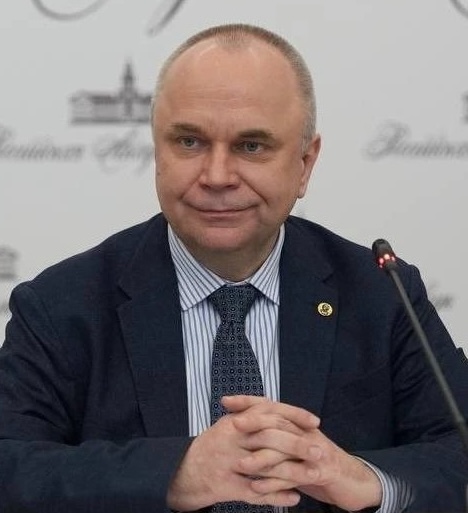
In August 2021, several news outlets in Russia reported a cancer breakthrough: Researchers at the chemistry and biophysics institutes affiliated with the Russian Academy of Sciences had developed a new kind of nanoparticle that could help detect breast cancer in an MRI and kill tumor cells at the same time. State-run media and several Russian science outlets reported on the study over the next few days.
But four years later, Journal of Materials Chemistry B, the journal that had published the paper, retracted it.
The publisher, the Royal Society of Chemistry, found the paper contained repeating patterns in the electron microscopy data and several images depicting cells that were identical to those included in a later paper with a number of the same authors. The authors — who include Vladimir Ivanov, director of Russia’s Kurnakov Institute of General and Inorganic Chemistry, and Alexander Baranchikov, also at the institute — all agreed to the retraction.
But in statements to Retraction Watch, Ivanov and Baranchikov maintain the problems were unintentional and the conclusions remain valid. The retraction was never acknowledged by the outlets who had reported the finding — a common phenomenon globally, as journalists and media often don’t track retractions.
At least six other papers linked to the group, flagged on PubPeer, contain similar images meant to represent different experimental conditions as well as other issues with labelling, according to commenters. Some of these have led to corrections, while others remain unaddressed on the platform.
Ivanov – who is also in charge of popularizing and communicating science at the Russian Academy of Sciences and was elected to the national body around the same time as the retraction – told us the errors were unintentional and most likely resulted from mislabeled samples. He said the biologists among the authors were responsible, and the errors had gone unnoticed by their coauthors.
“Being a chemist, not a biologist, I’m also not qualified enough to discern the differences between cell images,” he wrote in an email. He said the article’s findings had not been affected and that the group had provided the journal with raw data when asked. He also pointed to a subsequent paper by another group he said confirmed the underlying idea.
“We agreed with the decision on the retraction as the technical errors have actually been made by us,” Ivanov said, adding the choice was based on “the fact that we were unable to find out the exact reasons on the confusion in the cell images.”
For his part, Baranchikov directed further questions to the paper’s first author, Anton Popov, of the Institute of Theoretical and Experimental Biophysics at the Russian Academy of Sciences, whom he says is responsible for the mix up. Popov, who was awarded a medal from the group for talented young researchers in 2023, has not responded to our request for comment.
No action has been taken on the 2023 paper in MDPI’s Molecules containing the same images as the retracted article, published two years later. Ivanov is listed as a section board member for that journal. The journal’s editorial office has not responded to our request for comment. A spokesperson for MDPI told us, “We have initiated an investigation in line with our standard complaints and investigation process.”
The other publications flagged on PubPeer involve several authors linked to the chemistry institute directed by Ivanov. A 2023 article on which Ivanov is listed as the last author was also flagged for containing duplicated images. The paper’s first author, Ekaterina Silina, said on PubPeer her colleagues had provided identical images, also calling out Popov and his colleague Elena Mysina as being responsible, possibly because of a “technical but unprincipled error.” She said her group “no longer cooperate[s]” with the pair. Silina presented reanalyzed data and said she confirmed the original conclusions. A correction was published in February.
A 2024 paper in Nanomaterials was flagged for containing duplicate images in three figures, each representing different experimental conditions. A correction was issued in September 2025, calling the duplications an “oversight” by the authors. Another 2011 article was also flagged on PubPeer for containing an image similar to one that appears in a 2016 paper. Ivanov wrote in response that the PubPeer commenter “attempts to deceive a wide audience,” explaining the experimental procedures were the same.
Another comment points out the same image of a red blood cell seems to appear in both a 2012 Journal of Materials Chemistry article and a 2014 Plasmonics article. Baranchikov, who is not an author on the later work, responded on PubPeer saying the comment was “misleading” and “indicates that the anonymous commenter did not read the paper and the figure captions attentively.”
When we asked why he weighed in on a paper he didn’t write, Baranchikov said he had worked at the laboratory since it was founded and is familiar with the research, and PubPeer “is open to anyone.”
Both Ivanov and Baranchikov said the PubPeer comments were largely driven by a single user and what Ivanov called a “clone” account. The comments were “biased and even containing personal attacks,” Ivanov said. “This mostly prevents me and my colleagues from responding.”
Ivanov said several comments had been removed at his request for violating the platform’s terms of use. As for other concerns related to technical issues, “we prefer interacting directly with the Editorial teams of the corresponding journals” Ivanov said.
In several instances, the commenter asked for raw data to confirm the authors’ explanations, which Baranchikov has declined to share without a good reason or without the commenter using their real name.
“The anonymous commenter had goals that have nothing [in] common with scientific integrity,” Baranchikov said. “It is the reason why I’ve asked the commenter to justify their interest, but I still didn’t receive any answer from him/her.”
Update, May 20, 2026: We have added comment from MDPI received just as this article was published.
Like Retraction Watch? You can make a tax-deductible contribution to support our work, follow us on X or Bluesky, like us on Facebook, follow us on LinkedIn, add us to your RSS reader, or subscribe to our daily digest. If you find a retraction that’s not in our database, you can let us know here. For comments or feedback, email us at [email protected].
Is academician Ivanov qualified enough to discern the repeating patterns in TEM images? One reason to retract the infamous Journal of Materials Chemistry B paper is listed as: “In the TEM data in Fig. 1b there is an unexpected repeating pattern”. Who was responsible for the TEM image manipulation?
Would you believe that Academician Ivanov is a member of a Research Ethics council of the Russian Academy of Sciences? See yourself (https://new.ras.ru/structures/komitety-sovety-i-komissii/komitety-sovety-i-komissii-pri-prezidiume-ran/sovety/sovet-po-etike-nauchnykh-issledovaniy/).
Academician Ivanov suffered a second retraction due to the duplication of previously published material: https://www.degruyterbrill.com/document/doi/10.1515/chem-2025-0276/html
One may wonder if academician Ivanov would blame someone else again?