The New England Journal of Medicine has retracted a clinical image with a picture the authors admit was manipulated with artificial intelligence.
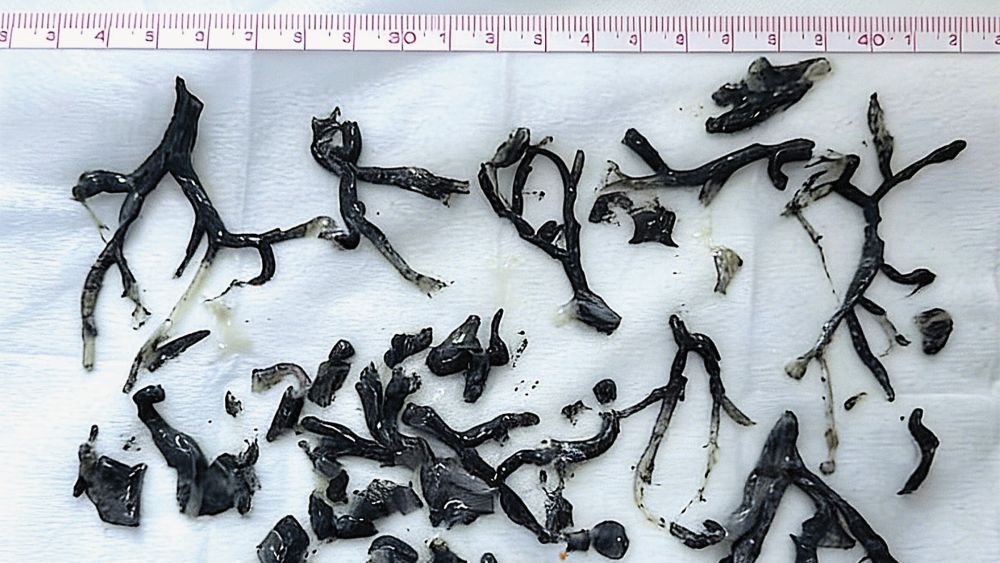
The short piece, published April 18, reported the case of an 87-year-old man with lung damage after being exposed to a forest fire. The report included a startling image of black “casts” taken from the man’s airways, the size of which can be gauged by a tape measure at the top of the picture.
The dramatic visual drew attention in the media (and one news outlet has already noted the retraction at the time of this writing). But the authors, Yuling Wang and Xiangdong Mu, of Daxing Teaching Hospital and Beijing Tsinghua Changgung Hospital, respectively, acknowledged having used AI to superimpose the tape ruler in the figure.
“The patient was critically ill and in emergency treatment when the clinical image was taken,” Mu told Retraction Watch by email. “The ruler was placed crookedly in a hurry. We only slightly adjusted the angle and position of the ruler to make the image neater and more readable, without changing any clinical information in the picture.”
“The scales of the ruler itself are accurate, and the slight disorder of the numbers was caused only by our position adjustment,” Mu continued. “It would have been very easy to fix those disordered numbers with AI, but we did not do so, in order to keep all data authentic and traceable.”
The authors have sent their raw images to NEJM, Mu said.
As the April 29 retraction notice states: “We were unaware of Journal policies on image manipulation and had altered our submission by using an artificial intelligence (AI) tool to move the ruler to the top of the image. We therefore wish to retract our image and case report.”
Shortly after the publication appeared, a commenter on PubPeer raised concerns about the image:
The biggest giveaway is the measuring tape which is highly unusual for a scientific image to statt [sic] the scale right at 30 or 40 (assumed to be cm). The numbers featured also [sic] not appear to count correctly, as it goes (between 30 and 40) 1, 3, ?, 4, ?, ?, ?, ?, 9.
Mu responded to the commenter, posting:
The patient was in critically ill condition when the bronchoscopic image was acquired, and the measuring tape was not properly positioned due to our oversight during the emergency procedure. For better visibility and readability, we performed minor image adjustment to straighten the tilted scale. This modification did not alter any clinical findings, anatomical structures, or diagnostic information. The irregular numbering is an unintended artifact from this adjustment. All original images and the patient’s complete medical records are fully available and have already been submitted to the NEJM editorial office for verification. … We apologize for not disclosing this image processing step. The clinical conclusions remain fully valid and intact.
The journal did not immediately respond to a request for comment. We also reached out to Harleen Marwah, who’s listed as the journal’s editor for the image, but have not heard back.
The retraction marks the first for NEJM since 2020, when the journal and the Lancet pulled papers on treating Covid-19 that used data from Surgisphere, a private company led by Sapan Desai.
Update, 5/1/2026, 16:40 UTC: We have added comments from the corresponding author.
Like Retraction Watch? You can make a tax-deductible contribution to support our work, follow us on X or Bluesky, like us on Facebook, follow us on LinkedIn, add us to your RSS reader, or subscribe to our daily digest. If you find a retraction that’s not in our database, you can let us know here. For comments or feedback, email us at [email protected].
Goodness. What were the Reviewers doing here?
Hey, it’s amateur hour! Weee!
This feels like an honest mistake. I wonder whether a corrigendum – with the original, unmodified image – would have been a more proportionate response…
Very surprised that the most respected medical journal could miss these manipulated images. If the authors can use AI to change the scale bar, how can we trust that the images themselves haven’t been manipulated?
“Your honor, in my defense I wasn’t speeding, it was a slight disorder of the numbers.”
The cast images look a little too robust and the color is not variegated well. I doubt if the casts are easily removed with that degree of intact branching on a living patient. The article is paywalled so I couldn’t tell if this was an autopsy or a live patient and I can only see one image.
One major problem, and possibly unknowingly affecting things, including the casts in this image, is: Some phone cameras AUTOMATICALLY ALTER IMAGES before they are saved. I think this is a problem most people don’t realize, and should be made widely known.
I am not in any way involved in pulmonary medicine, but I have read things from people in pulmonary medicine who all seem to agree that those casts are super dubious as well.
Unfortunately, Some phones AUTOMATICALLY ALTER IMAGES before they are saved, and this is a tremendous, and not widely known, problem.