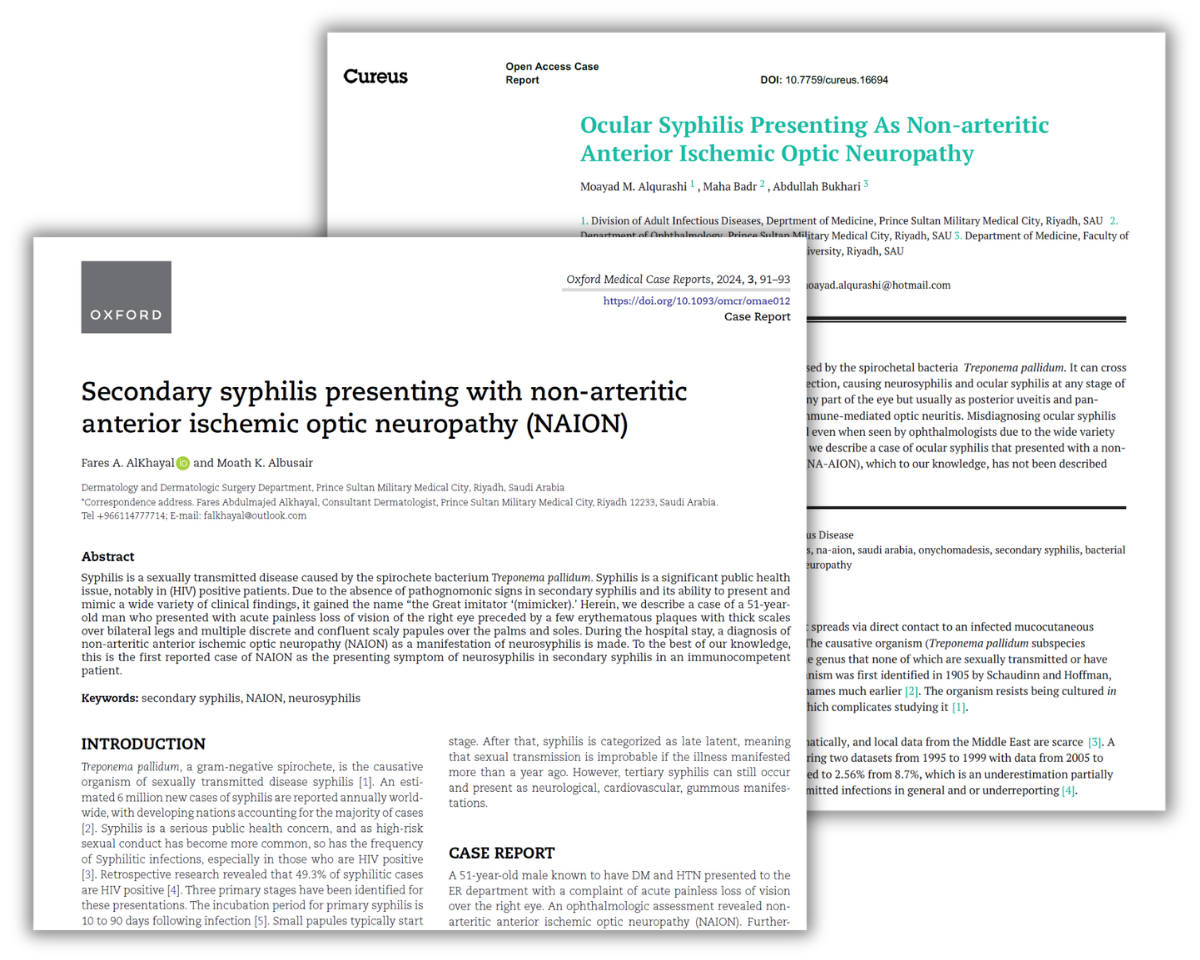
A researcher claims a case report he coauthored was plagiarized by doctors at the same institution three years later — a paper he was alerted to when a journal sent it to him for review.
Moayad Alqurashi, an infectious diseases specialist at King Fahad Armed Forces Hospital in Saudi Arabia, was the lead author on a 2021 case report published in Cureus about a patient who came to the emergency room with rapid vision loss. Doctors eventually diagnosed the patient with neurosyphilis, with non-arteritic anterior ischemic optic neuropathy, or NAION, as the presenting symptom. At the time, Alqurashi was a trainee at Prince Sultan Military Medical City in Riyadh.
Alqurashi told Retraction Watch that in 2023, while a reviewer for Skin Health and Disease, a Wiley title, he was invited to assess a report similar to the case he had written about. He said he notified the journal of similarities between the two cases, and the journal never published the report. The authors of that article had seen the same patient as part of a different department.
Fares Abdulmajed Alkhayal, of Prince Sultan Military Medical City and lead author of the second report, told us it was rejected from Skin Health and Disease because it was not novel. A representative for the British Association of Dermatologists, which publishes the journal, said their peer review process is confidential so they can’t disclose information about individual submissions.
But in March 2024 Alkhayal’s write-up of the same patient appeared in Oxford Medical Case Reports. Both the OMCR and Cureus papers claim they are the first reported case of NAION in neurosyphilis.
Alkhayal told us he was not aware of Alqurashi’s 2021 publication, and that the publication documents his own case. But Alqurashi said the patient was under his care, and Alkhayal and his team were not involved in his treatment or any follow-up appointments. Alqurashi said Alkhayal and his team were present only for the patient’s biopsy as part of the dermatology team.
“The treatment plan written in my publication is the accurate one,” said Alqurashi, adding that the patient’s therapy was switched after Alkhayal and his team were no longer seeing the patient.
Alqurashi contacted OMCR in April 2024 about the similarities, according to emails we have seen, and the journal responded by saying they would investigate the alleged overlap.
A representative for Oxford University Press confirmed to us that OCMR was made aware of potential similarities between the two case reports. “In 2024 the journal’s editorial team investigated and determined, while it is possible that the cases concern the same patient, the figures used in [the OCMR report] are original, the antibiotic treatments described in the two cases are different, and the two case reports are based upon separate examinations and treatments,” the spokesperson said.
OMCR retracted a report in 2021 because of a lack of written consent. Cureus, which has been published by Springer Nature since 2022, had 42 retractions in 2025. That year, it also lost its impact factor when it was delisted from Clarivate’s Web of Science.
Like Retraction Watch? You can make a tax-deductible contribution to support our work, follow us on X or Bluesky, like us on Facebook, follow us on LinkedIn, add us to your RSS reader, or subscribe to our daily digest. If you find a retraction that’s not in our database, you can let us know here. For comments or feedback, email us at [email protected].
Why is this a subject for RW?
That’s a serious allegation. If a case report was actually taken and published by someone else, it raises clear concerns about authorship, data ownership, and research ethics. In academic publishing, proper credit and consent are fundamental, and hospitals usually have strict policies about who can use patient data and how it’s documented.
But the results of the investigation did not support the allegation. Other than not being aware of the first case report, what did the authors of the second case report do wrong when they reported on their own treatment of this patient?
It’s in the article, the course of treatment isn’t accurate:
“Alqurashi said the patient was under his care, and Alkhayal and his team were not involved in his treatment or any follow-up appointments. Alqurashi said Alkhayal and his team were present only for the patient’s biopsy as part of the dermatology team.
“The treatment plan written in my publication is the accurate one,” said Alqurashi, adding that the patient’s therapy was switched after Alkhayal and his team were no longer seeing the patient. “
Yes, that was the accusation. However the OMCR investigation determined that a patient was seen and treated twice by different groups of doctors. The author of the first report assumed that the authors of the second report were writing about the same patient but changed the tx details. Apparently he was mistaken – the patient had a second course of tx that he wasn’t involved in. This RW article isn’t exactly clear. Are they suggesting the investigation was faulty and the second group of authors stole from the first? If not why does the accusation need to be publicized now in RW?