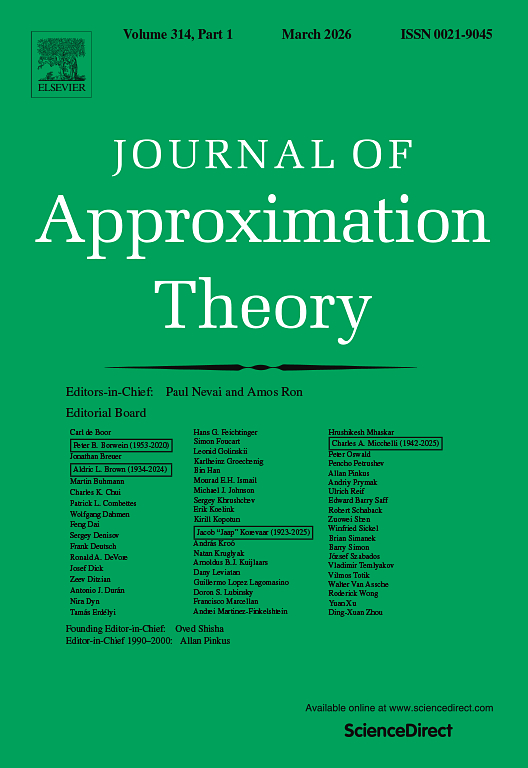
Forty-five of 48 members of the editorial board of the Journal of Approximation Theory resigned earlier this month for what they called Elsevier’s “concerning and potentially detrimental” decisions regarding the publication.
Paul Nevai, formerly a professor at The Ohio State University, was appointed editor-in-chief of JAT in 1990 and held the position for 35 years until December. That’s when he reached the end of his term and Elsevier informed him they’d be filling the position with someone else.
The mass resignation came after what Nevai said were several years of bad blood between the editors of the journal (including him) and the publisher, Giampiero Accardo. A representative for Elsevier told us designated publishers like Accardo are Elsevier employees who “oversee a portfolio of academic journals within a subject area, working closely with editors, authors, and research communities to support their development and long-term success.”
An April 3 email signed by 45 editors and both former editors-in-chief states: “While the publisher may seek to continue the journal under its existing name, in our view, the journal as we have known it has effectively ceased to exist.”
The journal was founded in 1968 and published by Academic Press until it was acquired by Elsevier in 2001.
Elsevier “made a series of decisions that a substantial majority of the editors found deeply concerning and potentially detrimental to the journal’s future,” the group resignation letter reads. “Despite efforts to address these concerns through discussions with the publisher, a mutually satisfactory resolution could not be reached.”
The letter doesn’t explicitly detail which decisions Elsevier made that the editors found problematic. Nevai told us the publisher increased oversight, employed heavy-handed involvement in editorial decisions and attempted to speed up the article production process.
Only three editors remain on the journal’s website. Retraction Watch reached out to them for comment but they did not respond.
“Editorial succession and rotation are important factors in ensuring the long-term health and sustainability of journals; by rotating editors, fresh approaches and perspectives can be brought to the journal and its community, helping to ensure it continues to serve its field effectively and sustainably,” Elsevier’s representative told us.
“We typically manage these transitions in close partnership with existing editors, often involving them in the nomination of their potential successors over a transition period,” they added.
The April 3 resignation wasn’t the first for the journal. Barry Simon, a prominent mathematical physicist, stepped away earlier this year in protest, Nevai said. Simon did not respond to our request for comment.
Nevai told us that, before Accardo took on the role of publisher, “everything was perfect,” and likened the publisher to a “mini-dictator.” Before the change, Nevai said, he and co-editor-in-chief Amos Ron had authority to appoint editors. But Elsevier was focused on expanding the editorial board to include researchers from a wider range of countries, according to Nevai.
Mathematics is a “completely merit based system,” he said, objecting to the move.
Nevai and Ron reached the end of their three-year terms in December. Nevai told us he expected his contract to be renewed and that he would decide when to retire.
Elsevier told us they had proposed a “collaborative process that included a one-year extension to allow for the identification of suitable successors, with input from the Editorial Board and the wider community. We were unfortunately unable to reach agreement on these points.”
Although Nevai told us he worked as an associate editor after the end of his term, the Elsevier spokesperson said there was “no formal agreement or appointment for him to take on an Associate Editor role. His position remained Editor-in-Chief during the discussions and following the conclusion of these discussions in late March, his access to the editorial system was removed.”
Nevai understands himself to have been effectively fired as associate editor at the end of March via an email from journal manager Priyadharsini Muthukumar “reassigning” four articles he had been given to review.
The journal joins our Mass Resignation List and is the second math journal in less than a month to do so. In March, we covered another instance of a mathematics journal’s editorial board who resigned en masse due to editorial changes enforced by Taylor & Francis.
Like Retraction Watch? You can make a tax-deductible contribution to support our work, follow us on X or Bluesky, like us on Facebook, follow us on LinkedIn, add us to your RSS reader, or subscribe to our daily digest. If you find a retraction that’s not in our database, you can let us know here. For comments or feedback, email us at [email protected].
The article is mostly accurate but not everything is so. For instance, “45 editors resign” is actually “51 editors resign” because some of the editors submitted their resignations with some delay, see jat.nevai.us.
you forgot “unqualified to assess” in front of “mini-dictator”.
Is it fair to be personal about the individual publisher? surely they are just implementing what their employer has asked of them? Would you give a cashier in a supermarket a hard time for following the supermarkets rules if you disagreed with them?
What a ridiculous comparison. A publisher is not a cashier. Also, you think that “just following orders” makes something okay? Really? You should know how that ends.
It would be great if you could maybe provide a reason why the comparison is ridiculous as you haven’t elaborated. It’s exactly the same, an employee who’s doing as their employer has asked of them and instead of directing all the anger at the corporation the individual has been targeted and name checked, that seems unfair to me.
You want more elaboration? I spelled it out for you already. A publisher is not a cashier. If you demand a more jargon-laden explanation, then how about this: You have resorted to the informal fallacy known as a “false equivalency.”
Let me present here my letter of resignation partially which explains what this particular editor of Elsevier did wrong. Instead of stopping him his ambitious top managers decided to lose income from permanent subscriptions in favor of questionable increase of the revenue. Rule number One of any business is never put under threat the main income of the company. It is a permanent subscription in this particular case. The Rule number Two is that any company shouldn’t try to increase its revenue to the absolute maximum since it is a very unstable point in the market. This editor did both things. Therefore, the issue with our journal rises a very obvious question about future of other mathematical journals published by Elsevier. By speeding reviewing process, Elsevier significantly diminish the quality of publications in its leading journals.