
In the summer of 2022, a researcher in Indonesia submitted a case report to Annals of Medicine and Surgery, one of several open-access journals founded and edited by Riaz Agha, a plastic surgeon and publisher in London. The manuscript, Agha responded, needed various changes to be considered for publication.
Among them: It should cite Agha’s paper on how to write surgical case reports, published two years earlier in the highly ranked International Journal of Surgery (IJS), the plastic surgeon’s flagship publication.
“Thanks Sir,” the Indonesian researcher replied. “I’ve added [the reference] to the manuscript.”
Although practices vary, the journals Agha founded aren’t alone in requiring authors to follow, and sometimes even cite, reporting guidelines. But a conflict of interest can arise when an editor demands authors reference guideline papers published in the editor’s own journals – as Agha does in his instructions to authors, reporting guidelines and editorial correspondence.
A Retraction Watch investigation shows the mandatory citations helped bring IJS’ impact factor close to that of the world’s highest-ranked surgery journal, JAMA Surgery, while also guaranteeing its founder thousands of mentions in the scientific literature. A high impact factor makes a journal more attractive to authors and readers, and allows publishers to hike publication fees. IJS has a $3,900 processing charge for a research or review article, almost twice that of its lower-ranked sister journal Annals of Medicine and Surgery.
The guidelines also promote another of Agha’s business ventures: a paid research registry he has suggested, and sometimes required, authors use when reporting on human research. The citation and registration requirements – while not unique on their own – seem to add up to serve Agha’s financial interests.
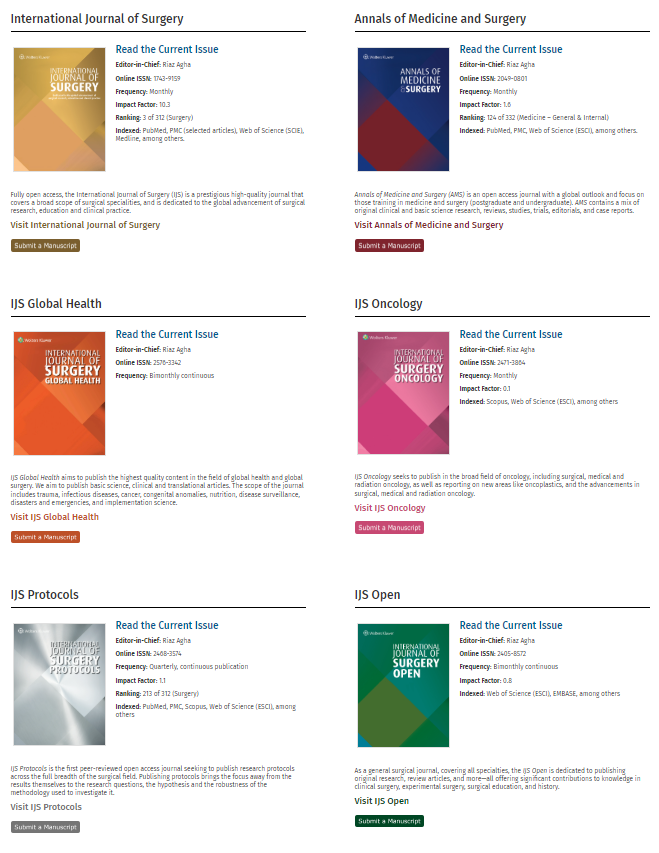
After Agha sold his small publisher, IJS Publishing Group (IJSPG), and its 10 titles to the Dutch multinational Wolters Kluwer in the fall of 2022, he took his reporting guidelines with him to the publishing outfit he launched two years later, the London-based Premier Science. But the citation mandate remains in place at his old journals, six of which he still edits today. As a result, large numbers of citations now flow every month from Wolters Kluwer to Premier Science.
When citation requirements become editorial policy, they create a “predictable” inflation that “undermines the spirit of what the [journal impact factor] is supposed to represent, namely, organic scholarly influence,” said Lokman Meho, a bibliometrician at the American University of Beirut in Lebanon, who helped with the analysis. “The effect is not trivial.”
A week after we contacted Wolters Kluwer, the publisher said it was “continuing to look into the information you have provided.”
Agha did not respond to requests for comment. Elizabeth Wager, a retired publications consultant and former chair of the Committee on Publication Ethics (COPE), who is listed as “advisor” on Premier Science’s website, said she had “never been actively involved with [Agha’s] journals.” Wager had agreed “to offer occasional advice on ethical issues,” she said, “but, so far, [Agha] hasn’t brought any cases or issues to me.” (Wager is also a former member of the board of directors of Retraction Watch’s parent non-profit, The Center for Scientific Integrity.)
We have attempted to contact Agha in the past, first about the Indian paper mill iTrilon, which claimed to have connections on the editorial boards of IJSPG journals and advertised papers it guaranteed would be published in the series, later about a deeply flawed case report in Annals of Medicine and Surgery and irregular registrations in Agha’s Research Registry. Agha, who was a member of COPE’s council in the early 2010s, never replied.
The eight titles that today make up Wolters Kluwer’s IJSPG collection of surgery journals originated with IJS, which Agha launched in 2003, when he was just 23 years old. In 2021, the year before the Dutch publisher acquired the publications, they generated about $2 million in revenue.
IJS’ ranking rose slowly over the years. Then in 2020, its impact factor suddenly took off, jumping to double digits the following year, while none of its sister journals reached an impact factor above 2. Reporting guidelines played a role in the ascent: Of the journal’s 20 most cited papers – several of which garnered thousands of cites each – 17 are reporting guidelines, according to data from Clarivate’s Web of Science.
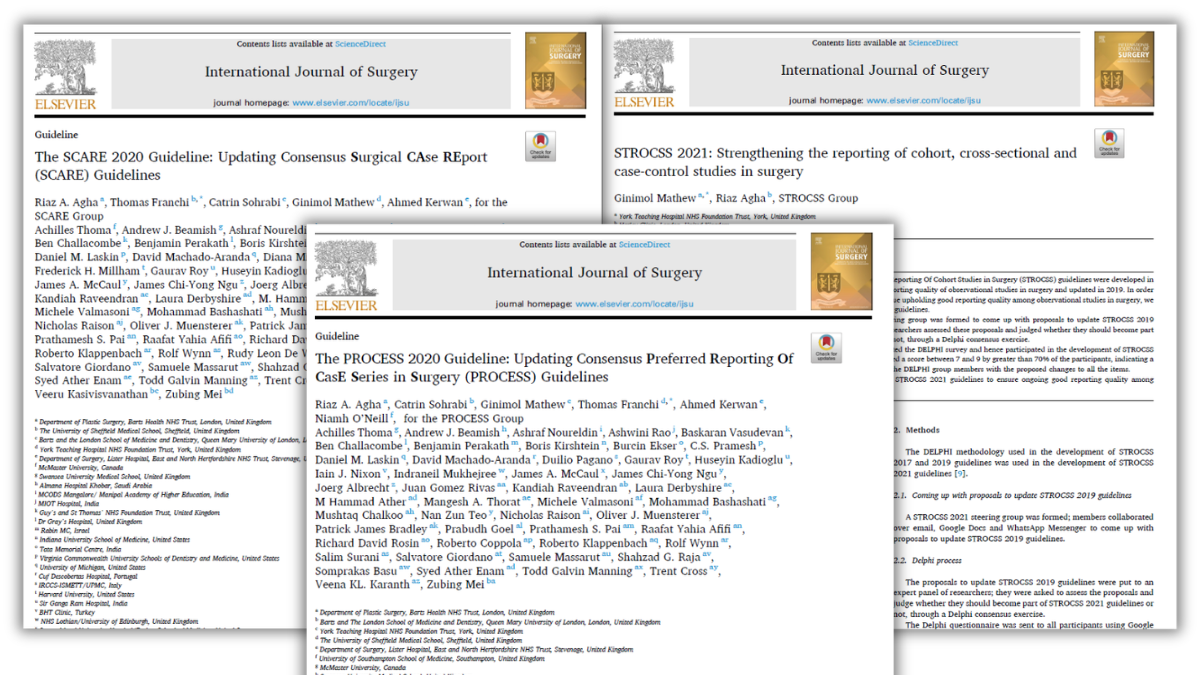
Several of the guideline papers were authored by Agha and colleagues, including SCARE for surgical case reports, PROCESS for surgical case series and STROCSS for surgical cohort studies. These guidelines are supported almost exclusively by Agha’s own journals. They have been updated every two years since they were first published in 2016 and 2017, which has caused them to continuously affect the impact factor calculations for IJS.
IJS also published reporting guidelines developed by others and appearing in several journals to reach more researchers. In these cases, Agha asked authors specifically to cite the paper in IJS.
Agha’s guidelines are not the only ones that explicitly urge authors to cite them in their manuscripts, although most appear not to do so. In any case, said Mario Malički, associate director of the Stanford Program on Research Rigor and Reproducibility, reporting guidelines “end up being some of the most cited papers across many disciplines.”
While some researchers have complained about the guidelines’ effect on journal impact factor, Malički said he supported broad citation requirements, noting that such mentions could easily be excluded from rankings if needed.
“Having said all of that,” he added, “is this a way for some journals to gain prestige? Very likely.”
The IJSPG journals’ instructions to authors state manuscripts should mention “that the research is being reported in line with the relevant guideline which should be named and cited.”
And authors comply: Agha’s work was cited in 573 of 1,207 papers in Annals of Medicine and Surgery in 2024, for instance, and in 1,509 of 1,568 papers in the International Journal of Surgery Case Reports, according to Web of Science (WoS) data. Most papers referencing the plastic surgeon’s guidelines are published in his own journals, which also account for more than half of the articles citing him overall.
To gauge the effect the citation requirements had on IJS’ ranking, we concentrated on 2022, the year the publication’s impact factor peaked and Agha sold his publishing house to Wolters Kluwer. Meho, the bibliometrician, found SCARE 2020, PROCESS 2020 and STROCSS 2021 were cited 1,185 times in 2022, according to WoS. That means these three papers accounted for 3.4 points of IJS’s impact factor of 15.3 in 2022, bringing it close to JAMA Surgery’s 16.9 points.
“Reporting guidelines often deserve citation,” Meho said, “but the situation becomes problematic when citation is mandatory regardless of contextual relevance.”
Meho also pointed to a pair of highly cited COVID-19 reviews by Agha and colleagues that were published in IJS in 2020. Without those two papers, the journal’s impact factor would have dropped another five points to just 6.9. “That is a very substantial concentration effect from a small number of papers,” Meho said.
In 2024, Agha launched Premier Science, which now publishes 21 open-access titles in fields including medicine, biology, psychology, data science, engineering and social science. The company is based at a London address corresponding to that of The London Office, a provider of virtual-office services, and was incorporated in 2025 as a subsidiary of Rockstar Private Equity Limited, a company Agha established in 2016.
Although none of the Premier Science journals is dedicated to surgery, Agha now publishes his surgical reporting guidelines in the Premier Journal of Science, his new flagship title. The firm’s website claims the journal is indexed in Scopus, but it was discontinued in 2025.
The switch has ensured a steady stream of citations flowing from Wolters Kluwer’s IJSPG journals to Premier Science: The SCARE 2025 guideline, for instance, has already been cited more than 1,000 times, according to Google Scholar, and almost all of those citations came from the IJSPG series.
Another popular Premier Science guideline publication is Agha’s AI guideline from 2025. Again, virtually all of its roughly 2,300 cites indexed by Google Scholar come from the IJSPG series. An anonymous commenter flagged this unusual citation pattern at PubPeer and pointed to a paper in IJS “showing evidence of coercive citation.”
The controversial citation requirement is not the only publishing initiative by the entrepreneurial plastic surgeon that makes experts bristle. In 2015, Agha launched an online database called the Research Registry and began requiring authors of “all research studies involving human participants” to register their work before submitting it to his journals. Since April 2018, when Agha started charging £99 per registration, more than 9,000 studies have been entered into his database, potentially bringing in fees close to US$1.2 million.
Agha’s database is mentioned prominently in the guidelines he publishes regularly and in his journals’ instructions to authors and editorial policies. In editorial correspondence from 2022, registration in the database was sometimes presented as a requirement, even for retrospective studies, our investigation found.
Wolters Kluwer claims its practices “are in line” with recommendations from the International Committee of Medical Journal Editors (ICMJE). But according to the ICMJE, observational studies do not require registration. What’s more, the ICMJE considers it “critical” that “registries are independent of for-profit interests,” endorsing ClinicalTrials.gov and those that are in the World Health Organization’s Registry Network because they are “accessible to the public at no charge, open to all prospective registrants, managed by a not-for-profit organization,” among other criteria. ICMJE does not recognize registration of trials in the Research Registry.
Peter de Leeuw, a former ICMJE member and an emeritus professor of medicine at Maastricht University Medical Center in the Netherlands, said Agha’s policies seemed aimed at “self-enrichment” and were “an unacceptable way of pursuing these things.”
Despite the free, publicly available databases accepted for use by the ICMJE, a Google search found more than a dozen cases of editorial correspondence involving manuscripts submitted to IJSPG journals in 2021 and 2022. While the wording varied slightly, several authors were told to use Agha’s database in no uncertain terms, and some received what appeared to be minimal peer review.
“Please ensure you submit your work with a Research Registry UIN: www.researchregistry.com– it can’t progress without being registered – even it its [sic] retrospective research,” stated an email signed by Agha about a systematic review and meta-analysis by a group of researchers in Indonesia.
Although the study had already been registered once in 2020 in PROSPERO, a free prospective register of systematic reviews, the authors registered it again in 2022 at the editor’s bidding.
Agha’s email left the authors “with no choice whatsoever” but to re-register their work, “even though the additional retrospective systematic review registration had absolutely no utility or benefit to anyone except the Research Registry,” said John Loadsman of the University of Sydney, a physician and scientific sleuth.
Authors of surgical case reports were told to “submit your work with a Research Registry unique identifying number (UIN) if its [sic] first in man i.e. the first time a new device or surgical technique is performed: www.researchregistry.com – it can’t progress without being registered.”
Two of Agha’s guidelines specifically mention the Research Registry as an option for the mandatory study registration, but neither discloses his financial conflict, which de Leeuw said should “definitely” have been done.
According to Agha, his register aims to counter positive publication bias, a problem that plagues much of science, and answer “the call to register every research study involving human participants,” which Agha ascribes to the 2013 version of the World Medical Association’s Declaration of Helsinki. Article 35 of that document, which lays down a set of principles for ethical research in humans, states that “Every research study involving human subjects must be registered in a publicly accessible database before recruitment of the first subject.” (Article 35 of the 2024 version states: “Medical research involving human participants must be registered in a publicly accessible database before recruitment of the first participant.”)
But Otmar Kloiber, secretary general of the World Medical Association, told us secondary use of data that was not foreseeable when the data were collected is governed by the Declaration of Taipei and “does not require registration.”
Loadsman said he first became aware of Agha’s registry “in 2022 as a result of the case I investigated involving what appeared to be paper-mill-generated protocol papers.” As we reported recently, those papers were published in Wolters Kluwer’s journal Medicine, which is not part of the IJSPG series, and 126 of them have now been tagged with an expression of concern.
“A substantial proportion of those ‘protocols’ were registered using the same obviously fake user name, and many also registered a study that allegedly commenced and completed recruitment on the same date as the registration,” Loadsman said. “This suggests nobody involved with Research Registry bothers to check even the most basic aspects of integrity before accepting the registration.”
Loadsman also wondered about the point of registering a case report. “It appears nearly 800 case reports have been registered on Research Registry since its inception, more than 600 of which have been since 2018 when a £99 fee became applicable,” he said.
Like Retraction Watch? You can make a tax-deductible contribution to support our work, follow us on X or Bluesky, like us on Facebook, follow us on LinkedIn, add us to your RSS reader, or subscribe to our daily digest. If you find a retraction that’s not in our database, you can let us know here. For comments or feedback, email us at [email protected].
The solution would have been so simple from the very beginning. Instead of taking into account the mean average of citations per article, the median number of citations should be considered when calculating the impact factor. This would disincentivize this guideline publishing epidemic by journals. Would love to see this journal getting placed in Q2 or Q3 category after this change.
I had the same problem when submitting to The Lancet group of journals and had to incorporate a guideline which was, you guessed it, published in The Lancet group of journals. BMJ does the same thing by publishing guidelines and inflating its impact factor.
Or, make it such that when incorporating reporting guidelines, simply mention their names without citing them.
I’m surprised there isn’t a guideline on how to register reviews on PROSPERO. Let’s wait a few years and we’ll probably see that too.
Excellent reporting. Hopefully Agha’s family of journals will be delisted from WoS and Scopus for citation manipulation.