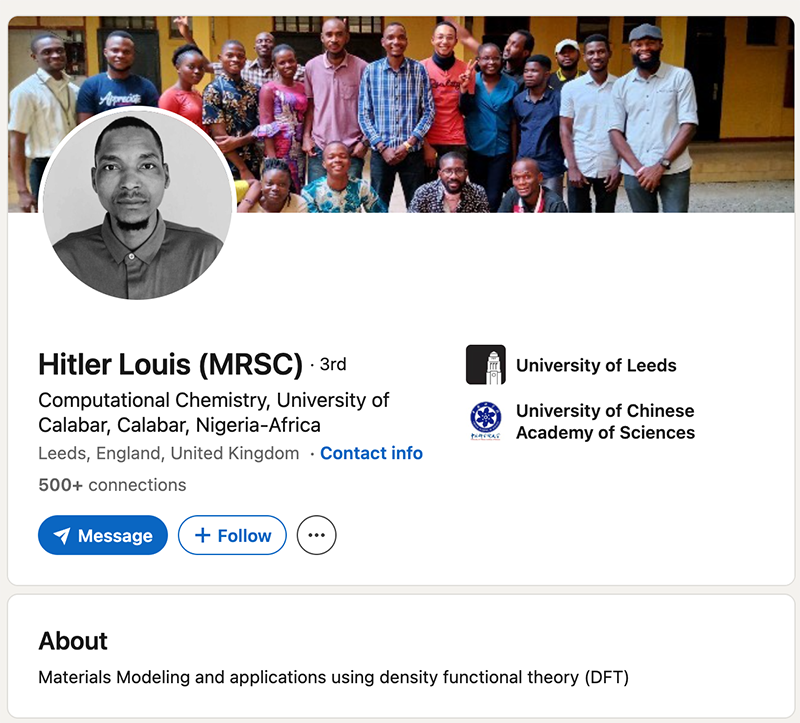
Racking up 35 retractions in just 24 months, chemist Hitler Louis has scored a place on our leaderboard.
The papers at issue, most of them published in Elsevier and Royal Society of Chemistry journals, exhibit a variety of problems, according to the retraction notices: identical plots supposedly representing different chemical systems, self-citations multiplying between manuscript submission and publication, compromised peer review and fundamental errors in chemical analyses.
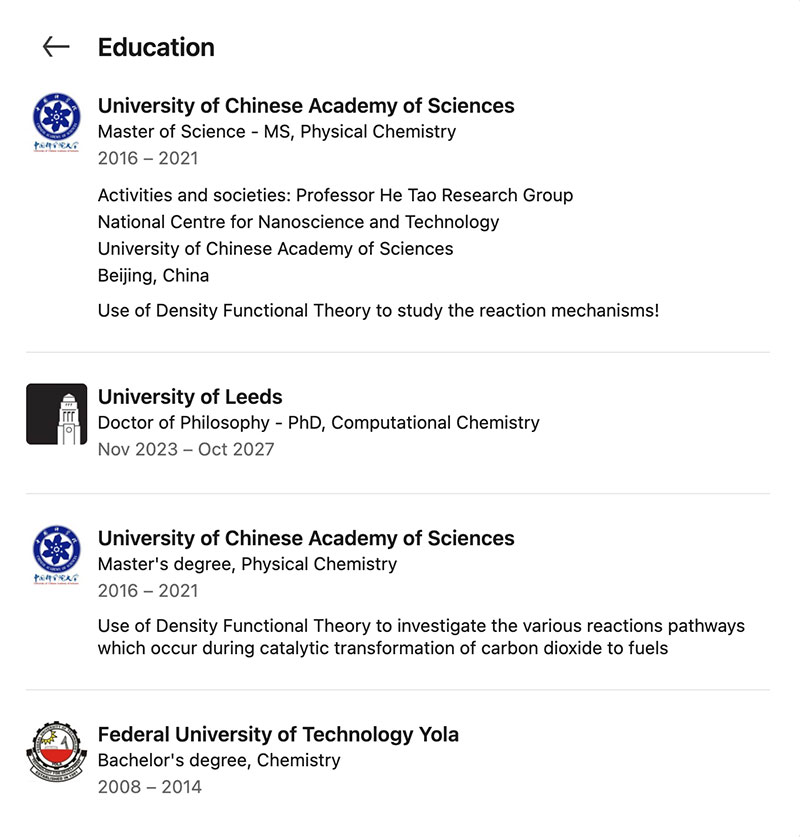
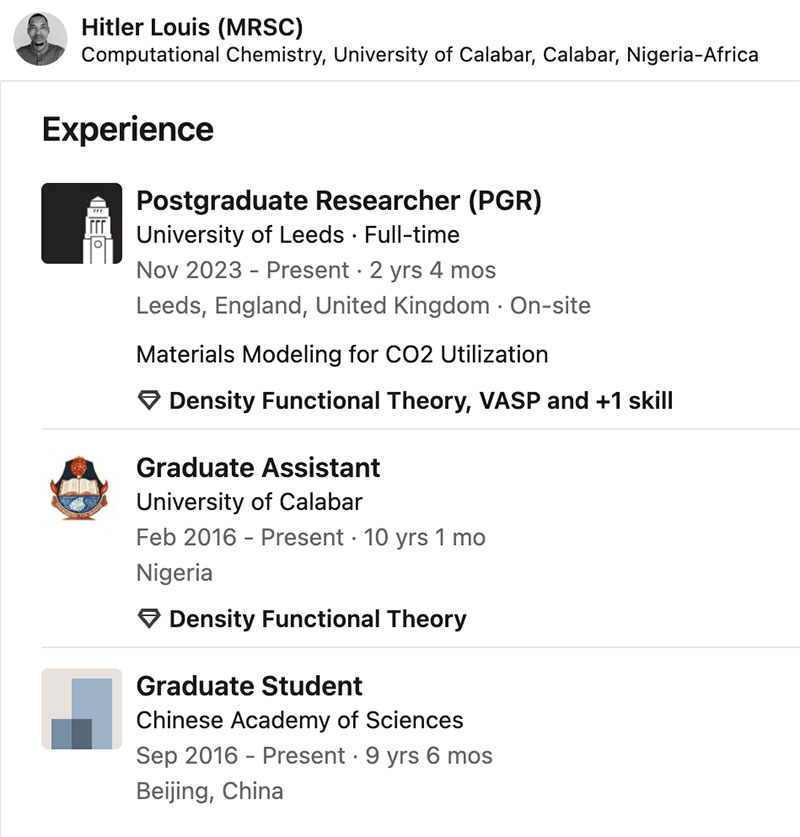
Louis – who also goes by Louis Hitler Muzong – did not respond to Retraction Watch’s requests for comment. Until recently, his LinkedIn page named him as a Ph.D. student in computational chemistry at the University of Leeds in the United Kingdom, with an expected completion date of October 2027. But retraction notices for two papers say Louis requested his Leeds affiliation be removed. One states “the research described in the article is not associated with that institution,” and the other that the affiliation “was given incorrectly.” The University of Leeds did not respond to a request to verify whether he was a student there.
Since we sent him questions, Louis’ LinkedIn profile appears to have been scrubbed. It no longer includes mention of Leeds, nor does it include previously listed affiliations to the University of Calabar in Nigeria or the University of Chinese Academy of Sciences. Now, the page identifies him only as working in chemistry in Nigeria. According to his profiles on Google Scholar and ResearchGate, however, Louis is a researcher in the Computational Chemistry and BioSimulation Research Group at the University of Calabar.
The most frequently named issue in the 35 retraction notices is that the authors use the same plots to represent different chemical systems, with duplications occurring in a single paper or across papers.
Innocent Benjamin, who appears as a coauthor with Louis on 19 of the retracted papers, graduated from the University of Portsmouth with a master’s in biology and biotechnology in 2025, according to his LinkedIn profile. Benjamin told us editorial concerns about image duplication “were largely centred on figure presentation and interpretation, not on fabrication of computational data.”
“There was no intent to misrepresent results,” he wrote. “The issue concerned visual presentation and interpretability rather than generation of artificial data.”
In at least eight of the retractions, named problems include citation manipulation. By the time one paper went from submission to publication in Heliyon, the authors had added 28 citations that were “not relevant to the topic of the paper and benefit authors,” including Louis, according to the retraction notice. In another Heliyon paper, between submission and publication, self-citations for Louis increased from seven to 38 and from two to nine for Benjamin. And in a third Heliyon paper, self-citations jumped from one to 14 for Louis and from two to 11 for Benjamin.
The notices state the authors were asked to explain why these references were added but were unable to give satisfactory answers. Benjamin told us that the references were included to provide context within their stream of research.
Two of the retraction notices also point to compromised peer review. These include one in Heliyon in which reviewers had asked for redundant references to their own papers, and another in Computational and Theoretical Chemistry, where editors expressed “significant doubts about the objectivity and thoroughness of the reviews conducted.”
A spokesperson for Elsevier, the publisher of these journals, said the reviewers had provided “biased and inaccurate reviews,” resulting in “flawed” articles. “It was subsequently determined that the issues identified warranted retraction rather than a corrigendum,” the spokesperson said. Twenty of Louis’ 35 retractions come from Elsevier journals. The spokesperson said they found out about the issues from a whistleblower and that investigation is still ongoing.
One Heliyon retraction notice identified “substantial” changes in authorship during the editorial process. Between submission and publication, five authors were added and one removed without adequate explanation or proof those added were qualified for authorship.
Several more of the retraction notices identify problems with the science. One paper retracted from Chemical Physics Impact included incorrect chemistry, and the authors claimed in the abstract to have analyzed UV spectroscopy data — an analysis which wasn’t included in the paper or the supplementary information. Another retracted paper from Scientific Reports had basic errors related to the conversion of units and incorrect calculations.
Retractions that include Benjamin, Louis’ frequent coauthor, date to August 2024, when Benjamin was a student at the University of Portsmouth. A spokesperson for that institution told us, “The retractions you reference relate to publications outside the scope of [Benjamin’s] degree studies,” adding the university only investigates conduct related to work for a specific degree.
Benjamin said he is “cooperating fully” with ongoing investigations.
“While retractions are serious matters, they are part of the self-correcting structure of science,” he said. “As a relatively young researcher, I remain committed to research integrity and to maintaining rigorous methodological standards in all ongoing and future research.”
Like Retraction Watch? You can make a tax-deductible contribution to support our work, follow us on X or Bluesky, like us on Facebook, follow us on LinkedIn, add us to your RSS reader, or subscribe to our daily digest. If you find a retraction that’s not in our database, you can let us know here. For comments or feedback, email us at [email protected].
I reported to Elsevier and the journal 5 horrific papers by Hitler Louis in the Computational and Theoretical Chemistry journal in May 2024. Of these 5, one was retracted, the other 4 were not acted on (only an expression of concern, intended to be temporary).
– In this paper, the authors simulated the wrong molecule: https://pubpeer.com/publications/C90B4A2F27620B6301D3B006E7547E
– Same in this paper: https://pubpeer.com/publications/D6525420E203EFA86256C7577B968C
– In this paper, the crystal structure reported is mathematically impossible: https://pubpeer.com/publications/7A68FB6C99A3E7A41D27832B172A81
– In this paper, it is not clear exactly what compound is studied: https://pubpeer.com/publications/BC190A928C6EF2389F46DBAD892B64
– In this paper, all references are completely mixed up: https://pubpeer.com/publications/EB0331DBF5F262125FEC913C1F48A8
Again and again, a mega journal involved in these shady articles… RIP Helyon, the journal no one ever asked for, care for, or read, to be honest.
I reviewed for Helyon once. Never again.
I’m sorry, I usually am not judgemental of people’s names… but “Hitler Louis” and “Innocent Benjamin”??? I’m frankly having a hard time believing that such a duo exists.
Unfortunate comment.
Came here to confirm this
Such names are not unheard of in Africa. Disbelief of the scale of fraudulent science is one thing, but disbelief of the names is a lack of cultural awareness…. They are funny names to a Eurocentric English perspective though yes.
Hitler is a European name, but not English, so your comment makes zero sense. It’s wild to have literally no cultural awareness and think Hitler is a decent name use. What part any African culture is using European names of mass murdering dictators?
Oh hey, I just read a book about the politics of names (https://cup.columbia.edu/book/the-politics-of-names/9780231221689/) that was mostly about the US but touched on this in passing—apparently it was an anti-colonialist thing, people who didn’t like (say) the British colonizers and knew that Hitler was an enemy of those same colonizers would adopt the name.
It is, in fact, a big part of African cultures. Only Western cultures think that it is important to quarantine historical evils. Dictator names abound in Africa. China still has Genghis Kahn on their money. Japan has Nazi fashion subcultures.
Calling Genghis Khan an “historical evil” and comparing him to nazism only betray ignorance, a very surface-level understanding of that time and region of the world, and an unfortunately common, in the West, demonization of Mongols and other steppes people.
”Japan has Nazi fashion subcultures” Not really, no. It is a fringe phenomenon. And an appalling one.
“Dictator names abound in Africa” Such as? On the other hand, I know for a fact that in the West, in the US for instance, people still name their kids after Robert E. Lee and the likes… Just an example among others. So much for “quarantining historical evils”…
Please. The English even named a tank after Oliver Cromwell who committed genocide on the Irish. Apparently that’s not offensive to them. Neither is the name ‘Hitler’ offensive to cultures not touched by the Holocaust. If only we had a repository of knowledge where people could educate themselves over the peculiarities of different cultures… like an international web filled with information.
Seriously, Hitler? As far as I know, this was a very unusual name, even in Adolf Hitler’s time. His real family name was Hiedler, but a grandfather or great-grandfather changed the spelling. Although not directly relevant to the question of scientific fraud, it is hard to beleve that bestowing this name on a child indicates anything other than admiration for the former mass murderer.
lmao, thinking same here……
Here is one time you would be 100% correct when you scream “you are literally Hitler!”
I’m quite honestly shocked and surprised no one has said it yet.
Your name means “heel”.
Agreed, although I’d say it is perfectly fine to be judgemental if parents name their son “Hitler” and he doesn’t change his name as an (apparently educated) adult.
Respectfully, changing any part of one’s name is not as straightforward and commonly thought about by most people. Not only is the bureaucracy involved in official changes (within the government level only, mind you) a mother in many global jurisdictions but attempting to do so also affects one’s personal identity that was developed growing up, creates challenges in name recognition and bonding with people from the past, and also causes problems for any service or personal effects (accolades, contracts, record) dependent on the name of the person.
It’s part of the reason why funny and illogical surnames still exist today
Dude, his name is *Hitler*
I think dealing with the challenges in changing your name are a small cost.
He did change his name, to Louis Muzong, per the article.
But not enough to not use it on his LinkedIn, where there is no reason not to use a preferred name over your given name.
Would you believe Hitler Louis or Innocent Benjamin?
Lol
Does nobody want to entertain the possibility that these papers are ai slop and that these people don’t actually exist, and that this is really just an elaborate attempt at internet trolling? It’s exceedingly difficult to find any positive evidence that either of these people exist, at all. It is, however, to me, very believable that someone wanted to troll a bunch of people for attention by publishing and then forcing retractions on papers authored by (Hitler, L; Innocent, B). It is probably relatively easy to do, especially to target small universities in relatively poor/developing countries who don’t have much robust social media presence, reputation, or manpower.
Some of the retracted papers are from 2021 and earlier, which indicates that either Mr. Hitler was a pioneer in AI generated garbage, or he legitimately is a bad actor in science.
that’s what I was thinking too. as i was reading this it dawned on me just how intangible so much of publishing is nowadays and how that will lead to this sort of fakery.