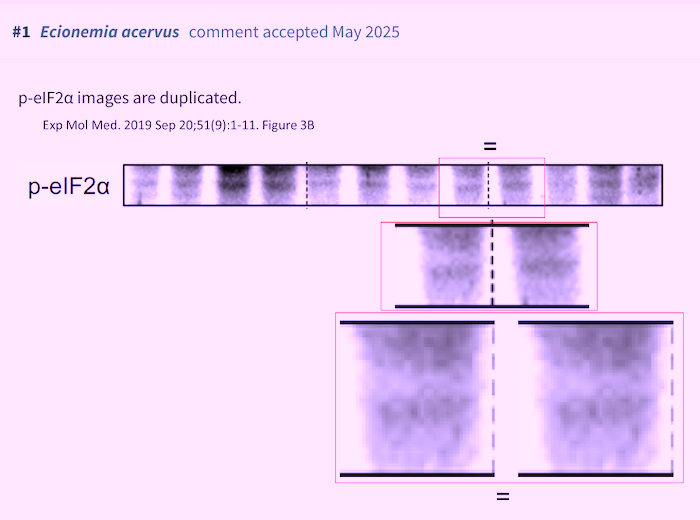
Mike Rossner had never seen anything like it. At first, the anonymous comment on PubPeer, which claimed a lane of a western blot in a research paper had been duplicated, seemed nothing out of the ordinary to Rossner, who specializes in detecting image manipulation in biomedical research. The surprise came when he looked closer at the magnified images the commenter had provided to support their allegation.
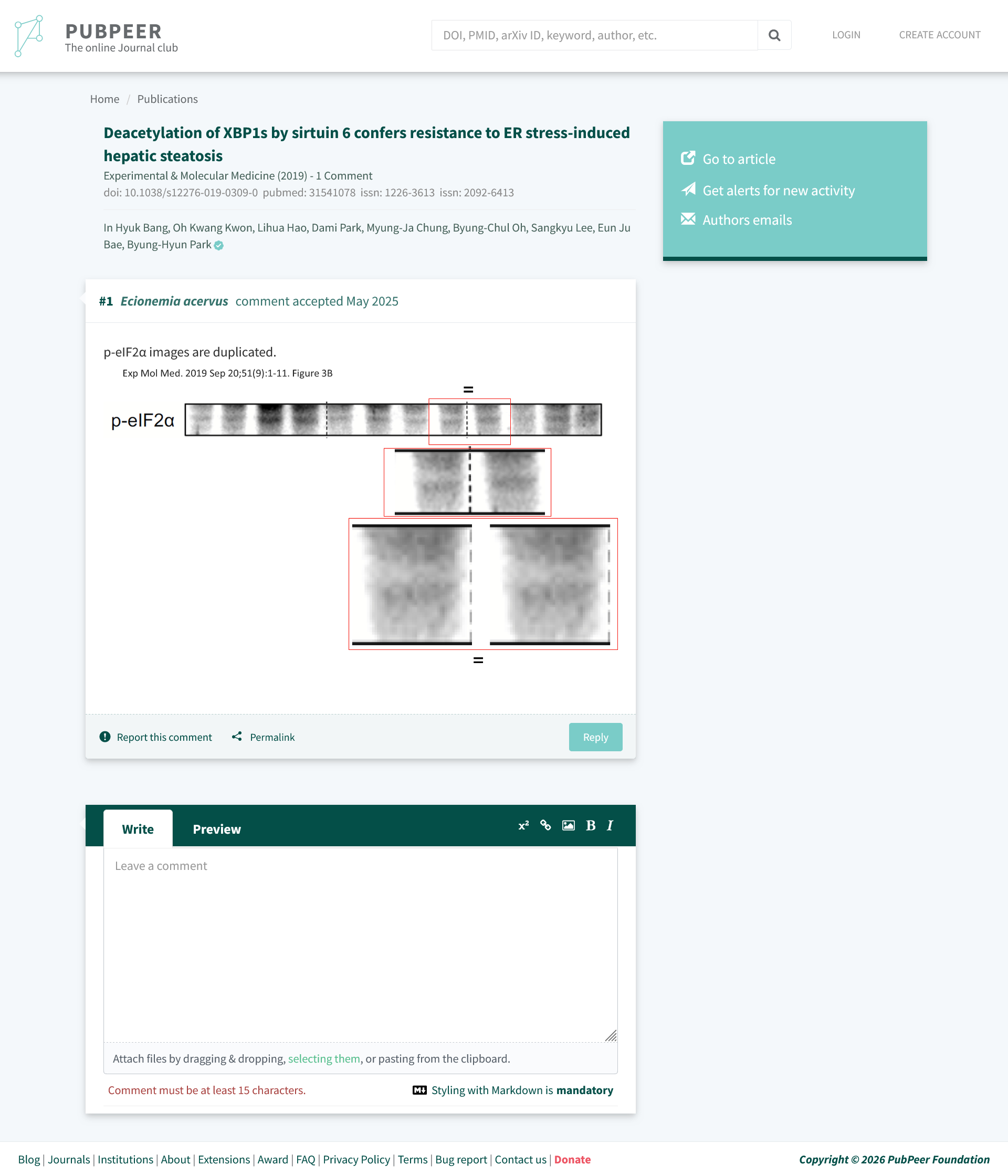
While the two enlarged lanes in the anonymous comment were indeed identical to each other, close inspection of the original image from the paper, which the comment included, clearly showed two different lanes. It wasn’t hard to see how the fakery had been achieved: A single lane had been copied and pasted on top of an adjacent lane.
“I have looked at thousands of PubPeer allegations, and this is the first time I have come across what appear to be fabricated allegations,” Rossner told us.
Intrigued, Rossner searched for other posts by the same person, who had commented under the pseudonym Ecionemia acervus. He found several. In two of them, the commenter again appeared to have fabricated the supporting evidence, as Rossner described in a short report detailing his analysis.
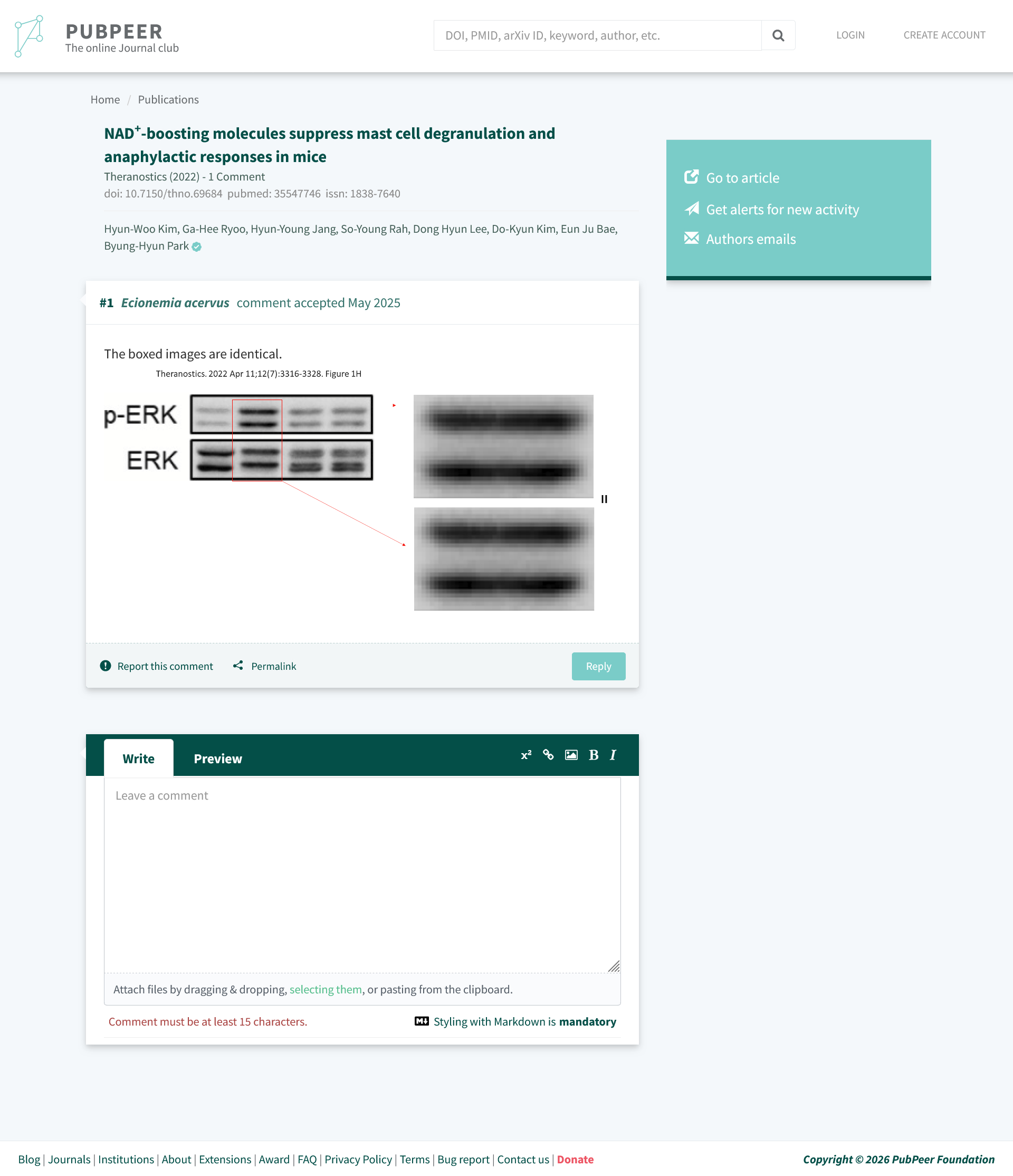

The three fake comments all targeted papers by the same senior researcher, Byung-Hyun Park, a professor at Korea Advanced Institute of Science & Technology in Daejeon, South Korea. Park is a corresponding author or coauthor on 16 articles that have been flagged on PubPeer.
Park told us he was aware of the comments but had “no knowledge of who made these allegations and no interest in their identity.”
“The National Research Foundation of Korea has reviewed the original uncropped Western blot data for the papers in question and found no evidence of data manipulation,” Park said. “We have also recently received an inquiry from [the Journal of the American Society of Nephrology], and our university has initiated an official investigation into this matter and all related PubPeer comments. We will fully cooperate with this process.” One of the fabricated comments was directed against a paper in the Journal of the American Society of Nephrology, which has also been flagged by another commenter..
Park added that, “for the papers for which I am responsible, I am able to provide clarification and respond to most of the concerns raised. I will determine whether retraction is warranted based on the findings of the ongoing investigation.”
All of the allegations Rossner traced to the anonymous commenter were directed toward papers by either Park or Han-Jung Chae, a professor and dean at Jeonbuk National University in Jeonju, where Park worked until 2023. Chae, who has had nearly three dozen papers flagged on PubPeer, did not reply to a request for comment.
While some researchers have worried about sleuthing being “weaponized,” Rossner said he wasn’t certain what to make of the fake claims he found.
“This case is particularly strange, because there are numerous allegations by this person (under the same pseudonym and other pseudonyms) that appear to be legitimate,” he wrote in an email. “Why would this person make up just a few allegations when there are already many allegations made against this author that appear to be legitimate?”
PubPeer deleted the cooked-up allegations after we contacted them for this story. (Disclosure: Retraction Watch’s cofounder Ivan Oransky sits on PubPeer’s board of directors but is not involved in the site’s operations.)
“The images in the comments appear to be quite carefully designed to mislead our moderators,” a PubPeer spokesperson who wishes to remain anonymous told us. “The true images were sufficiently small and low-resolution such that the moderators did not notice the difference. Such misleading comments are, naturally, forbidden on PubPeer and we have disabled them.”
“Although such bad-faith comments are very rare,” the spokesperson added, “our moderators try to be alert to the possibility when checking comments before they appear and will react very promptly when alerted to potential problems in posts already made public.”
Like Retraction Watch? You can make a tax-deductible contribution to support our work, follow us on X or Bluesky, like us on Facebook, follow us on LinkedIn, add us to your RSS reader, or subscribe to our daily digest. If you find a retraction that’s not in our database, you can let us know here. For comments or feedback, email us at [email protected].
The earliest archived version of the paper on Wayback Machine (archive.org) is Feb’ 2020 and it has no problems. Unless it was corrected immediately after publication, we can probably rule out the possibility that the original paper had problems and then had a stealth correction performed.
Very weird indeed.
This would be less of an issue if pubpeer would accept directly referencing the original image (e.g. just indicating Figure 1) instead of insisting that everything be in the commentary. I’ve always thought they did that to make things easier for reviewers and this seems to be evidence that is the case.
It definitely is bizarre. I looked at another paper flagged by the same anonymous commenter, and while they only mentioned one figure, several other figures in the paper seem to have very crude duplications similar to the one figure flagged. Undoubtedly this paper should be retracted, so why would they make up additional concerns?
https://pubpeer.com/publications/F7498DD1790911B306E0FC4E3D284D
@Paul Brookes, the low-res figure in the comments are those in the paper, which also argues against a stealth correction in this case (Frederik Joelving pointed this out to us).
The comments appear not to have been reported, neither by Rossner nor even by the author (who should have been alerted at the time of posting). Had an earlier report been received, PubPeer would have verified the comments and removed them much sooner.
@John, the requirement to include figures etc does make evaluation of the comments much easier for moderators, but also for readers. Having to leave the page to follow each link disrupts the flow of reading (a lot), and there are also many papers to which neither moderators nor readers have access. How to evaluate an image you can’t see? The inclusion requirement also helps filter some of the AI slop we receive. The rare bad-faith comments that make it through are usually reported immediately by readers or the authors and removed, which minimises the incentives to engage in such activities.
“This case is particularly strange, because there are numerous allegations by this person (under the same pseudonym and other pseudonyms) that appear to be legitimate,” he wrote in an email. “Why would this person make up just a few allegations when there are already many allegations made against this author that appear to be legitimate?”
First of all, if someone is already using multiple pseudonyms, that’s problematic. Second, are the fake allegations only against this particular author and the legitimate ones against others? Then it’s either their enemy who doesn’t know how psy-ops work, or it could be the author themselves. I mean, am I allowed to say these obvious things, or just hint at it like the others?