A Cell Press journal quietly removed part of a funding statement from a paper related to gender-affirming hormone therapy that the authors say was included in error. Experts called the move “worrying.”
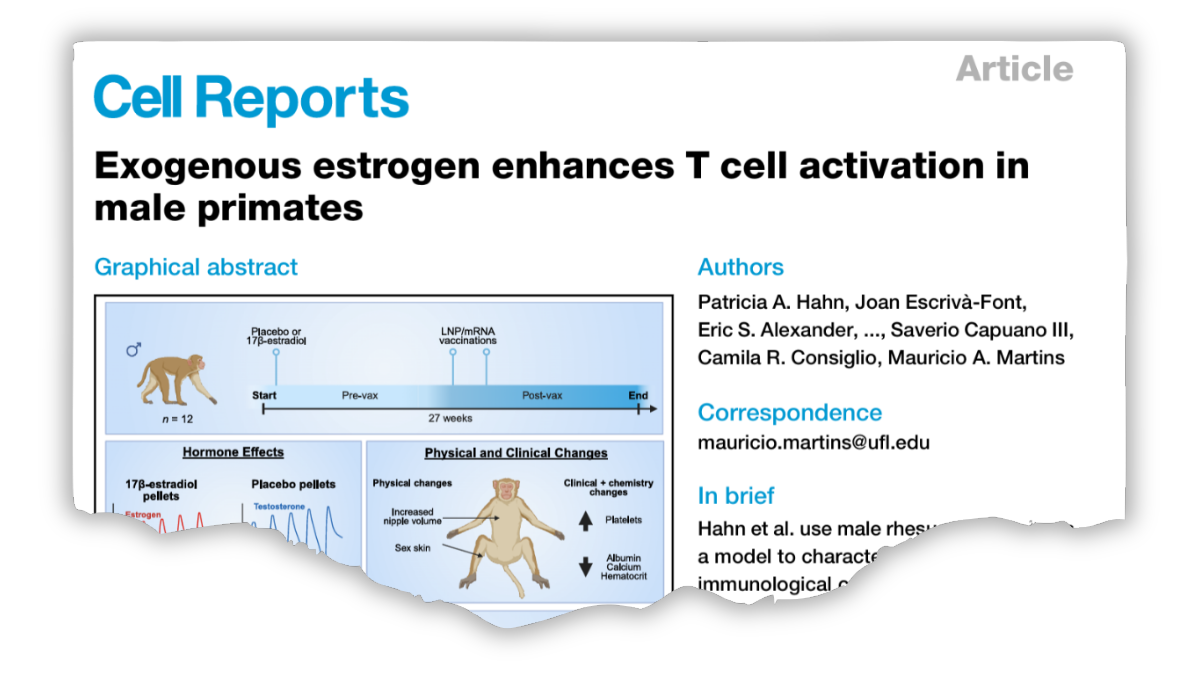
The authors of the paper, which appeared in Cell Reports on September 23, gave estrogen therapy to male monkeys to better understand how hormone therapies used in gender clinics might affect the immune system.
The research drew attention from several conservative news organizations, some of which called the project “disturbing” and alleged the work cost millions of dollars in National Institutes of Health funding.
An archived version of the paper dated October 6 included a state-funded grant, which is no longer listed in the acknowledgement. The removed statement read:
The study was further supported by a pilot award by the HIV/AIDS and Emerging Infectious Diseases Institute (HEIDI) at the University of Miami through the State of Florida Funding Initiative (M.A.M.) sponsored by the State of Florida, Department of Health (award contract #CODVD to M. Stevenson).
Corresponding author Mauricio Martins is a researcher at the Herbert Wertheim Scripps Institute for Biomedical Innovation and Technology at the University of Florida in Jupiter. Martins told Retraction Watch the statement was “inadvertently carried over from a different paper published around the same time” and that the Florida Department of Health grant supported another project unrelated to the Cell Reports paper.
When asked specifically whether the university or the state of Florida asked him to remove the statement, Martins replied they did not. “Once I realized that the HEIDI funding statement in the Cell Reports paper was incorrect, I asked the journal to correct it,” he said.
Martins did not respond to our question asking which paper the funding statement originally belonged to. But another article he coauthored in August in Mary Ann Liebert’s AIDS Research and Human Retroviruses received a correction this month to add the HEIDI grant to the funding statement. The article, reporting on an HIV-related immunological experiment in monkeys, shares three other coauthors with the Cell Reports paper.
The HEIDI award is a state-funded pilot grant given to research on HIV/AIDS at the University of Miami’s Miller School of Medicine. The award’s website no longer lists previous recipients of the grant, but according to an archived version of the website, Martins received the grant in the 2022-2023, 2021-2022 and 2017-2018 award cycles.
HEIDI director Mario Stevenson, who was named in the now-removed text, did not respond to a request for comment on whether he was aware of the paper or asked that the funding statement be removed. (He is not a coauthor on the Cell Reports study.) The Florida Department of Health also did not respond to questions on whether they were aware of the study or the funding statement.
When we asked why Cell Reports, owned by Elsevier, did not issue a correction to the article to signal the change, Shawnna Buttery, the editor-in-chief, told us their policy “considers grant and funder details to be non-scientific content of great importance to authors and their funders but not of interest to our readers, and our policy is to make such changes without requiring a Correction notice.”
Mohammad Hosseini, who teaches research ethics at Northwestern University in Chicago, disagreed with that assessment. “If, as they say, the funding statement was only useful for the authors and funders, then there would be no reason to disclose funding information,” he told us. “I believe that the change warranted a correction and cannot really get my head around why the journal or the publisher decided against it.”
Andrew Grey at the University of Auckland, who has previously written for Retraction Watch, called Buttery’s statement “worrying.”
“The authors made an error, which has been corrected. Readers should be made aware of the correction. It’s a straightforward matter to do so,” Grey said.
Funding disclosures are “pretty central to research integrity in a publication,” Lisa Rasmussen, the editor-in-chief of Accountability in Research, told us. “If funding declarations can be made to disappear after publication with no record, it’s easy to imagine how this could go wrong given particular political or other pressures.”
Journals have been called out before for making changes without noting them in a correction. Last year, a team of researchers found 131 articles with what they called “stealth corrections,” changes to author information, figures or data, editorial process records, or other alterations — including to funding statements.
Like Retraction Watch? You can make a tax-deductible contribution to support our work, follow us on X or Bluesky, like us on Facebook, follow us on LinkedIn, add us to your RSS reader, or subscribe to our daily digest. If you find a retraction that’s not in our database, you can let us know here. For comments or feedback, email us at [email protected].
What a wrong-headed take from RetractionWatch. I can’t believe I’m saying this, but Elsevier has got the right of it this time.
Funding information is indeed completely irrelevant to readers, when that “information” is that there wasn’t any! That was the entire “error” here; a piece of legally mandated boilerplate (part of the conditions for accepting funding is that you have to disclose it, obviously, as gracious acknowledgement of the funders) was associated to the wrong paper by mistake. It happens. Dr. Hosseini should reserve his criticism for actual cases of misconduct.
And generally speaking, there is not even anything wrong with not bothering to publish a “Correction” for non-scientific administrivia that is this insignificant. I know that I personally, as a researcher, am frustrated by the proliferation of these exact sort of Correction that is detached from the content of the article in question.
It’s obvious that this entire affair was the academic equivalent of sending an email without the attachment. Silly. But harmless.
The quality of this project is really going down the drain if this sort of reporting is what you’re choosing to focus on. Seriously! You did *not* need to spend time getting quotes from six different people for this fauxposé.
Yes, if they added in or changed a funder after publication then that would be a problem. Having a change from funded to not funded is not.
Changes to text of published articles should to be documented through whatever process is appropriate. Also, this is pretty benign attempt to correct an embarrassing error on the part of author and/or journal for not catching the funding statement being on the wrong article. I think ‘stealth corrections’ merit discussion because they obviously have the potential for abuse, but this article was an odd reading experience for me, as though I kept expecting the next paragraph to reveal evidence of some kind of wrongdoing (or even somewhat suspicious behavior) that would justify the “worrying” characterization and the investigative effort evident here.
I’d be very interested in a further look at stealth corrections, particularly if there is data addressing interesting and significant questions about the phenomenon (eg. different publisher practices, what kinds of edits are made, if and how they are documented). I think that approach is preferable to focus on individual cases, as this is probably a subject where the individual cases are likely to largely be similar to this one in their simplicity and non-worryingness.
Any change in a paper, no matter public readers are interested in the related information or not, MUST be transparent and published, including funding and support resources. This might seem insignificant to me as an academic reader but for institutions, administration purposes, tax office, or other financial matters can be significant and necessary to be formally informed.
Here, in this paper with a sort of controversial subject of gender, the funding/support or lack of funding should be transparent. If the funding party does not fully agree with the results and conclusions of the research or wish to hide their involvement, they could directly and clearly publish it as an open statement.