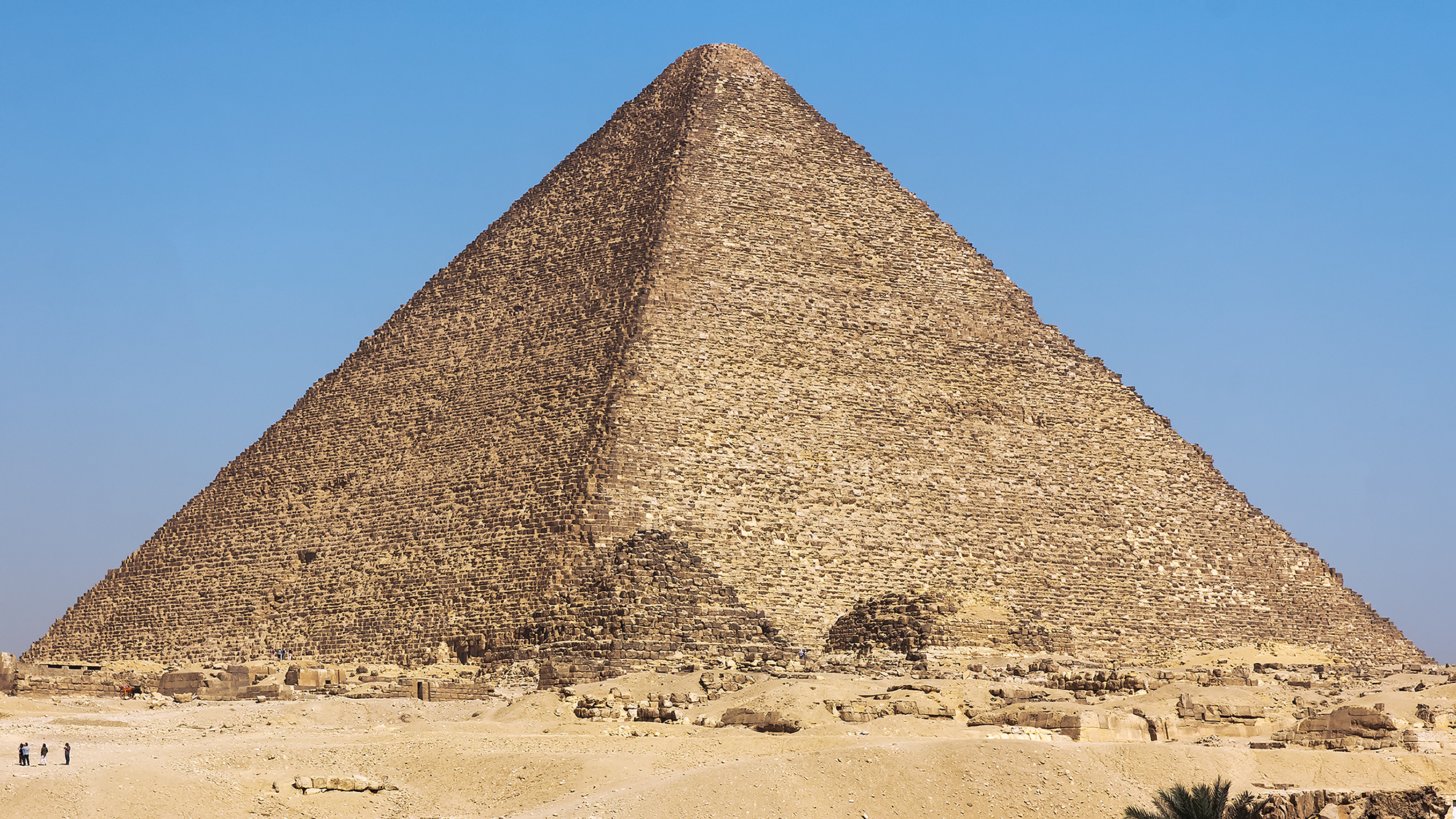
Douwe C. van der Zee/Wikimedia Commons

A journal has retracted a paper by two Italian scientists who claimed to have found hidden structures inside of the oldest and largest of the Pyramids of Giza.
The study, published in Remote Sensing in October 2022, purportedly used synthetic aperture radar to penetrate the Pyramid of Khufu with energy pulses and process the echoes received, revealing a network of rooms, corridors and tunnels. The paper has been cited seven times, according to Clarivate’s Web of Science, as well as in a 2021 report by Ireland’s Environmental Protection Agency.
The journal retracted the study on Aug. 10 after a reader “brought concerns to the attention of the Editorial Office regarding methodological issues with this article.” The editors investigated the claims and “confirmed serious methodological flaws and statistical errors that were deemed to undermine the scientific conclusions of the article.”
The scientists’ subsequent 2025 findings using synthetic aperture radar went viral — appearing most recently on the History Channel in an August episode of “The UnXplained” narrated by William Shatner and titled “What’s Really Hidden Beneath the Pyramids of Giza?” and on the popular Joe Rogan Experience podcast.
Lawrence Conyers, an expert in the application of radar to archaeology, pointed out multiple issues with the study to Retraction Watch. In particular, Conyers said it’s physically impossible for synthetic aperture radar to penetrate through the pyramid, reflect off of internal structures and return to the satellite sensor. To claim otherwise is to ignore the fundamental laws of how electric and magnetic fields operate, Conyers told us.
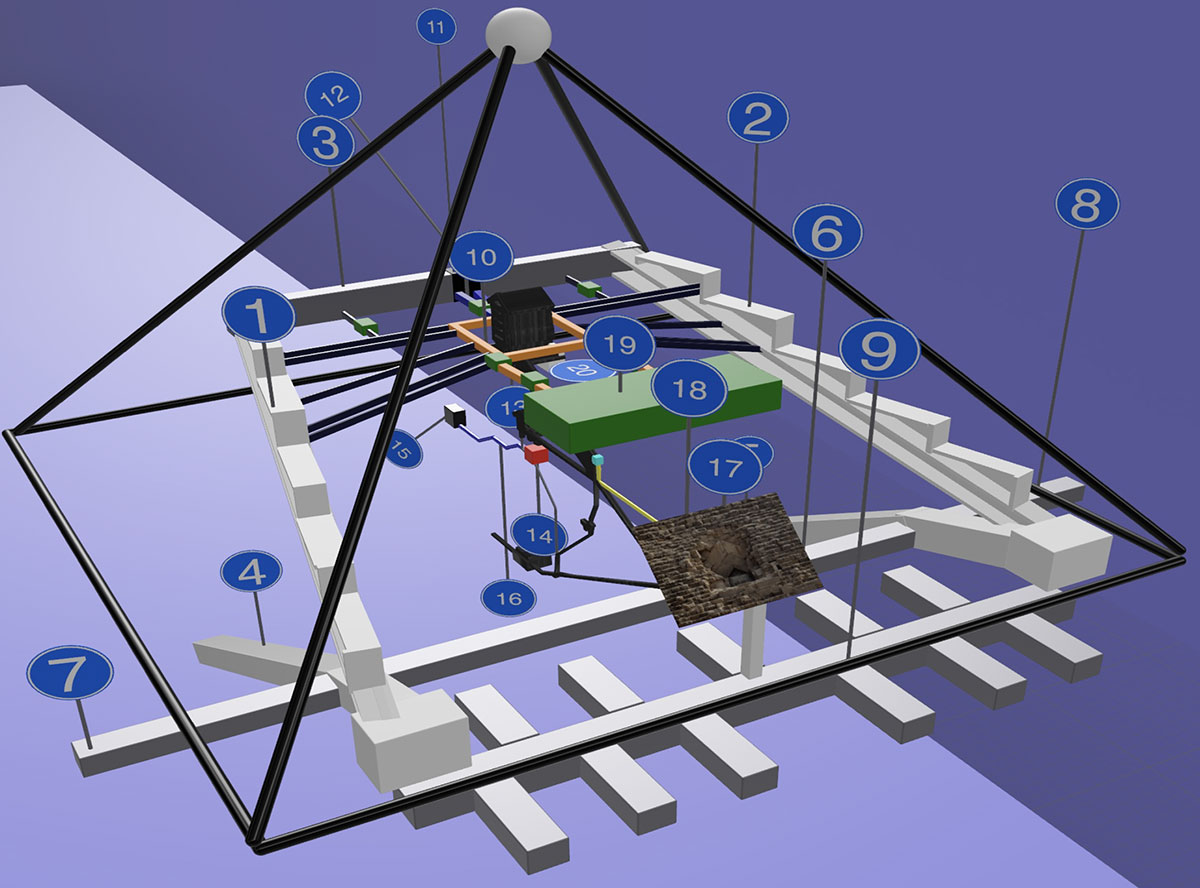
F. Biondi, C. Malanga/Remote Sensing 2022
The researchers — Corrado Malanga, an organic chemist at the University of Pisa in Italy and Filippo Biondi, a telecommunication engineer who was a visiting professor at the University of Strathclyde in Scotland at the time — tried to get around the penetration problem by claiming “micro-movements,” or background seismic noise, could generate a 3D image by measuring the tiny motion changes in the radar signal.
But that explanation is technically unsound, Conyers said: A radar sensor can measure only what it directly “sees”; the tiny micro-vibrations involved are far below the level needed for a satellite to detect.
“I don’t care what magical properties you are using, it just doesn’t work,” said Conyers, who is professor emeritus at the University of Denver. Conyers was asked to peer review the original study and told the editor he would not recommend publishing it unless they got an additional reviewer who understood the paper’s many mathematical equations, Conyers told us.
Last March, Malanga, Biondi and colleagues held a press conference announcing an even more sensational discovery.
Following what moderator Nicola Ciccolo called the successful application of synthetic aperture radar “to reveal internal features of the Great Pyramid of Khufu,” the team expanded their scope to the entire Giza Plateau and reportedly identified five identical structures around the base of one pyramid. They then claimed to find eight cylindrical shafts surrounded by spiral pathways linking two massive cube-shaped structures the size of city blocks. A network of chambers and tunnels supposedly extends out from the base of the pyramid, reaching two kilometers in depth.
“It’s like having two giant underground halls or cavities, each fed into by four spiral-wrapped shafts from above,” Malanga said during the press conference. “The entire complex of structures seems to extend laterally and even deeper beyond the immediate area of the Pyramid of Khafre.”
While many scientists quickly dismissed these claims — which have not been published or peer-reviewed — the discovery was widely shared and covered by numerous outlets including the Daily Mail and the New York Post.
Two weeks after the retraction from Remote Sensing, Biondi shared a link to the History Channel episode with his followers on X.
Biondi and Malanga did not respond to multiple requests for comment. According to the paper’s retraction notice, Biondi and Malanga disagreed with the retraction.
Single aperture radar “can’t see through rock. Period. The end. It does not work,” Sarah Parcak, and archaeologist and Egyptologist at the University of Alabama at Birmingham said in a YouTube video about these findings. “I could get any satellite imagery to look almost any way I wanted with enough manipulation,” Parcak said. “That’s what I think these guys have done — they’ve willfully misinterpreted the data.”
Update, Sept. 1, 2026: The top photo has been replaced. As commenters pointed out, the original photo was the Pyramid of Khafre.
Like Retraction Watch? You can make a tax-deductible contribution to support our work, follow us on X or Bluesky, like us on Facebook, follow us on LinkedIn, add us to your RSS reader, or subscribe to our daily digest. If you find a retraction that’s not in our database, you can let us know here. For comments or feedback, email us at [email protected].
I said this from the start. SAR goes a few meters deep. They insisted they had some kind proprietary data interpretation. Yes, it seems it was their imaginations.
This information is old and outdated the Italian team doesn’t use simple SAR scans that, of course, don’t simply scan through rocks. They use SAR Doppler tomography in a completely different way which professor Biondi developed himself. It’s a completely different methodology which is not explained here at all. It’s been proven to work numerous times, it has other peer review papers than this old one. It’s been previously applied to scan successfully into mountains to see Underground mines, and used to scan bridges for stress fractures. This journalistic review, and the retraction of one professor’s opinion, doesn’t prove the methodology wrong at all. It doesn’t give readers all the information and it’s definitely not giving any updated 2026 information. Don’t believe everything you read.
This Sarah Parcak does not know the difference between simple SAR and SAR Doppler tomography. The British originally developed the technology, but the Italians adapted it to scan deep into bedrock. Sarah Parcak is a vocal venomous critic typical of the iron clad archeological community that will not accept ANYTHING but the established narrative. Doppler tomography was used to detect the giant particle accelerator 1 kilometer beneath the surface in Italy and it detected not only the hidden voids in the pyramid of Khufu above the king’s chamber, but also the labyrinth in Hawara the Egyptians began excavating in earnest in March. Once the full depths of the labyrinth are re look released to the public this nonsense about the methodology of the Italian team and what they found beneath the pyramids and you will never hear a squeak out of Sarah Parcaks mouth again.
It seems to me that a better initial test of their method would have been to show how it works for know structures. To avoid bias they could have had a second party provide them with the data from a structure they were unfamiliar with, and then only compared their results with the actual mapping afterwards. Then they wouldn’t have needed to wait for excavations to prove their claims.
Don’t look up in action. News media should also be required to issue retractions when they publish false findings and face consequences.
From the introduction of the paper on radar imaging of pyramids:
> Recent theoretical and experimental studies have produced several unusual and interesting results on the cold fusion of matter experienced on dense lithium [24].
There are more of these irrelevant bits. Or citation plantations? Being made up is only one of the issues with the paper.
It certainly reads like a greatest hits of conspiracy nonsense. Aliens? Cast in situ? Advanced unknown civilizations? And all in the first 1 and a half pages. Not even wrong!
The pyramid in your picture is not the Great Pyramid. It is the second, smaller pyramid alongside it.
It’s not the second, slightly smaller pyramid of Khafre, because that one still has the top capstones.
It would also aid credibility if this article had the right picture at the top. This is definitely not the Great Pyramid of Khufu.
Oops. The photographer described their own photo incorrectly on Flickr. Others noted this in the comments there.
Thanks all – the photo has been replaced.
“To claim otherwise is to ignore the fundamental laws of how electric and magnetic fields operate, Conyers told us.”
In a transmission line, created by a copper wire concatenated with Aluminum wire, the junction where the metals meet creates a point of reflectance (depending on frequency, wire length, and other variables). Even if it were just a copper wire and then air, that boundary at the junction of copper and air has a reflectance (and that is basically how antenna work). Similarly, any radar can penetrate anything when operated at low enough frequencies and high enough power/amplitude (or are we now saying the Earth’s magnetic field doesn’t exist inside a stone building?). Similarly, reference ‘ultra-low frequency’ communications submarines or even simply the AM band while driving a car through the mountains where FM doesn’t work.
In my opinion, Conyers critique was the one that most deviated from fundamental electrical principles and he operated in malfeasance by intentionally misrepresenting them for gain. That said, if the original paper failed to provide a methodology, which could lead to repeatable experiment or explain the measurements, then the paper was equally at fault and retraction was proper. Two wrongs make a right it seems.
context: “Conyers said it’s physically impossible for synthetic aperture radar to penetrate through the pyramid, reflect off of internal structures and return to the satellite sensor”
Biondi and Malanga’s analysis used data from the X-band synthetic aperture radar on the COSMO-SkyMed satellite constellation. In context, Conyers remark is completely correct.
With respect to ELF, it has very low bandwidth/resolution. Satellite ELF SAR doesn’t sound very practical.
The easiest way to get a lot of attention for anything about the past is to claim that you have new ‘technology’ and ‘evidence’ that everything ever claimed by those that study our past – archaeologists, historians– is wrong. Through in an iconic structure and a theory about mysterious prehistoric super cultures or aliens (even better) and the mainstream media will amplify without fact-checking.
That’s…a lot of effort for some inaccessable subterranian tunnels & chambers that may or may not even be there. lol! I mean? I didn’t watch that episode & exclaim, “Whoa! This changes everything!”. I was just like, “…Oh, I thought that secret underground tunnels were already half the plotline of basically every movie ever made about pyramid raiders” or, “Err, but isn’t that just generally how pretty much every subterranian annex, mine, sewer & crypt was built for thousands of years?”. You know. That kind-of thing. I mean, I don’t live in an abandoned Colorado mine in The Rockies. So, I don’t bounce enough signals off rocks to know for sure whether these guys are full of it or not but I do know that this ‘discovery’ made no impact on my already limited historical understanding of a structure that predates every other standing structure on the planet.
It’s important to know that just because one professor, at one University, retracts a paper it is not the ‘be all, end all’ or proof of false claim or methodologies. It is just one person’s uninformed and outdated opinion. The Italian team is not just using Synthetic Aperture Radar on its own, they are using a unique SAR Doppler tomography that professor Biondi developed himself. It is not even used in the same way that normal SAR is used. Of course normal SAR does not scan through rocks on its own. Applying this reasoning to SAR Doppler tomography is an old, outdated and invalid argument based on biased opinions from 2022 by individuals wanting to shut down something that doesn’t fit mainstream academic opinion of “tombs everywhere”.
Biondi’s methodology, and how it works exactly, have been thoroughly proven and explained in great detail during many of their conferences, science summits, and on many different podcasts, and interviews. And yes, there are other peer review papers on it.
I also want to point out that the same SAR Doppler Tomography technology has previously been demonstrated and used to successfully to scan through entire mountains into underground mines, and into the structures of bridges to identify stress fractures. So, used in practical modern application.
Fact is, the tunnels beneath the Great Pyramid exist. The passages and rooms beneath the Hawara pyramid and Labyrinth exist, and they were proven using GPR and normal SAR satellite scans back in 2008 and 2015 long before the Italian team’s new scan technology. Nobody doubts the Hawara passages existence. There’s absolutely no reason to doubt that the same ancient people who built structures there wouldn’t also logically build underground passages a few miles away beneath the Giza Plateau. The Limestone Bedrock is easy to excavate into, and already filled with natural holes. Egypt is an extraordinarily hot place to live, so it makes perfect sense people would want to have much cooler underground places to go to.
Biondi and Malanga have already been in the process of scanning much of the rest of the Giza plateau and other ancient structures; data which will come out later this year, and the Egyptian government has already commenced excavations at Hawara because of it.
What you’re missing or ignoring is that it’s one person’s opinion of two other people’s unsubstantiated assertions.
They may have a new and better technique, but they’re expecting everyone to take their word for it. Does it work? Trust them. How does it work? They’re not telling anyone. If the technique is as revolutionary as they’re claiming, the authors should encourage people to use it in other places.
Yes. In fact, they are excavating the first 20 meters of material on top of the labyrinth to get down to the ceiling stones. Originally they were going to work on a dewatering preservation project to protect the step pyramid itself but without explanation the Egyptian government jumped head first into a full archeological excavation and based on satellite images released recently it’s a massive excavation they are undertaking
If the person’s holding back scientists looking for truth would allow them im sure the mysteries would end.
But it’s an M.C. Escher staircase in the pyramid so give this one a pass.
William Shatner and the new york post, now there’s two credible sources!!