
The market for fake authorship on a research paper has prices to match every budget, according to a new dataset compiled from thousands of advertisements on social media platforms and paper mill websites.
The dataset, called BuyTheBy, is the first systematic attempt to understand the market for paper mill products, according to its creators. It compiles more than 18,000 text-based advertisements from seven paper mills operating across India, Iraq, Uzbekistan, Latvia, Ukraine, Russia and Kazakhstan, collected at various points between March 2020 to April 2026. The researchers found prices vary widely depending on geography, ranging from $56 to $5,631 for a first author slot, according to a preprint submitted to arXiv.
Several of the advertisements appear to correspond with published papers subsequently published in the targeted journals, with identical titles to those advertised. But cracking down on the industry with datasets such as these will be difficult, some experts say, especially as the business model evolves rapidly with AI.
Paper mills are businesses that sell fabricated manuscripts and authorship slots on those manuscripts, explained Reese Richardson, a researcher at Northwestern University in Chicago, and lead author of the preprint. The earliest reports of paper mill activity more than a decade ago came from China, where publishing was a prerequisite for graduation or promotion for biomedical researchers, and they became “easy targets” in schemes promising quick, guaranteed, authorship on English-language papers, according to a 2024 review of the industry.
For people with no research training and no funding, needing a published paper to advance their career, “coughing up a few thousand dollars in order to move on with their life” can be attractive, said Brian E. Perron, a professor of social work at the University of Michigan, who has written about the paper mill industry.
Paper mills have since flourished in countries where researchers are rewarded for a lengthy publication history with more funding or promotions. We’ve covered the sprawling paper mill market for years, including a Russian business claiming to have secured authorship slots for thousands of researchers, similar operations in Iran and Latvia, as well as journals’ efforts to clean out paper mill products from their catalogs. Research published last year by Richardson and colleagues found that paper mill fraud was accelerating far beyond what corrective measures such as retractions or flags on PubPeer could keep up with.
Finding channels peddling fake authorship “is so easy it will make your head spin,” Richardson said. He has joined dozens of Facebook groups, WhatsApp chats, Telegram channels, and pages on Instagram and LinkedIn to keep track of paper mill activity. To track one down, the trick is to think like their target market — desperate researchers. “If you look things up like an academic desperate for publications would, you will find them,” he said.
The price for first author slots ranged from $56 to $5,631, according to the dataset compiled by Richardson, Spencer Hong of Northwestern University and Anna Abalkina of Freie Universität Berlin, who also maintains the Retraction Watch Hijacked Journal Checker. The highest prices generally came from ads posted by a paper mill operating in Russia, which caters to local and Kazakhstan-based researchers. The cheapest prices for authorship slots were from a paper mill operating in India, all priced below $150. The Indian mill’s Telegram channel posted more than 1,000 advertisements between March 2022 and July 2024.
Aside from article authorship, these included ads for textbook authorship, patents, copyright registrations, design registrations and even national awards. “Anything that could be counted toward a reputation is for sale,” Richardson said, explaining that patents count toward promotions and tenure in India.
Richardson attributes the price gap to income differences across the countries where the mills operate. Some fields, such as medicine and materials science, also seem to be more expensive than fields like business and education, though the current analysis was not designed to extract these conclusions.
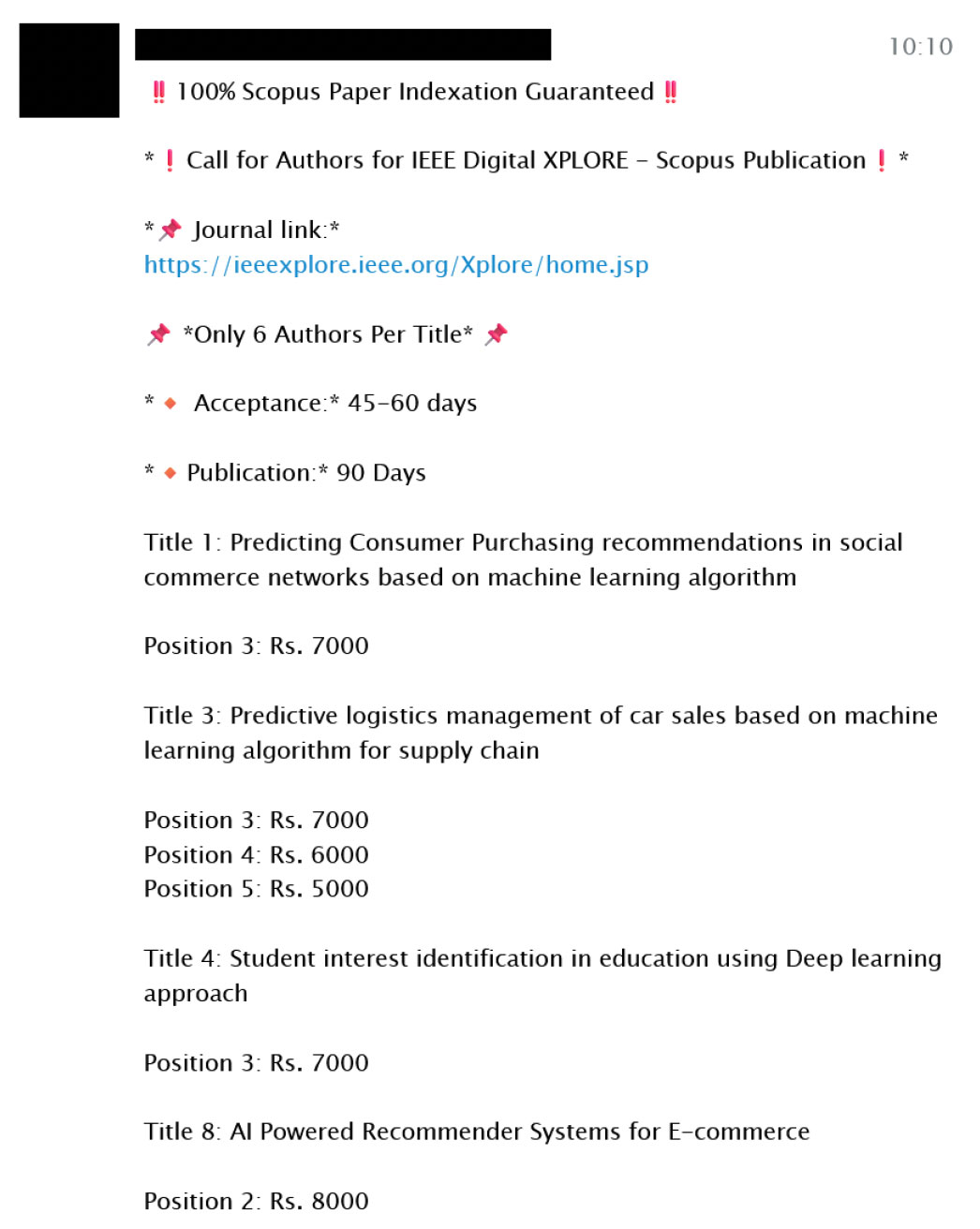
The Indian paper mill almost exclusively advertised authorship positions in Institute of Electrical and Electronics Engineers (IEEE) conference proceedings and small, regional journals, with IEEE ads accounting for about 20 percent of the advertisements that named a specific publication. One ad posted in June 2024 called for authors on four papers targeting IEEE Xplore, promising Scopus indexation and no more than six authors per title. A spokesperson for IEEE told us, “When we become aware of possible issues with content, we take the time to carefully review and, when warranted, we retract nonconforming publications.”
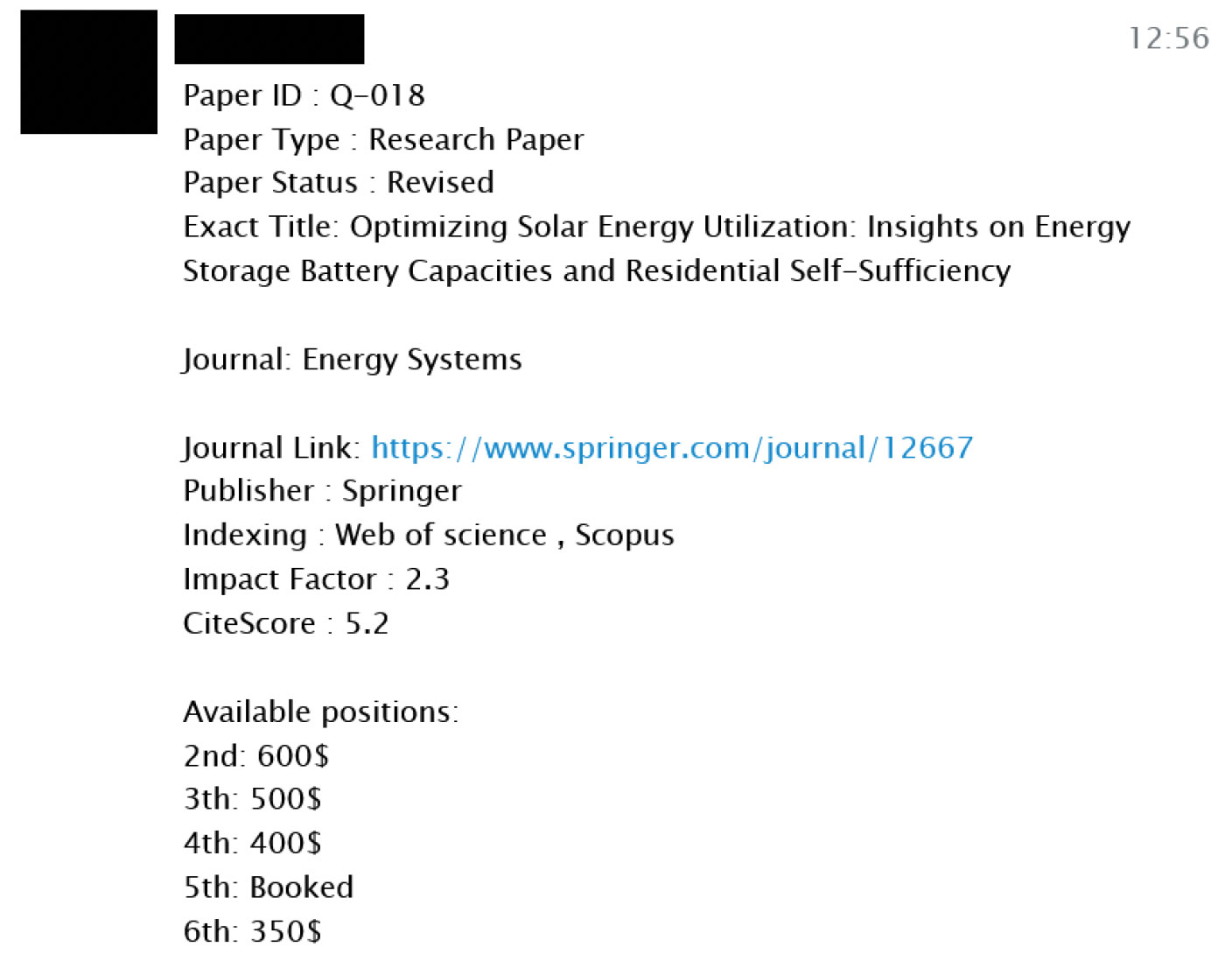
The Iraq-based paper mill posted an advertisement in March 2024 targeting the Springer Nature journal Energy Systems with a paper titled “Optimizing Solar Energy Utilization: Insights on Energy Storage Battery Capacities and Residential Self-Sufficiency.” The authorship slots were advertised for $350 to $600. According to the advertisement, the paper had already passed the revision stage.
Energy Systems published a paper with that exact title in September 2024. The first author, Qusay Hassan, has a string of retractions related to late-stage authorship changes, and in those retractions, was unable to verify the contribution of the added authors. Last year, we also reported that he had received several awards from Iraq’s ministry of higher education and scientific research, despite his retraction record. He has not responded to requests for comment.
Tim Kersjes, head of research integrity at Springer Nature, said in an emailed statement they will investigate the cases flagged in the new dataset. He noted some advertised submissions are intercepted before publication, and ads don’t reliably indicate where a paper will be published. “Paper mill activity is adaptive and deliberately opaque, which means no single signal can or should be relied upon in isolation,” he said. Individuals they find to be involved face being added to internal watchlists that limit their ability to publish and can block them from roles in peer review and editorial boards, Kersjes said.
Richardson estimates that among the more than 5,500 unique products listed for sale, a simple search would turn up a significant number of published matches. “If you spent time actually trawling through the dataset, you would find quite a few,” he said. But paper mills can often change article titles and journal targets, he said, complicating efforts to detect the final product from the advertisement alone.
Matching ads to published papers can be based on a “preponderance of evidence,” Perron said. The sequence of events, matching titles and sometimes matching abstracts can all indicate a link between the ad and the publication, but still stop short of 100% certainty, said Perron, who was not involved in the new analysis.
The dataset covers seven paper mills and doesn’t include ones based in Iran or China, which are “huge players in the paper mill game,” Richardson said. The dataset also doesn’t capture whether purchases were completed and the papers ultimately published. “It’s far from comprehensive,” he said.
Perron sees the dataset as a snapshot of a business model that’s changing because of AI. “What we’re looking at is a historical view of where the paper mills have evolved,” he said, adding that the mills are probably outsourcing production to AI, but still handling the administrative route to publication.
Rather than undertaking a comprehensive analysis in this preprint, Richardson wants BuyTheBy to be the starting point for journals, publishers and other authorities to take action. “We compiled this dataset so that other people can use it,” he said, “and we hope that other people take on that analysis in whichever way that they feel fit.”
Perron thinks the dataset is useful for identifying possible fraud and making corrections, but won’t be enough to take on the industry that is rapidly evolving with AI-generated text. “The technology has advanced so fast and so quickly and has gotten so good,” he said, “that the [publishers] are struggling to figure out: how do you manage it?”
Like Retraction Watch? You can make a tax-deductible contribution to support our work, follow us on X or Bluesky, like us on Facebook, follow us on LinkedIn, add us to your RSS reader, or subscribe to our daily digest. If you find a retraction that’s not in our database, you can let us know here. For comments or feedback, email us at [email protected].