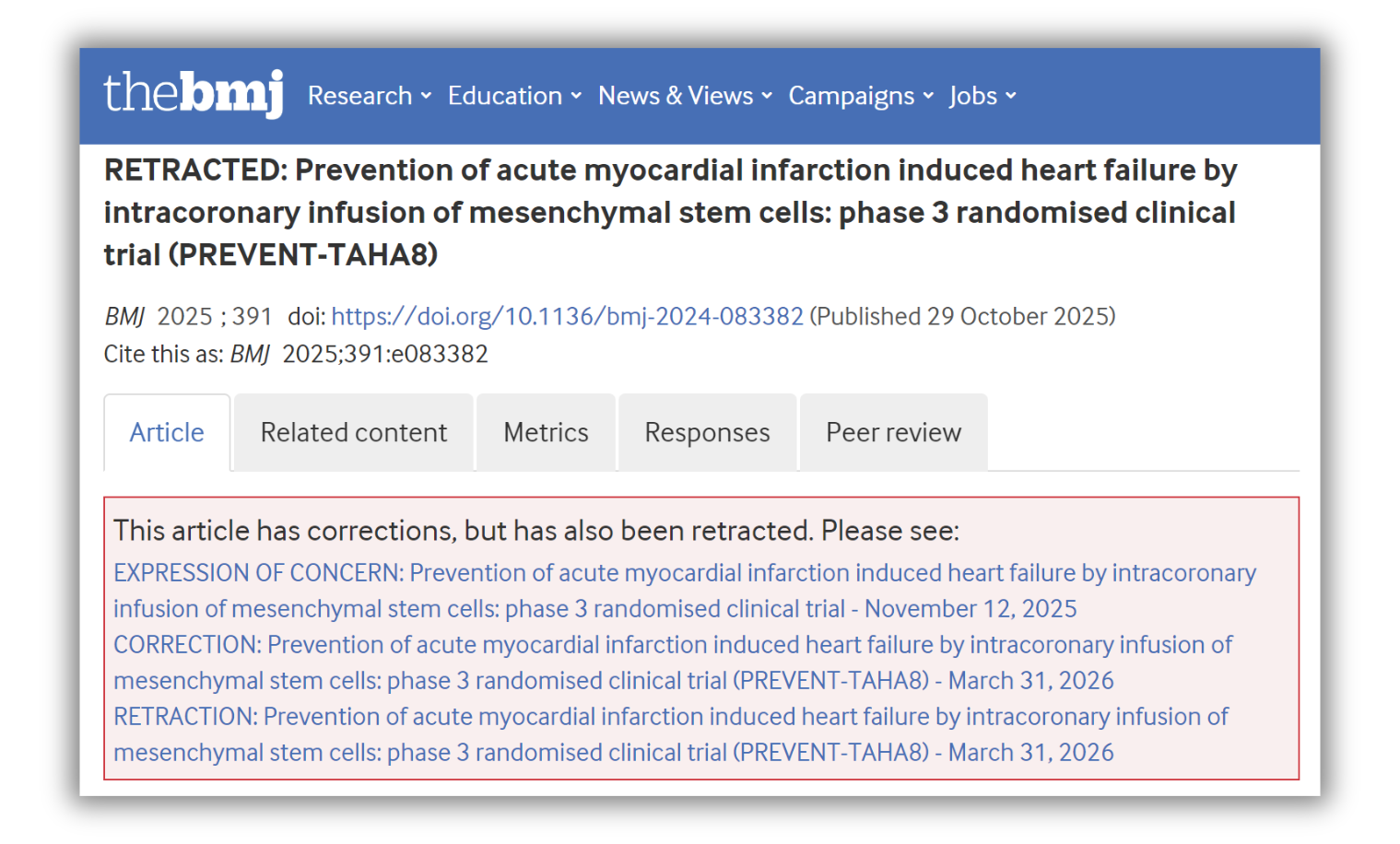
The BMJ has retracted a paper on stem cell therapy for heart failure after sleuths flagged the work for “serious” inconsistencies in data.
Published in October, the paper reported the results of a phase III clinical trial of more than 400 patients in Shiraz, Iran, looking at whether stem cell therapy lowers the risk of heart failure after a heart attack. The journal announced the results in a press release, and news of the findings appeared in several outlets. New Scientist called the study the “strongest evidence yet that stem cells can help the heart repair itself.”
A week after the study was published, sleuths took to PubPeer to point out inconsistencies between the data reported in the article and the dataset uploaded with it. The concerns included a “curious repeating pattern” of records in the dataset and a high number of integers for the height and weight of patients.
According to the retraction notice, published today, the journal reviewed the issues raised and found “apparent recruitment outside of the inclusion criteria, including those over 65 years old; discrepancy in the number of participants enrolled; and data irregularities, such as unusual patterns in the data.”
Dorothy Bishop, who was the first to flag issues with the study on PubPeer, told Retraction Watch there was “ample evidence that the data were not trustworthy 5 months ago, and it is concerning that The BMJ did not retract the article more swiftly, given the implications for patient safety.”
The authors claimed the data issues were “unintentional and arose from integration of hospital level datasets,” according to the retraction notice, and supplied a revised dataset.
“Readers were able to identify some of the data concerns connected to the paper because they were made publicly available in an open access repository in line with The BMJ’s data-sharing policy. However, the data were not reviewed by the journal before publication,” the notice continues. “The journal is currently trialling how it might better manage review of data before publication.”
In November, Bishop told us some of the data issues could have been flagged during peer review, but the sequence of events outlined in the reports suggests the authors didn’t share the dataset until after the manuscript had already been reviewed.
In a correction published today alongside the retraction, Anthony Mathur and Sheik Dowlut were removed as authors on the paper. According to the notice, the two cardiologists at Queen Mary University of London provided “feedback on the manuscript before its submission.”
Both asked corresponding author Armin Attar, a professor at Shiraz University of Medical Sciences, to be removed from the manuscript prior to publication, the notice reads, but neither responded to subsequent emails sent by the journal during the article submission process. The authors asked the journal to be removed from the paper after it was published.
Authorship concerns, along with the data issues flagged on PubPeer, resulted in The BMJ issuing an expression of concern on the paper on Nov. 12.
Sleuths on PubPeer pointed out potential conflicts of interest for Mathur: He is a director of the Heart Cells Company, which supports the charity Heart Cells Foundation, for which Mathur is a trustee. The foundation funds a unit — led by Mathur — that administers stem cell therapies to cardiac patients. When we reached out to Mathur for our earlier article, he referred us to Attar “for more specific detail on the clinical study.”
Mathur’s university page still lists the now-retracted paper.
Attar did not respond to our requests for comment for this article or our previous ones. Mathur and Dowlut did not immediately respond to our emails regarding their involvement on the paper.
The retraction notice also flagged “inconsistent information about the timing of recruitment and the registration of the study.” The protocol the authors submitted to The BMJ indicated the trial was registered before patient enrollment. But a previous publication of the protocol, as well as the original date recorded in clinicaltrials.gov, indicated the trial was registered after recruitment began. The date was later amended “in a way which suggested that the study had been registered prospectively.”
“The BMJ does not publish retrospectively registered trials,” the notice continues.
Because the trial took place in Iran, The BMJ said in the retraction notice they had asked the Iran Food and Drug Administration to assess concerns about the paper, but stopped receiving responses from the organization in December.
“It is disappointing that The BMJ seemed more interested in seeking an external opinion rather than relying on their own independent experts, thereby delaying retraction and putting patient safety at risk,” Bishop said of the journal’s decision to refer the concerns to the Iran FDA prior to retraction.
“The journal will continue to correspond with the Iranian regulator to ask them to investigate the trial when they are able to do so,” the notice says.
Retractions in The BMJ are rare. The journal issued its first retraction in 1989 and has retracted a total of 14 articles, according to the Retraction Watch Database. This retraction marks the second in four months for the journal; the last was in December, for a paper reporting the results of another cardiac clinical trial that had “severe” discrepancies in randomization.
Like Retraction Watch? You can make a tax-deductible contribution to support our work, follow us on X or Bluesky, like us on Facebook, follow us on LinkedIn, add us to your RSS reader, or subscribe to our daily digest. If you find a retraction that’s not in our database, you can let us know here. For comments or feedback, email us at [email protected].